As the need for faster and more adaptable digital assets continues to grow, the AI 3D model generator has become an increasingly important tool for designers, developers, and creative teams. Tripo Studio, created by Tripo AI, reflects this shift by providing a unified workspace where ideas, images, and text can be transformed into practical 3D models.
Rather than framing AI as a replacement for human creativity, Tripo is designed to remove repetitive technical steps, allowing creators to focus more on form, structure, and visual refinement.
From Early Experiments to Production-Ready Workflows

The development of AI-driven 3D tools has followed a clear trajectory. Early solutions often delivered visually interesting results, but the models themselves were difficult to edit, animate, or integrate into real projects due to inconsistent topology and limited control.
Tripo Studio takes a more production-oriented approach. It assumes that AI-generated assets should work within existing pipelines rather than exist as isolated outputs. Generation is treated as the starting point, not the final step.
Users are encouraged to continue shaping their models after generation—adjusting geometry, refining surfaces, and optimizing structure. This mindset is particularly valuable for professionals who need assets suitable for animation, real-time engines, or interactive environments.
Seen this way, Tripo functions not only as a 3D AI generator, but as a connective layer between automation and established 3D creation practices.
Core Features of Tripo Studio
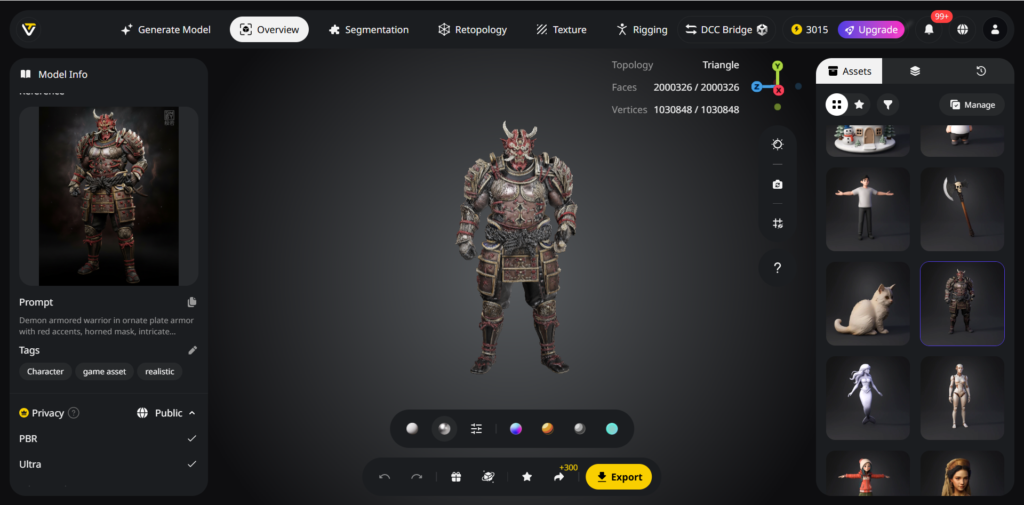
Image to 3D Model
Tripo enables users to build 3D assets from reference images, supporting workflows commonly described as 2D Image to 3D model conversion. Once an image is uploaded, creators can further guide the output using text instructions and built-in editing tools, fine-tuning proportions and structural details.
To achieve better results, Tripo recommends avoiding images with cluttered backgrounds, overly flat visuals, or incomplete subjects. Clear lighting, strong silhouettes, and well-defined shapes help the system interpret depth and volume more effectively.
The Image to 3D Model approach ensures that image-based generation remains flexible, serving as a foundation rather than a locked result.
Text to 3D Model
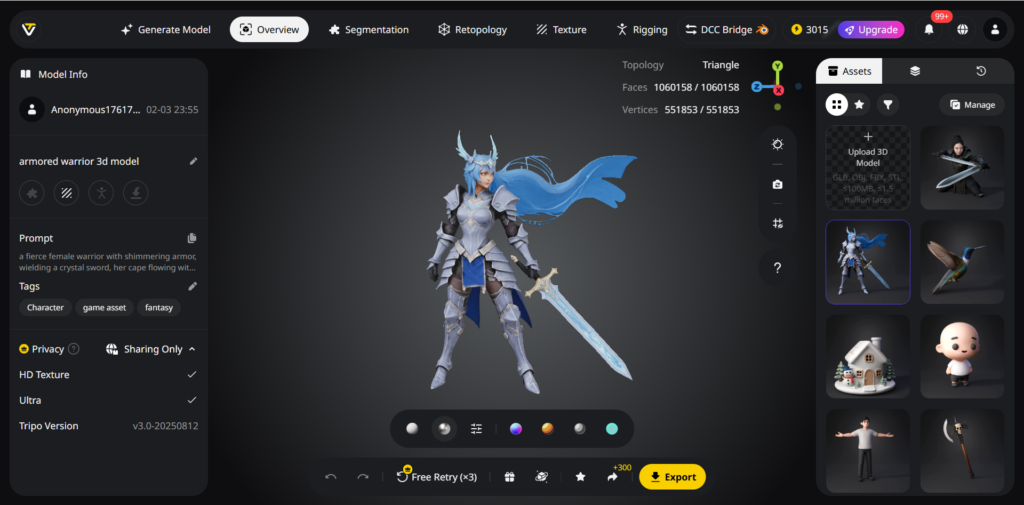
With Text to 3D Model, users describe the object they want to create using natural language. Tripo translates these descriptions into three-dimensional forms, making the feature especially useful during early concept stages when no visual references are available.
By iterating on prompts or generating variations, creators can quickly explore different forms and directions. Within the broader AI 3D model generator ecosystem, this capability helps shorten the distance between abstract ideas and editable 3D drafts.
Intelligent Segmentation
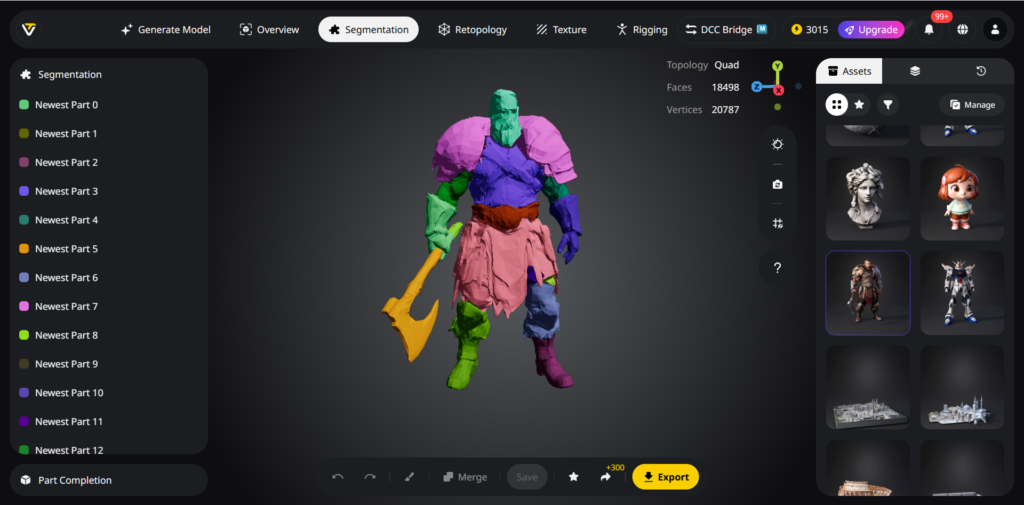
Tripo’s intelligent segmentation allows models to be automatically divided into editable components. Each segment can be modified independently, making it easier to refine specific parts, adjust proportions, or replace elements without affecting the entire model.
Segmentation also supports partial regeneration, enabling users to improve selected sections instead of restarting from scratch. This modular workflow fits naturally into professional editing processes and helps reduce unnecessary revisions.
Smart Retopology
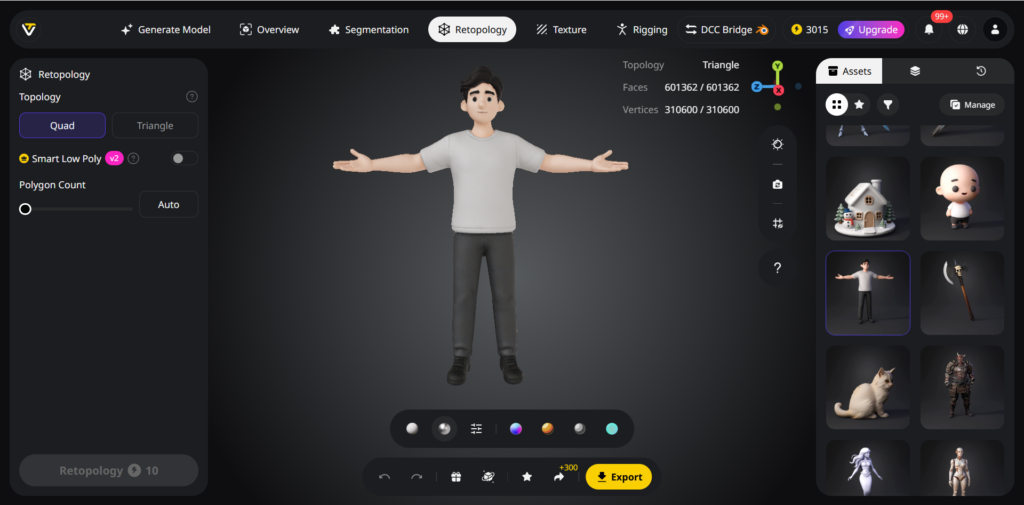
Topology quality plays a critical role in animation, deformation, and rendering performance. Tripo offers smart retopology tools that allow models to be remeshed using quad-based or triangle-based geometry.
Quad meshes are generally preferred for animation and detailed edits, while triangle meshes help preserve surface detail and are often used for static or high-detail assets. Tripo also includes a Smart Low Poly option, producing simplified meshes that are easier to edit and optimize.
These settings can be defined during generation or adjusted afterward, giving users flexibility as project needs evolve.
AI Texturing
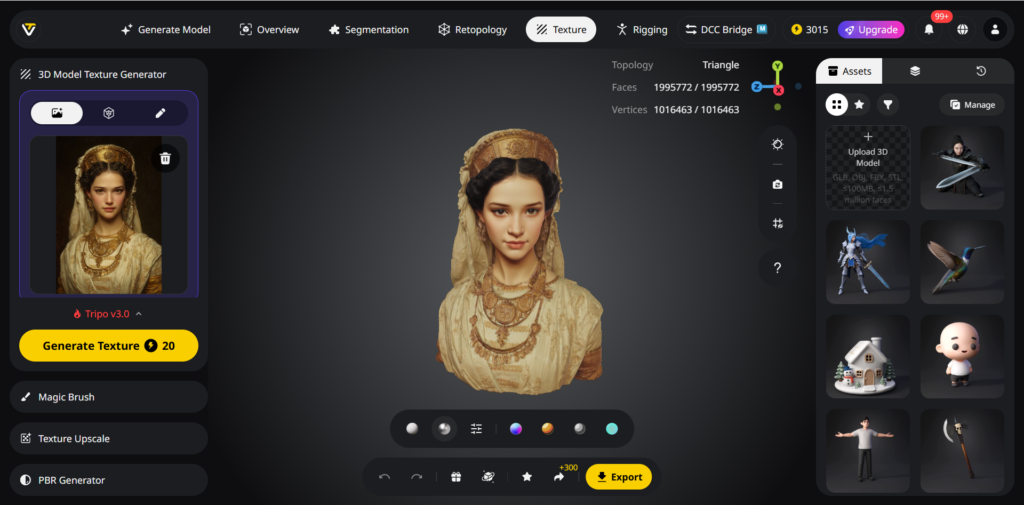
The AI texturing module brings texture generation, editing, upscaling, and PBR workflows into a single environment. Users can guide material creation by uploading reference images or describing surface characteristics in text.
Localized adjustments can be made using tools like Magic Brush, while the PBR generator produces materials with physically accurate reflectance for realistic rendering. This integrated setup reduces the need to switch between multiple applications during surface refinement.
AI Auto Rigging
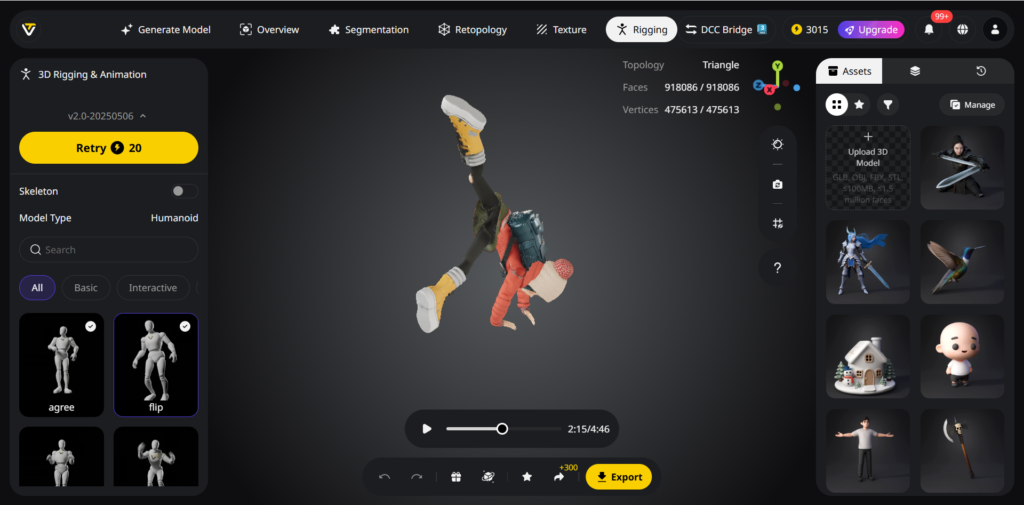
Rigging is traditionally one of the most time-intensive stages of character creation. Tripo’s AI auto-rigging feature automatically adds skeletal structures and generates animation-ready models.
This allows creators to test motion, proportions, and deformation early in the workflow. For teams working under tight schedules, auto rigging can significantly reduce the time required to move from a static model to an animated asset.
Model Stylization
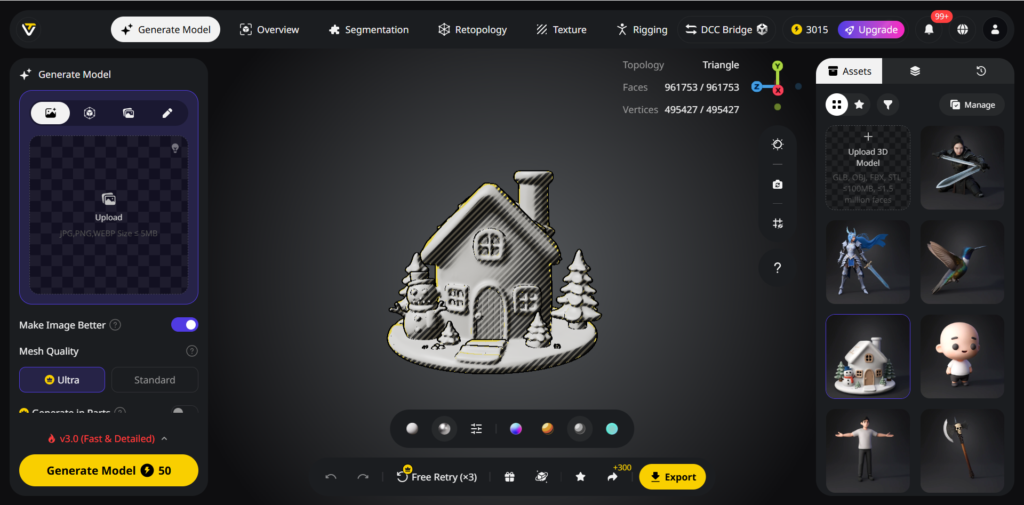
In addition to realistic outputs, Tripo supports multiple stylization modes, including cartoon, sketch, and hologram styles. These options make it easier to experiment with visual direction without rebuilding geometry or textures from scratch.
Stylization is particularly useful for concept art, promotional visuals, and projects where artistic style takes priority over physical realism.
Tripo 3.0: Refining the Core Algorithm
Tripo Studio is powered by the Tripo 3.0 algorithm, which emphasizes improved geometry quality, structural consistency, and stable generation results. Compared to earlier versions, it delivers cleaner topology and closer alignment between prompts, reference images, and final outputs.
Rather than focusing solely on speed, the algorithm balances efficiency with usability, ensuring models remain suitable for further editing. This reflects a broader trend in the AI 3D model generator space, where production readiness matters more than experimental novelty.
Image Generation Options for Stronger References
Tripo Studio includes multiple AI-based image generation options designed to help creators produce better reference visuals before moving into 3D creation. Each option addresses different creative needs, making the 2D to 3D transition more reliable.
Nano Banana focuses on refining image inputs by cleaning edges, improving structure, and enhancing clarity. This is especially helpful when starting from rough sketches, low-resolution images, or visuals with distracting backgrounds.
GPT-4o brings multimodal understanding to image generation, allowing text and image prompts to be interpreted together. This helps generate visuals that more accurately reflect creative intent, particularly for complex concepts.
Flux Kontext is designed for consistency across asset sets. It helps maintain unified style, proportions, and detail levels when creating multiple related images, resulting in more cohesive 3D outputs.
Together, these options give creators greater control over reference quality, improving results when those visuals are fed into the AI 3D model generator workflow.
Bridging AI Creation with Your Professional Pipeline
Beyond its core generation capabilities, Tripo Studio is built as an open platform designed to integrate seamlessly into existing professional workflows. It functions as a powerful DCC (Digital Content Creation) bridge, connecting AI-powered generation with industry-standard tools artists and developers already use.
Tripo provides native plugins for major software like Blender, Maya, Unity, and Unreal Engine, allowing you to generate and import assets directly into your scene without leaving your familiar environment. For broader compatibility, models can be exported in universal formats such as GLB, FBX, OBJ, and STL, ready for animation, rendering, game development, or 3D printing.
AI, Accessibility, and the Future of 3D Creation
The future of 3D creation is unlikely to be fully automated or entirely manual. Instead, it will rely on tools that combine algorithmic assistance with human decision-making. Platforms like Tripo Studio demonstrate how this balance can be achieved in practice.
By emphasizing editability, pipeline compatibility, and realistic production needs, Tripo shows how an AI 3D model generator can act as a creative collaborator rather than a closed system. For individuals exploring a free AI 3D model generator or teams seeking scalable workflows, solutions built around flexibility and transparency are likely to shape the next generation of 3D content creation.