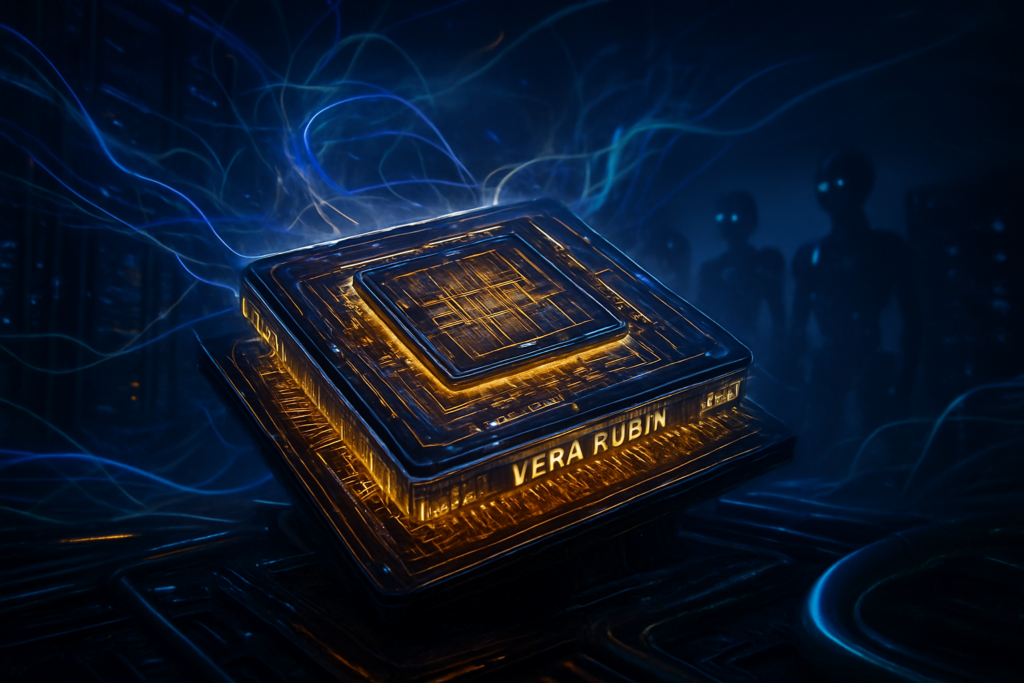
As the artificial intelligence landscape shifts from simple chatbots to complex agentic reasoning and physical robotics, Nvidia (NASDAQ: NVDA) has officially moved into full production of its next-generation "Vera Rubin" platform. Named after the pioneering astronomer who provided the first evidence of dark matter, the Rubin architecture is more than just a faster chip; it represents a fundamental pivot in the company’s roadmap. By shifting to a relentless one-year product cycle, Nvidia is attempting to outpace a phenomenon CEO Jensen Huang calls "computation inflation," where the exponential growth of AI model complexity threatens to outstrip the physical and economic limits of current hardware.
The arrival of the Vera Rubin platform in early 2026 marks the end of the two-year "Moore’s Law" cadence that defined the semiconductor industry for decades. With the R100 GPU and the custom "Vera" CPU at its core, Nvidia is positioning itself not just as a chipmaker, but as the architect of the "AI Factory." This transition is underpinned by a strategic technical shift toward High-Bandwidth Memory (HBM4) integration, involving a high-stakes partnership with Samsung Electronics (KRX: 005930) to secure the massive volumes of silicon required to power the next trillion-parameter frontier.
The Silicon of 2026: R100, Vera CPUs, and the HBM4 Breakthrough
At the heart of the Vera Rubin platform is the R100 GPU, a marvel of engineering fabricated on Taiwan Semiconductor Manufacturing Company's (NYSE: TSM) enhanced 3nm (N3P) process. Moving away from the monolithic designs of the past, the R100 utilizes a modular chiplet architecture on a massive 100x100mm substrate. This design allows for approximately 336 billion transistors—a 1.6x increase over the previous Blackwell generation—delivering a staggering 50 PFLOPS of FP4 inference performance per GPU. To put this in perspective, a single rack of Rubin-powered servers (the NVL144) can now reach 3.6 ExaFLOPS of compute, effectively turning a single data center row into a supercomputer that would have been unimaginable just three years ago.
The most critical technical leap, however, is the integration of HBM4 memory. As AI models grow, they hit a "memory wall" where the speed of data transfer between the processor and memory becomes the primary bottleneck. Rubin addresses this by featuring 288GB of HBM4 memory per GPU, providing a bandwidth of up to 22 TB/s. This is achieved through an eighth-stack configuration and a widened 2,048-bit memory interface, nearly doubling the throughput of the Blackwell Ultra refresh. To ensure a steady supply of these advanced modules, Nvidia has deepened its collaboration with Samsung, which is utilizing its 6th-generation 10nm-class (1c) DRAM process to produce HBM4 chips that are 40% more energy-efficient than their predecessors.
Beyond the GPU, Nvidia is introducing the Vera CPU, the successor to the Grace processor. Unlike Grace, which relied on standard Arm Neoverse cores, Vera features 88 custom "Olympus" Arm cores designed specifically for agentic AI workflows. These cores are optimized for the complex "thinking" chains required by autonomous agents that must plan and reason before acting. Coupled with the new BlueField-4 DPU for high-speed networking and the sixth-generation NVLink 6 interconnect—which offers 3.6 TB/s of bidirectional bandwidth—the Rubin platform functions as a unified, vertically integrated system rather than a collection of disparate parts.
Reshaping the Competitive Landscape: The AI Factory Arms Race
The shift to an annual update cycle is a strategic masterstroke designed to keep competitors like Advanced Micro Devices (NASDAQ: AMD) and Intel (NASDAQ: INTC) in a perpetual state of catch-up. While AMD’s Instinct MI400 series, expected later in 2026, boasts higher raw memory capacity (up to 432GB), Nvidia’s Rubin counters with superior compute density and a more mature software ecosystem. The "CUDA moat" remains Nvidia’s strongest defense, as the Rubin platform is designed to be a "turnkey" solution for hyperscalers like Microsoft (NASDAQ: MSFT), Meta (NASDAQ: META), and Alphabet (NASDAQ: GOOGL). These tech giants are no longer just buying chips; they are deploying entire "AI Factories" that can reduce the cost of inference tokens by 10x compared to previous years.
For these hyperscalers, the Rubin platform represents a path to sustainable scaling. By reducing the number of GPUs required to train Mixture-of-Experts (MoE) models by a factor of four, Nvidia allows these companies to scale their models to 100 trillion parameters without a linear increase in their physical data center footprint. This is particularly vital for Meta and Google, which are racing to integrate "Agentic AI" into every consumer product. The specialized Rubin CPX variant, which uses more affordable GDDR7 memory for the "context phase" of inference, further allows these companies to process millions of tokens of context more economically, making "long-context" AI a standard feature rather than a luxury.
However, the aggressive one-year rhythm also places immense pressure on the global supply chain. By qualifying Samsung as a primary HBM4 supplier alongside SK Hynix (KRX: 000660) and Micron Technology (NASDAQ: MU), Nvidia is attempting to avoid the shortages that plagued the H100 and Blackwell launches. This diversification is a clear signal that Nvidia views memory availability—not just compute power—as the defining constraint of the 2026 AI economy. Samsung’s ability to hit its target of 250,000 wafers per month will be the linchpin of the Rubin rollout.
Deflating ‘Computation Inflation’ and the Rise of Physical AI
Jensen Huang’s concept of "computation inflation" addresses a looming crisis: the volume of data and the complexity of AI models are growing at roughly 10x per year, while traditional CPU performance has plateaued. Without the massive architectural leaps provided by Rubin, the energy and financial costs of AI would become unsustainable. Nvidia’s strategy is to "deflate" the cost of intelligence by delivering 1000x more compute every few years through a combination of GPU/CPU co-design and new data types like NVFP4. This focus on efficiency is evident in the Rubin NVL72 rack, which is designed to be 100% liquid-cooled, eliminating the need for energy-intensive water chillers and saving up to 6% in total data center power consumption.
The Rubin platform also serves as the hardware foundation for "Physical AI"—AI that interacts with the physical world. Through its Cosmos foundation models, Nvidia is using Rubin-powered clusters to generate synthetic 3D data grounded in physics, which is then used to train humanoid robots and autonomous vehicles. This marks a transition from AI that merely predicts the next word to AI that understands the laws of physics. For companies like Tesla (NASDAQ: TSLA) or the robotics startups of 2026, the R100’s ability to handle "test-time scaling"—where the model spends more compute cycles "thinking" before executing a physical movement—is a prerequisite for safe and reliable automation.
This wider significance cannot be overstated. By providing the compute necessary for models to "reason" in real-time, Nvidia is moving the industry toward the era of autonomous agents. This mirrors previous milestones like the introduction of the Transformer model in 2017 or the launch of ChatGPT in 2022, but with a focus on agency and physical interaction. The concern, however, remains the centralization of this power. As Nvidia becomes the "operating system" for AI infrastructure, the industry’s dependence on a single vendor’s roadmap has never been higher.
The Road Ahead: From Rubin Ultra to Feynman
Looking toward the near-term future, Nvidia has already teased the "Rubin Ultra" for 2027, which will feature 16-high HBM4 stacks and even greater memory capacity. Beyond that lies the "Feynman" architecture, scheduled for 2028, which is rumored to explore even more exotic packaging technologies and perhaps the first steps toward optical interconnects at the chip level. The immediate challenge for 2026, however, will be the massive transition to liquid cooling. Most existing data centers were designed for air cooling, and the shift to the fully liquid-cooled Rubin racks will require a multi-billion dollar overhaul of global infrastructure.
Experts predict that the next two years will see a "disaggregation" of AI workloads. We will likely see specialized clusters where Rubin R100s handle the heavy lifting of training and complex reasoning, while Rubin CPX units handle massive context processing, and smaller edge-AI chips manage simple tasks. The challenge for Nvidia will be maintaining this frantic annual pace without sacrificing reliability or software stability. If they succeed, the "cost per token" could drop so low that sophisticated AI agents become as ubiquitous and inexpensive as a Google search.
A New Era of Accelerated Computing
The launch of the Vera Rubin platform is a watershed moment in the history of computing. It represents the successful execution of a strategy to compress decades of technological progress into a single-year cycle. By integrating custom CPUs, advanced HBM4 memory from Samsung, and next-generation interconnects, Nvidia has built a fortress that will be difficult for any competitor to storm in the near future. The key takeaway is that the "AI chip" is dead; we are now in the era of the "AI System," where the rack is the unit of compute.
As we move through 2026, the industry will be watching two things: the speed of liquid-cooling adoption in enterprise data centers and the real-world performance of Agentic AI powered by the Vera CPU. If Rubin delivers on its promise of a 10x reduction in token costs, it will not just deflate "computation inflation"—it will ignite a new wave of economic productivity driven by autonomous, reasoning machines. For now, Nvidia remains the undisputed architect of this new world, with the Vera Rubin platform serving as its most ambitious blueprint yet.
This content is intended for informational purposes only and represents analysis of current AI developments.
TokenRing AI delivers enterprise-grade solutions for multi-agent AI workflow orchestration, AI-powered development tools, and seamless remote collaboration platforms.
For more information, visit https://www.tokenring.ai/.