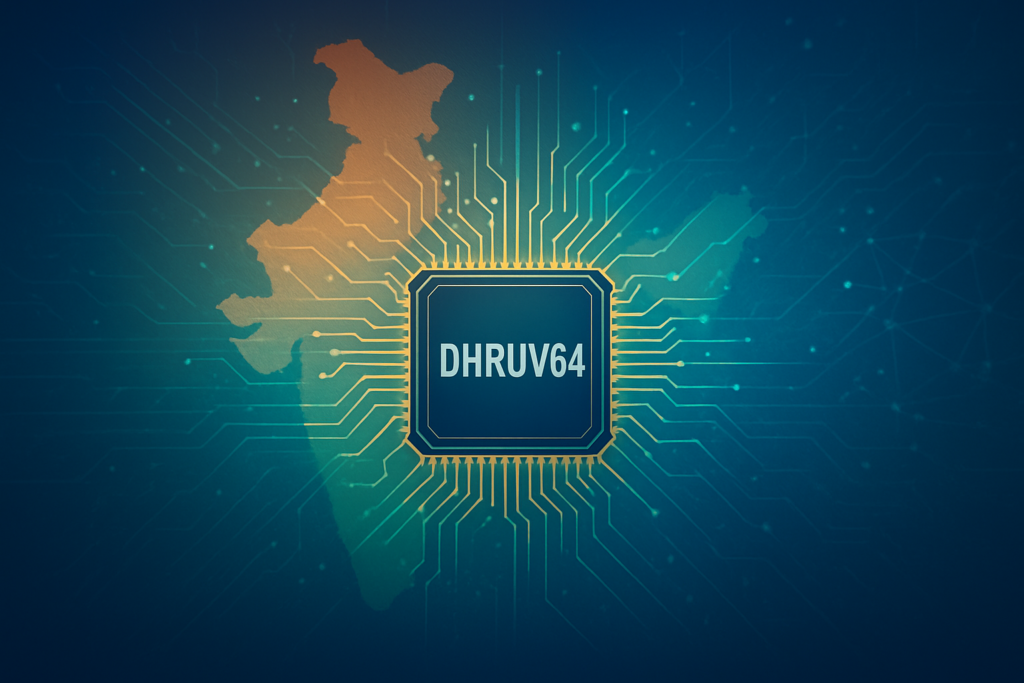
India has achieved a significant leap in its pursuit of technological self-reliance with the launch of DHRUV64, the nation's first homegrown 1.0 GHz, 64-bit dual-core microprocessor. Developed by the Centre for Development of Advanced Computing (C-DAC) under the Microprocessor Development Programme (MDP) and supported by initiatives like Digital India RISC-V (DIR-V), DHRUV64 marks a pivotal moment in India's journey towards indigenous chip design and manufacturing. This advanced processor, built with modern architectural features, offers enhanced efficiency, improved multitasking capabilities, and increased reliability, making it suitable for a diverse range of strategic and commercial applications, including 5G infrastructure, automotive systems, consumer electronics, industrial automation, and the Internet of Things (IoT).
The immediate significance of DHRUV64 for India's semiconductor ecosystem and technological sovereignty is profound. By strengthening a secure and indigenous semiconductor ecosystem, DHRUV64 directly addresses India's long-term dependence on imported microprocessors, especially crucial given that India consumes approximately 20% of the global microprocessor output. This indigenous processor provides a modern platform for domestic innovation, empowering Indian startups, academia, and industry to design, test, and prototype indigenous computing products without relying on foreign components, thereby reducing licensing costs and fostering local talent. Moreover, technological sovereignty, defined as a nation's ability to develop, control, and govern critical technologies essential for its security, economy, and strategic autonomy, is a national imperative for India, particularly in an era where digital infrastructure is paramount for national security and economic resilience. The launch of DHRUV64 is a testament to India's commitment to "Aatmanirbhar Bharat" (self-reliant India) in the semiconductor sector, laying a crucial foundation for building a robust talent pool and infrastructure necessary for long-term leadership in advanced technologies.
DHRUV64: A Deep Dive into India's Indigenous Silicon
The DHRUV64 is a 64-bit dual-core microprocessor operating at a clock speed of 1.0 GHz. It is built upon modern architectural features, emphasizing higher efficiency, enhanced multitasking capabilities, and improved reliability. As part of C-DAC's VEGA series of processors, DHRUV64 (specifically the VEGA AS2161) is a 64-bit dual-core, 16-stage pipelined, out-of-order processor based on the open-source RISC-V Instruction Set Architecture (ISA). Key architectural components include multilevel caches, a Memory Management Unit (MMU), and a Coherent Interconnect, designed to facilitate seamless integration with external hardware systems. While the exact fabrication process node for DHRUV64 is not explicitly stated, it is mentioned that its "modern fabrication leverages technologies used for high-performance chips." This builds upon prior indigenous efforts, such as the THEJAS64, another 64-bit single-core VEGA processor, which was fabricated at India's Semi-Conductor Laboratory (SCL) in Chandigarh using a 180nm process. DHRUV64 is the third chip fabricated under the Digital India RISC-V (DIR-V) Programme, following THEJAS32 (fabricated in Silterra, Malaysia) and THEJAS64 (manufactured domestically at SCL Mohali).
Specific performance benchmark numbers (such as CoreMark or SPECint scores) for DHRUV64 itself have not been publicly detailed. However, the broader VEGA series, to which DHRUV64 belongs, is characterized as "high performance." According to V. Kamakoti, Director of IIT Madras, India's Shakti and VEGA microprocessors are performing at what can be described as "generation minus one" compared to the latest contemporary global microprocessors. This suggests they achieve performance levels comparable to global counterparts from two to three years prior. Kamakoti also expressed confidence in their competitiveness against contemporary microprocessors in benchmarks like CoreMark, particularly for embedded systems.
DHRUV64 represents a significant evolution compared to earlier indigenous Indian microprocessors like SHAKTI (IIT Madras) and AJIT (IIT Bombay). Both DHRUV64 and SHAKTI are based on the open-source RISC-V ISA, providing a royalty-free and customizable platform, unlike AJIT which uses the proprietary SPARC-V8 ISA. DHRUV64 is a 64-bit dual-core processor, offering more power than the single-core 32-bit AJIT, and aligning with the 64-bit capabilities of some SHAKTI variants. Operating at 1.0 GHz, DHRUV64's clock speed is in the mid-to-high range for indigenous designs, surpassing AJIT's 70-120 MHz and comparable to some SHAKTI C-class processors. Its 16-stage out-of-order pipeline is a more advanced microarchitecture than SHAKTI's 6-stage in-order design or AJIT's single-issue in-order execution, enabling higher instruction-level parallelism. While SHAKTI and AJIT target strategic, space, and embedded applications, DHRUV64 aims for a broader range including 5G, automotive, and industrial automation.
The launch of DHRUV64 has been met with positive reactions, viewed as a "major milestone" in India's quest for self-reliance in advanced chip design. Industry experts and the government highlight its strategic significance in establishing a secure and indigenous semiconductor ecosystem, thereby reducing reliance on imported microprocessors. The open-source RISC-V architecture is particularly welcomed for eliminating licensing costs and fostering an open ecosystem. C-DAC has ambitious goals, aiming to capture at least 10% of the Indian microprocessor market, especially in strategic sectors. While specific detailed reactions from the AI research community about DHRUV64 are not yet widely available, its suitability for "edge analytics" and "data analytics" indicates its relevance to AI/ML workloads.
Reshaping the Landscape: Impact on AI Companies and Tech Giants
The DHRUV64 microprocessor is poised to significantly reshape the technology landscape for AI companies, tech giants, and startups, both domestically and internationally. For the burgeoning Indian AI sector and startups, DHRUV64 offers substantial advantages. It provides a native platform for Indian startups, academia, and industries to design, test, and scale computing products without dependence on foreign processors, fostering an environment for developing bespoke AI solutions tailored to India's unique needs. The open-source RISC-V architecture significantly reduces licensing costs, making prototype development and product scaling more affordable. With India already contributing 20% of the world's chip design engineers, DHRUV64 further strengthens the pipeline of skilled semiconductor professionals, aligning with the Digital India RISC-V (DIR-V) program's goal to establish India as a global hub for Electronics System Design and Manufacturing (ESDM). Indian AI companies like Soket AI, Gnani AI, and Gan AI, developing large language models (LLMs) and voice AI solutions, could leverage DHRUV64 and its successors for edge inference and specialized AI tasks, potentially reducing reliance on costly hosted APIs. Global AI computing companies like Tenstorrent are also actively seeking partnerships with Indian startups, recognizing India's growing capabilities.
DHRUV64's emergence will introduce new dynamics for international tech giants and major AI labs. India consumes approximately 20% of the global microprocessor output, and DHRUV64 aims to reduce this dependence, particularly in strategic sectors. C-DAC's target to capture at least 10% of the Indian microprocessor market could lead to a gradual shift in market share away from dominant international players like (NASDAQ: INTC) Intel, (NASDAQ: AMD) AMD, and (NASDAQ: QCOM) Qualcomm, especially in government procurement and critical infrastructure projects aligned with "Make in India" initiatives. While DHRUV64's initial specifications may not directly compete with high-performance GPUs (like (NASDAQ: NVDA) NVIDIA or Intel Arc) or specialized AI accelerators (like (NASDAQ: GOOGL) Google TPUs or Hailo AI chips) for large-scale AI model training, its focus on power-efficient edge AI, IoT, and embedded systems presents a competitive alternative for specific applications. International companies might explore collaboration opportunities or face increased pressure to localize manufacturing and R&D. Furthermore, DHRUV64's indigenous nature and hardware-level security features could become a significant selling point for Indian enterprises and government bodies concerned about data sovereignty and cyber threats, potentially limiting the adoption of foreign hardware in sensitive applications.
The introduction and broader adoption of DHRUV64 could lead to several disruptions. Companies currently relying on single-source international supply chains for microprocessors may begin to integrate DHRUV64, diversifying their supply chain and mitigating geopolitical risks. The low cost and open-source nature of RISC-V, combined with DHRUV64's specifications, could enable the creation of new, more affordable smart devices, IoT solutions, and specialized edge AI products. In sectors like 5G infrastructure, automotive, and industrial automation, DHRUV64 could accelerate the development of "Indian-first" solutions, potentially leading to indigenous operating systems, firmware, and software stacks optimized for local hardware. India's efforts to develop indigenous servers like Rudra, integrated with C-DAC processors, signal a push towards self-reliance in high-performance computing (HPC) and supercomputing, potentially disrupting the market for imported HPC systems in India over the long term.
DHRUV64 is a cornerstone of India's strategic vision for its domestic tech sector, embodying the "Aatmanirbhar Bharat" initiative and enhancing digital sovereignty. By owning and controlling core microprocessor technology, India gains greater security and control over its digital economy and strategic sectors. The development of DHRUV64 and the broader DIR-V program are expected to foster a vibrant ecosystem for electronics system design and manufacturing, attracting investment, creating jobs, and driving innovation. This strategic autonomy is crucial for critical areas such as defense, space technology, and secure communication systems. By championing RISC-V, India positions itself as a significant contributor to the global open-source hardware movement, potentially influencing future standards and fostering international collaborations based on shared innovation.
Wider Significance: A Strategic Enabler for India's Digital Future
The DHRUV64 microprocessor embodies India's commitment to "Atmanirbhar Bharat" (self-reliant India) in the semiconductor sector. With India consuming approximately 20% of the world's microprocessors, indigenous development significantly reduces reliance on foreign suppliers and strengthens the nation's control over its digital infrastructure. While DHRUV64 is a general-purpose microprocessor and not a specialized AI accelerator, its existence is foundational for India's broader AI ambitions. The development of indigenous processors like DHRUV64 is a crucial step in building a domestic semiconductor ecosystem capable of supporting future AI workloads and achieving "data-driven AI leadership." C-DAC's roadmap includes the convergence of high-performance computing and microprocessor programs to develop India's own supercomputing chips, with ambitions for 48 or 64-core processors in the coming years, which would be essential for advanced AI processing. Its adoption of the open-source RISC-V ISA aligns with a global technology trend towards open standards in hardware design, eliminating proprietary licensing costs and fostering a collaborative innovation environment.
The impacts of DHRUV64 extend across national security, economic development, and international relations. For national security, DHRUV64 directly addresses India's long-term dependence on imported microprocessors for critical digital infrastructure, reducing vulnerability to potential service disruptions or data manipulation in strategic sectors like defense, space, and government systems. It contributes to India's "Digital Swaraj Mission," aiming for sovereign cloud, indigenous operating systems, and homegrown cybersecurity. Economically, DHRUV64 fosters a robust domestic microprocessor ecosystem, promotes skill development and job creation, and encourages innovation by offering a homegrown technology at a lower cost. C-DAC aims to capture at least 10% of the Indian microprocessor market, particularly in strategic applications. In international relations, developing indigenous microprocessors enhances India's strategic autonomy, giving it greater control over its technological destiny and reducing susceptibility to geopolitical pressures. India's growing capabilities could strengthen its position as a competitive player in the global semiconductor ecosystem, influencing technology partnerships and signifying its rise as a capable technology developer.
Despite its significance, potential concerns and challenges exist. While a major achievement, DHRUV64's current specifications (1.0 GHz dual-core) may not directly compete with the highest-end general-purpose processors or specialized AI accelerators offered by global leaders in terms of raw performance. However, C-DAC's roadmap includes developing more powerful processors like Dhanush, Dhanush+, and future octa-core, 48-core, or 64-core designs. Although the design is indigenous, the fabrication of these chips, especially for advanced process nodes, might still rely on international foundries. India is actively investing in its semiconductor manufacturing capabilities (India Semiconductor Mission – ISM), but achieving complete self-sufficiency across all manufacturing stages is a long-term goal. Building a comprehensive hardware and software ecosystem around indigenous processors, including operating systems, development tools, and widespread software compatibility, requires sustained effort and investment. Gaining significant market share beyond strategic applications will also involve competing with entrenched global players.
DHRUV64's significance is distinct from many previous global AI milestones. Global AI milestones, such as the development of neural networks, deep learning, specialized AI accelerators (like Google's TPUs or NVIDIA's GPUs), and achievements like AlphaGo or large language models, primarily represent advancements in the capabilities, algorithms, and performance of AI itself. In contrast, DHRUV64 is a foundational general-purpose microprocessor. Its significance lies not in a direct AI performance breakthrough, but in achieving technological sovereignty and self-reliance in the underlying hardware that can enable future AI development within India. It is a strategic enabler for India to build its own secure and independent digital infrastructure, a prerequisite for developing sovereign AI capabilities and tailoring future chips specifically for India's unique AI requirements.
The Road Ahead: Future Developments and Expert Predictions
India's ambitions in indigenous microprocessor development extend to both near-term enhancements and long-term goals of advanced chip design and manufacturing. Following DHRUV64, C-DAC is actively developing the next-generation Dhanush and Dhanush+ processors. The roadmap includes an ambitious target of developing an octa-core chip within three years and eventually scaling to 48-core or 64-core chips, particularly as high-performance computing (HPC) and microprocessor programs converge. These upcoming processors are expected to further strengthen India's homegrown RISC-V ecosystem. Beyond C-DAC's VEGA series, other significant indigenous processor initiatives include the Shakti processors from IIT Madras, with a roadmap for a 7-nanometer (nm) version by 2028 for strategic, space, and defense applications; AJIT from IIT Bombay for industrial and robotics; and VIKRAM from ISRO–SCL for space applications.
India's indigenous microprocessors are poised to serve a wide array of applications, focusing on both strategic autonomy and commercial viability. DHRUV64 is capable of supporting critical digital infrastructure, reducing long-term dependence on imported microprocessors in areas like defense, space exploration, and government utilities. The processors are suitable for emerging technologies such as 5G infrastructure, automotive systems, consumer electronics, industrial automation, and Internet of Things (IoT) devices. A 32-bit embedded processor from the VEGA series can be used in smart energy meters, multimedia processing, and augmented reality/virtual reality (AR/VR) applications. The long-term vision includes developing advanced multi-core chips that could power future supercomputing systems, contributing to India's self-reliance in HPC.
Despite significant progress, several challenges need to be addressed for widespread adoption and continued advancement. India still heavily relies on microprocessor imports, and a key ambition is to meet at least 10% of the country's microprocessor requirement with indigenous chips. A robust ecosystem is essential, requiring collaboration with industry to integrate indigenous technology into next-generation products, including common tools and standards for developers. While design capabilities are growing, establishing advanced fabrication (fab) facilities within India remains a costly and complex endeavor. To truly elevate India's position, a greater emphasis on innovation and R&D is crucial, moving beyond merely manufacturing. Addressing complex applications like massive machine-type communication (MTC) also requires ensuring data privacy, managing latency constraints, and handling communication overhead.
Experts are optimistic about India's semiconductor future, predicting a transformative period. India is projected to become a global hub for semiconductor manufacturing and AI leadership by 2035, leveraging its vast human resources, data, and scientific talent. India's semiconductor market is expected to more than double from approximately $52 billion in 2025 to $100-$110 billion by 2030, representing about 10% of global consumption. India is transitioning from primarily being a chip consumer to a credible producer, aiming for a dominant role. Flagship programs like the India Semiconductor Mission (ISM) and the Digital India RISC-V (DIR-V) Programme are providing structured support, promoting indigenous chip design, and attracting significant investments. Geopolitical shifts, including supply chain diversification, present a rare opportunity for India to establish itself as a reliable player. Several large-scale semiconductor projects, including fabrication, design, and assembly hubs, are being established across the country by both domestic and international companies, with the industry projected to create 1 million jobs by 2026.
Comprehensive Wrap-up: India's Leap Towards Digital Sovereignty
The DHRUV64 microprocessor stands as a testament to India's growing prowess in advanced chip design and its unwavering commitment to technological self-reliance. This indigenous 64-bit dual-core chip, operating at 1.0 GHz and built on the open-source RISC-V architecture, is more than just a piece of silicon; it's a strategic asset designed to underpin India's digital future across critical sectors from 5G to IoT. Its development by C-DAC, under the aegis of initiatives like DIR-V, signifies a pivotal shift in India's journey towards establishing a secure and independent semiconductor ecosystem. The elimination of licensing costs through RISC-V, coupled with a focus on robust, efficient design, positions DHRUV64 as a versatile solution for a wide array of strategic and commercial applications, fostering indigenous innovation and reducing reliance on foreign imports.
In the broader context of AI history, DHRUV64’s significance lies not in a direct AI performance breakthrough, but as a foundational enabler for India’s sovereign AI capabilities. It democratizes access to advanced computing, supporting the nation's ambitious goal of data-driven AI leadership and nurturing a robust talent pool in semiconductor design. For India's technological journey, DHRUV64 is a major milestone in the "Aatmanirbhar Bharat" vision, empowering local startups and industries to innovate and scale. It complements other successful indigenous processor projects, collectively reinforcing India's design and development capabilities and aiming to capture a significant portion of the domestic microprocessor market.
The long-term impact of DHRUV64 on the global tech landscape is profound. It contributes to diversifying the global semiconductor supply chain, enhancing resilience against disruptions. India's aggressive push in semiconductors, backed by significant investments and international partnerships, is positioning it as a substantial player in a market projected to exceed US$1 trillion by 2030. Furthermore, India's ability to produce chips for sensitive sectors strengthens its technological sovereignty and could inspire other nations to pursue similar strategies, ultimately leading to a more decentralized and secure global tech landscape.
In the coming weeks and months, several key developments will be crucial indicators of India's momentum in the semiconductor space. Watch for continued investment announcements and progress on the ten approved units under the "Semicon India Programme," totaling approximately US$19.3 billion. The operationalization and ramp-up of major manufacturing facilities, such as (NASDAQ: MU) Micron Technology's ATMP plant in Sanand, Gujarat, and (NSE: TATACHEM) Tata Group's TSAT plant in Morigaon, Assam, will be critical. Keep a close eye on the progress of next-generation indigenous processors like Dhanush and Dhanush+, as well as C-DAC's roadmap for octa-core and higher-core-count chips. The outcomes of the Design-Linked Incentive (DLI) scheme, supporting 23 companies in designing 24 chips, and the commercialization efforts through partnerships like the MoU between L&T Semiconductor Technologies (LTSCT) and C-DAC for VEGA processors, will also be vital. The DHRUV64 microprocessor is more than just a chip; it's a statement of India's ambition to become a formidable force in the global semiconductor arena, moving from primarily a consumer to a key contributor in the global chip landscape.
This content is intended for informational purposes only and represents analysis of current AI developments.
TokenRing AI delivers enterprise-grade solutions for multi-agent AI workflow orchestration, AI-powered development tools, and seamless remote collaboration platforms.
For more information, visit https://www.tokenring.ai/.