
What a brutal six months it’s been for Sprout Social. The stock has dropped 40.1% and now trades at $8.02, rattling many shareholders. This might have investors contemplating their next move.
Is there a buying opportunity in Sprout Social, or does it present a risk to your portfolio? Get the full stock story straight from our expert analysts, it’s free.
Why Is Sprout Social Not Exciting?
Despite the more favorable entry price, we don't have much confidence in Sprout Social. Here are three reasons why SPT doesn't excite us and a stock we'd rather own.
1. Weak Billings Point to Soft Demand
Billings is a non-GAAP metric that is often called “cash revenue” because it shows how much money the company has collected from customers in a certain period. This is different from revenue, which must be recognized in pieces over the length of a contract.
Sprout Social’s billings came in at $116.9 million in Q3, and over the last four quarters, its year-on-year growth averaged 11.1%. This performance was underwhelming and suggests that increasing competition is causing challenges in acquiring/retaining customers. 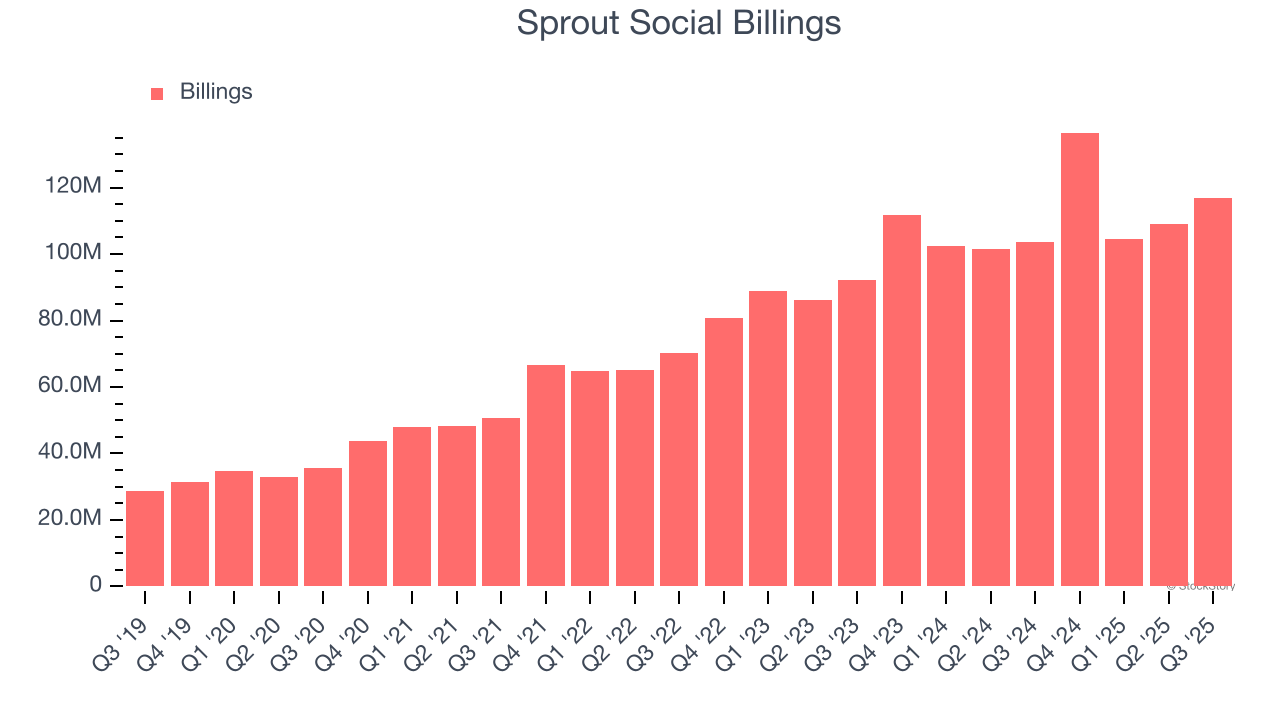
2. Projected Revenue Growth Is Slim
Forecasted revenues by Wall Street analysts signal a company’s potential. Predictions may not always be accurate, but accelerating growth typically boosts valuation multiples and stock prices while slowing growth does the opposite.
Over the next 12 months, sell-side analysts expect Sprout Social’s revenue to rise by 10.8%, a deceleration versus its 29.1% annualized growth for the past five years. This projection doesn't excite us and indicates its products and services will see some demand headwinds.
3. Operating Losses Sound the Alarms
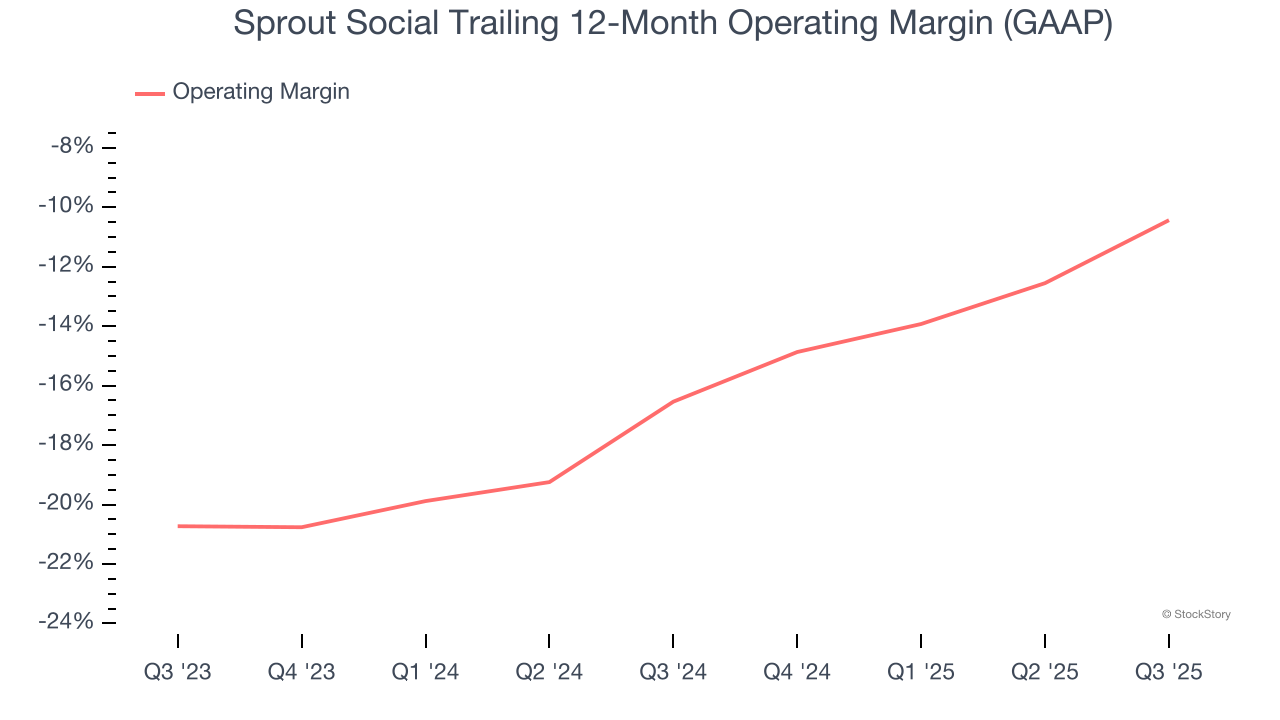
While many software businesses point investors to their adjusted profits, which exclude stock-based compensation (SBC), we prefer GAAP operating margin because SBC is a legitimate expense used to attract and retain talent. This metric shows how much revenue remains after accounting for all core expenses – everything from the cost of goods sold to sales and R&D.
Sprout Social’s expensive cost structure has contributed to an average operating margin of negative 10.4% over the last year. Unprofitable, high-growth software companies require extra attention because they spend heaps of money to capture market share. As seen in its fast historical revenue growth, this strategy seems to have worked so far, but it’s unclear what would happen if Sprout Social reeled back its investments. Wall Street seems to think it will face some obstacles, and we tend to agree.
Final Judgment
Sprout Social isn’t a terrible business, but it doesn’t pass our bar. Following the recent decline, the stock trades at 0.9× forward price-to-sales (or $8.02 per share). While this valuation is optically cheap, the potential downside is big given its shaky fundamentals. We're pretty confident there are superior stocks to buy right now. We’d suggest looking at a fast-growing restaurant franchise with an A+ ranch dressing sauce.
High-Quality Stocks for All Market Conditions
The market’s up big this year - but there’s a catch. Just 4 stocks account for half the S&P 500’s entire gain. That kind of concentration makes investors nervous, and for good reason. While everyone piles into the same crowded names, smart investors are hunting quality where no one’s looking - and paying a fraction of the price. Check out the high-quality names we’ve flagged in our Top 5 Growth Stocks for this month. This is a curated list of our High Quality stocks that have generated a market-beating return of 244% over the last five years (as of June 30, 2025).
Stocks that have made our list include now familiar names such as Nvidia (+1,326% between June 2020 and June 2025) as well as under-the-radar businesses like the once-micro-cap company Kadant (+351% five-year return). Find your next big winner with StockStory today.