
Healthcare diagnostics company Labcorp Holdings (NYSE: LH) fell short of the market’s revenue expectations in Q4 CY2025, but sales rose 5.6% year on year to $3.52 billion. On the other hand, the company’s outlook for the full year was close to analysts’ estimates with revenue guided to $14.7 billion at the midpoint. Its non-GAAP profit of $4.07 per share was 3.2% above analysts’ consensus estimates.
Is now the time to buy Labcorp? Find out by accessing our full research report, it’s free.
Labcorp (LH) Q4 CY2025 Highlights:
- Revenue: $3.52 billion vs analyst estimates of $3.57 billion (5.6% year-on-year growth, 1.4% miss)
- Adjusted EPS: $4.07 vs analyst estimates of $3.94 (3.2% beat)
- Adjusted EBITDA: $470.3 million vs analyst estimates of $591.3 million (13.4% margin, 20.5% miss)
- Adjusted EPS guidance for the upcoming financial year 2026 is $17.90 at the midpoint, beating analyst estimates by 2.2%
- Operating Margin: 7.6%, up from 6.5% in the same quarter last year
- Free Cash Flow Margin: 13.9%, down from 20% in the same quarter last year
- Organic Revenue rose 3.8% year on year (miss)
- Market Capitalization: $23.43 billion
"In 2025, Labcorp grew revenue over 7% and delivered double-digit adjusted EPS growth, margin expansion and strong free cash flow. Performance was driven by continued strength in our Diagnostics and Central Laboratory businesses," said Adam Schechter, Chairman and CEO of Labcorp.
Company Overview
With over 600 million tests performed annually and involvement in 90% of FDA-approved drugs in 2023, Labcorp (NYSE: LH) provides laboratory testing services and drug development solutions to doctors, hospitals, pharmaceutical companies, and patients worldwide.
Revenue Growth
A company’s long-term sales performance is one signal of its overall quality. Any business can have short-term success, but a top-tier one grows for years. Unfortunately, Labcorp struggled to consistently increase demand as its $13.95 billion of sales for the trailing 12 months was close to its revenue five years ago. This was below our standards and is a sign of lacking business quality.
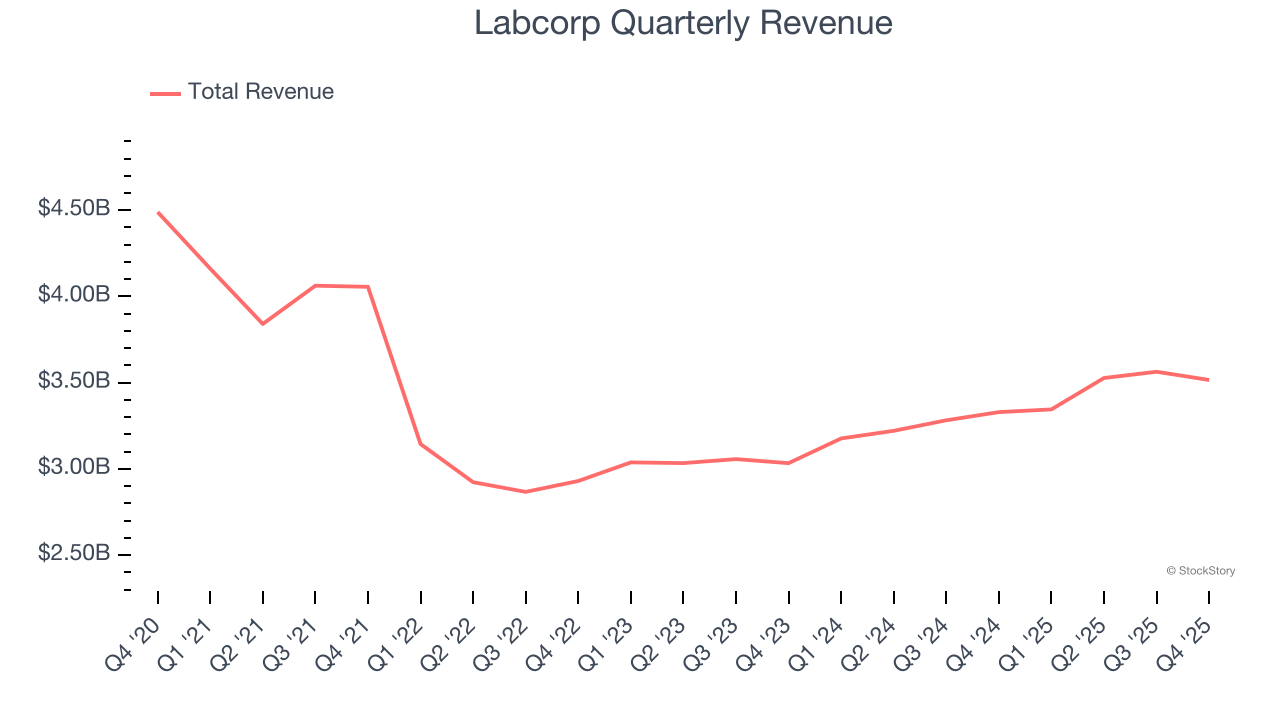
Long-term growth is the most important, but within healthcare, a half-decade historical view may miss new innovations or demand cycles. Labcorp’s annualized revenue growth of 7.1% over the last two years is above its five-year trend, which is encouraging. 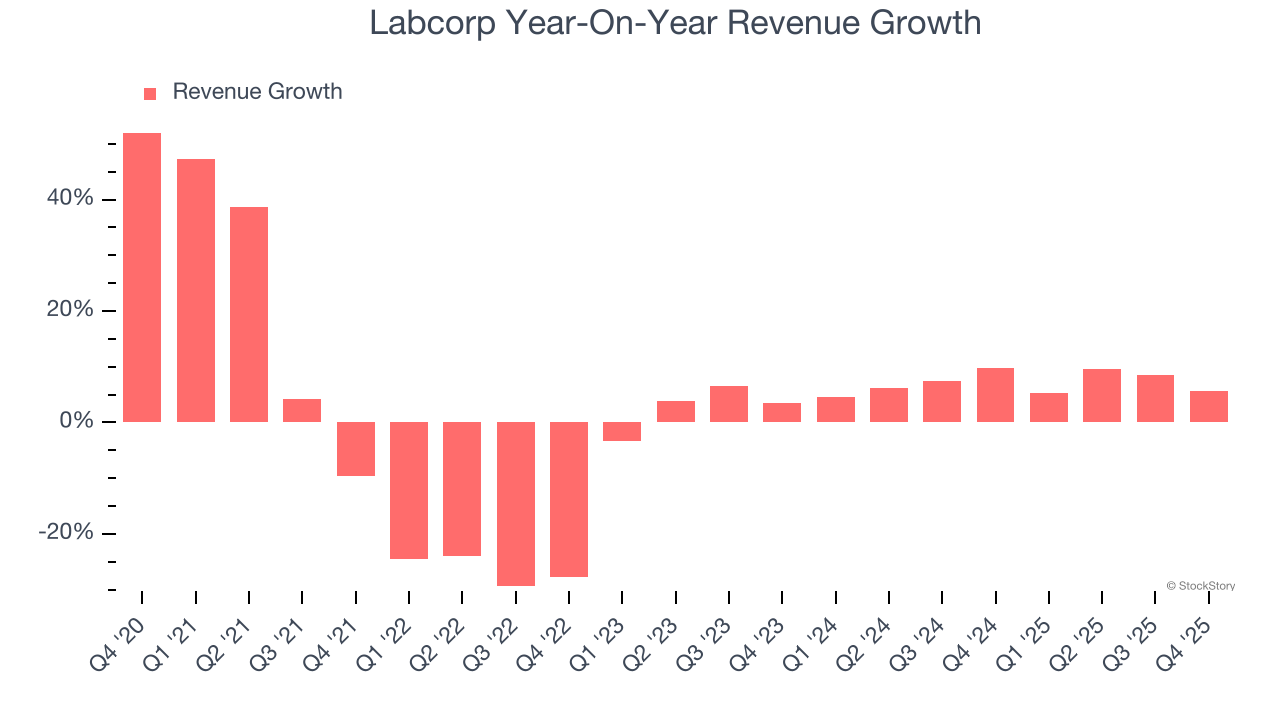
We can dig further into the company’s sales dynamics by analyzing its organic revenue, which strips out one-time events like acquisitions and currency fluctuations that don’t accurately reflect its fundamentals. Over the last two years, Labcorp’s organic revenue averaged 4.5% year-on-year growth. Because this number is lower than its two-year revenue growth, we can see that some mixture of acquisitions and foreign exchange rates boosted its headline results. 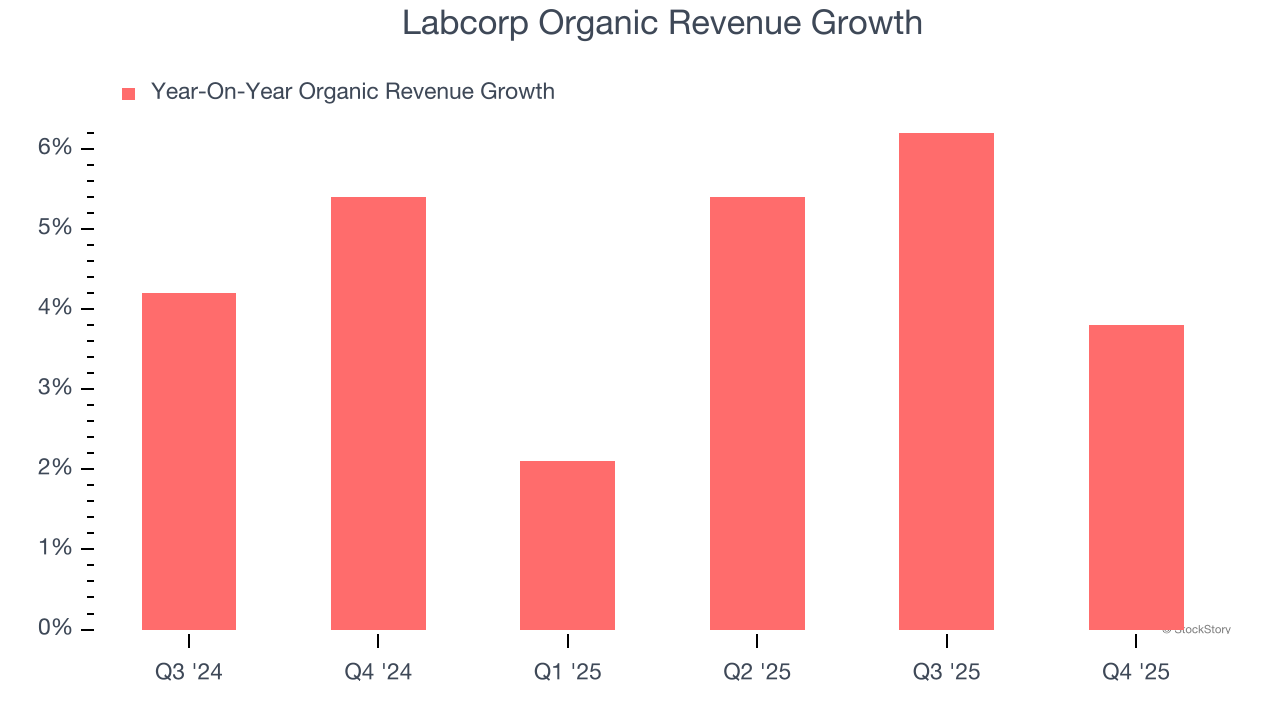
This quarter, Labcorp’s revenue grew by 5.6% year on year to $3.52 billion, missing Wall Street’s estimates.
Looking ahead, sell-side analysts expect revenue to grow 4.7% over the next 12 months, a slight deceleration versus the last two years. This projection doesn't excite us and indicates its products and services will face some demand challenges.
The 1999 book Gorilla Game predicted Microsoft and Apple would dominate tech before it happened. Its thesis? Identify the platform winners early. Today, enterprise software companies embedding generative AI are becoming the new gorillas. a profitable, fast-growing enterprise software stock that is already riding the automation wave and looking to catch the generative AI next.
Operating Margin
Operating margin is a key measure of profitability. Think of it as net income - the bottom line - excluding the impact of taxes and interest on debt, which are less connected to business fundamentals.
Labcorp has done a decent job managing its cost base over the last five years. The company has produced an average operating margin of 11.9%, higher than the broader healthcare sector.
Looking at the trend in its profitability, Labcorp’s operating margin decreased by 10.3 percentage points over the last five years, but it rose by 4 percentage points on a two-year basis. Still, shareholders will want to see Labcorp become more profitable in the future.
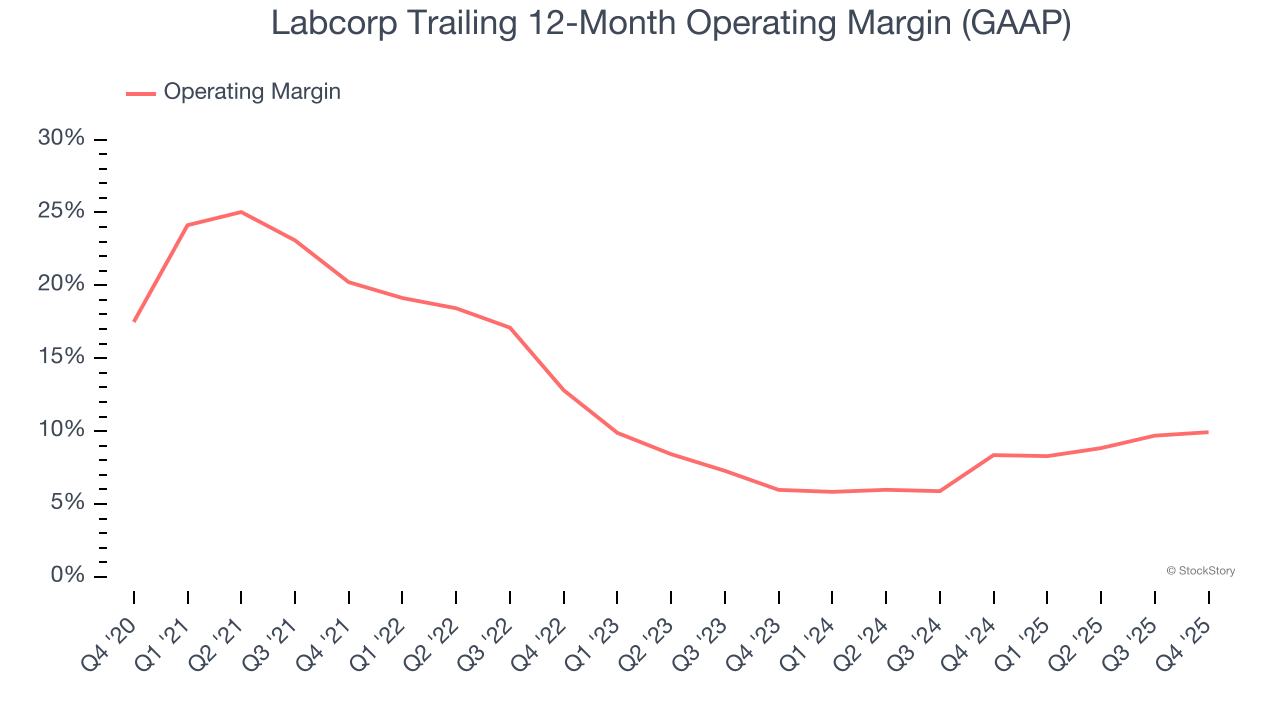
This quarter, Labcorp generated an operating margin profit margin of 7.6%, up 1.1 percentage points year on year. This increase was a welcome development and shows it was more efficient.
Earnings Per Share
We track the long-term change in earnings per share (EPS) for the same reason as long-term revenue growth. Compared to revenue, however, EPS highlights whether a company’s growth is profitable.
Sadly for Labcorp, its EPS declined by 7.2% annually over the last five years while its revenue was flat. This tells us the company struggled because its fixed cost base made it difficult to adjust to choppy demand.
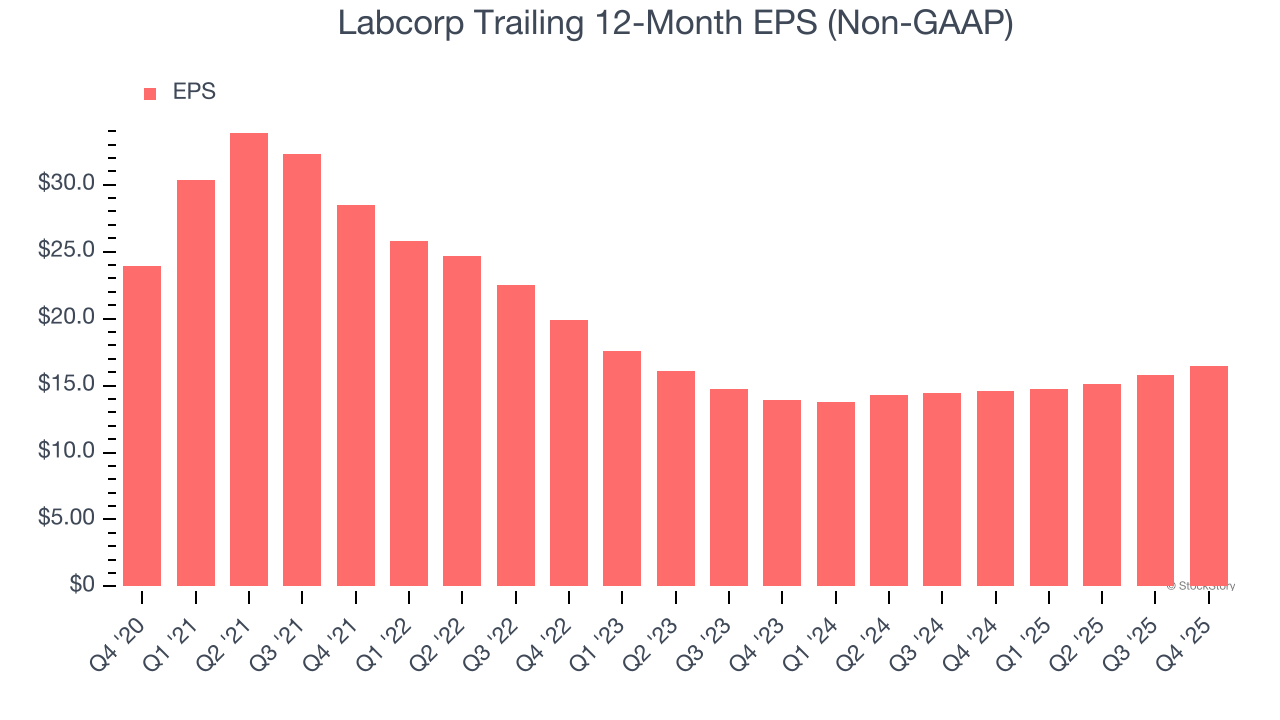
We can take a deeper look into Labcorp’s earnings to better understand the drivers of its performance. As we mentioned earlier, Labcorp’s operating margin expanded this quarter but declined by 10.3 percentage points over the last five years. This was the most relevant factor (aside from the revenue impact) behind its lower earnings; interest expenses and taxes can also affect EPS but don’t tell us as much about a company’s fundamentals.
In Q4, Labcorp reported adjusted EPS of $4.07, up from $3.45 in the same quarter last year. This print beat analysts’ estimates by 3.2%. Over the next 12 months, Wall Street expects Labcorp’s full-year EPS of $16.44 to grow 6.2%.
Key Takeaways from Labcorp’s Q4 Results
It was encouraging to see Labcorp beat analysts’ full-year EPS guidance expectations this quarter. We were also glad its full-year revenue guidance was in line with Wall Street’s estimates. On the other hand, its revenue slightly missed and its organic revenue fell slightly short of Wall Street’s estimates. Overall, this was a weaker quarter. The stock remained flat at $282.50 immediately following the results.
So do we think Labcorp is an attractive buy at the current price? We think that the latest quarter is only one piece of the longer-term business quality puzzle. Quality, when combined with valuation, can help determine if the stock is a buy. We cover that in our actionable full research report which you can read here (it’s free).