Medical device company ResMed (NYSE: RMD) beat Wall Street’s revenue expectations in Q4 CY2025, with sales up 11% year on year to $1.42 billion. Its non-GAAP profit of $2.81 per share was 3.2% above analysts’ consensus estimates.
Is now the time to buy ResMed? Find out by accessing our full research report, it’s free.
ResMed (RMD) Q4 CY2025 Highlights:
- Revenue: $1.42 billion vs analyst estimates of $1.40 billion (11% year-on-year growth, 1.6% beat)
- Adjusted EPS: $2.81 vs analyst estimates of $2.72 (3.2% beat)
- Adjusted EBITDA: $570.5 million vs analyst estimates of $550.8 million (40.1% margin, 3.6% beat)
- Operating Margin: 34.6%, up from 32.5% in the same quarter last year
- Free Cash Flow Margin: 21.9%, similar to the same quarter last year
- Constant Currency Revenue rose 8% year on year (10% in the same quarter last year)
- Market Capitalization: $37.54 billion
“Our second quarter results demonstrate the strength and resilience of our global business as we continue advancing our mission to help people sleep better, breathe better, and live longer and healthier lives in the comfort of their own home,” said Resmed’s Chairman and CEO, Mick Farrell.
Company Overview
Founded in 1989 to address the then-underdiagnosed condition of sleep apnea, ResMed (NYSE: RMD) develops cloud-connected medical devices and software solutions that treat sleep apnea, COPD, and other respiratory disorders for home and clinical use.
Revenue Growth
A company’s long-term sales performance can indicate its overall quality. Any business can have short-term success, but a top-tier one grows for years. Luckily, ResMed’s sales grew at a decent 11.8% compounded annual growth rate over the last five years. Its growth was slightly above the average healthcare company and shows its offerings resonate with customers.
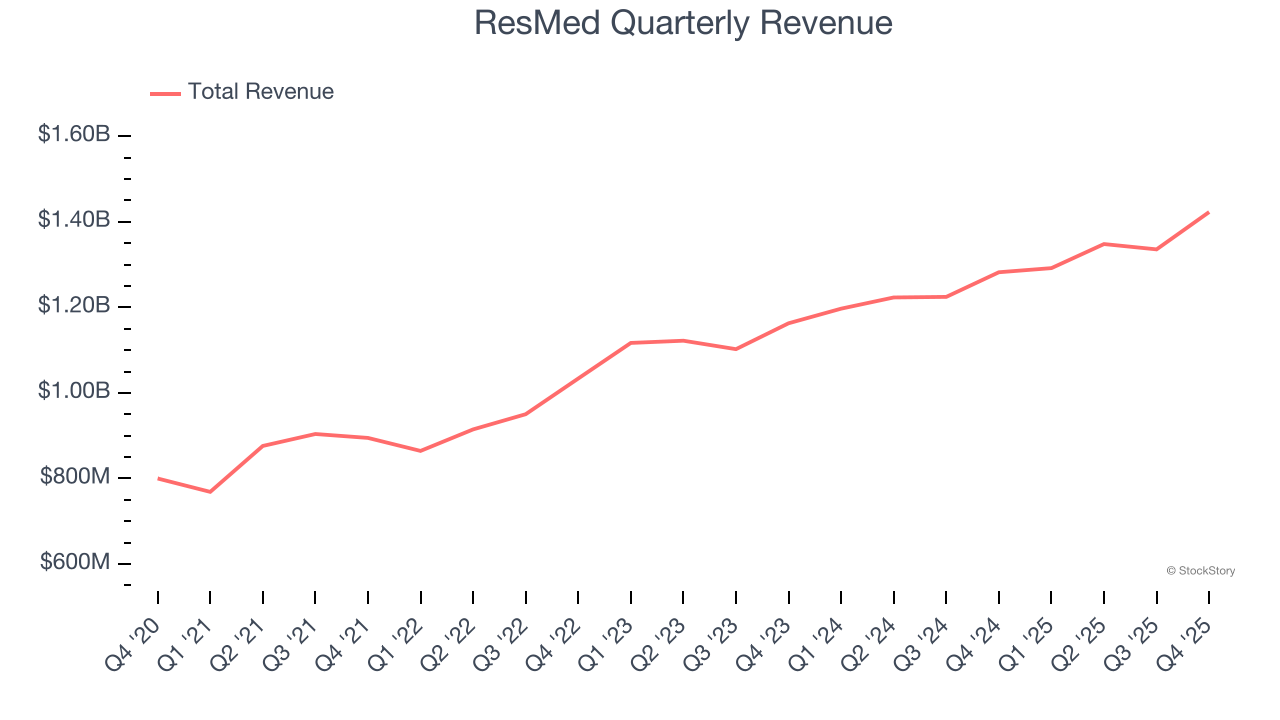
Long-term growth is the most important, but within healthcare, a half-decade historical view may miss new innovations or demand cycles. ResMed’s annualized revenue growth of 9.5% over the last two years is below its five-year trend, but we still think the results were respectable. 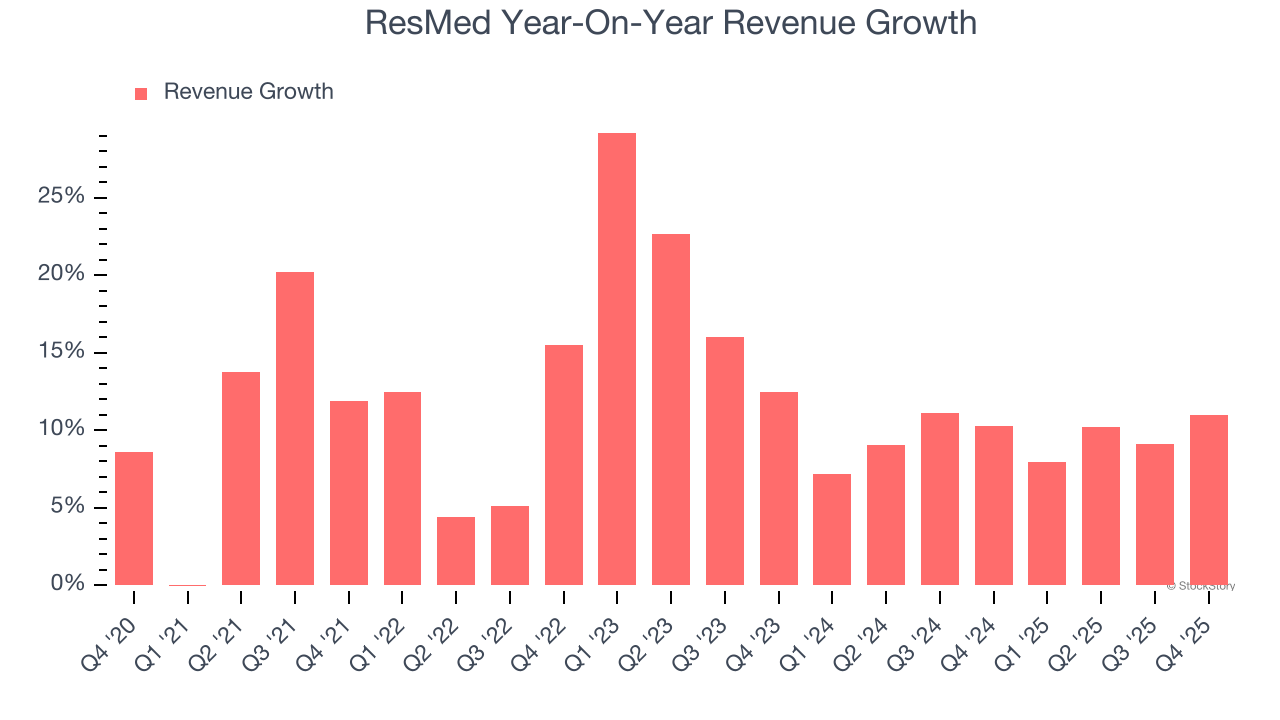
We can dig further into the company’s sales dynamics by analyzing its constant currency revenue, which excludes currency movements that are outside their control and not indicative of demand. Over the last two years, its constant currency sales averaged 9% year-on-year growth. Because this number aligns with its normal revenue growth, we can see that ResMed has properly hedged its foreign currency exposure. 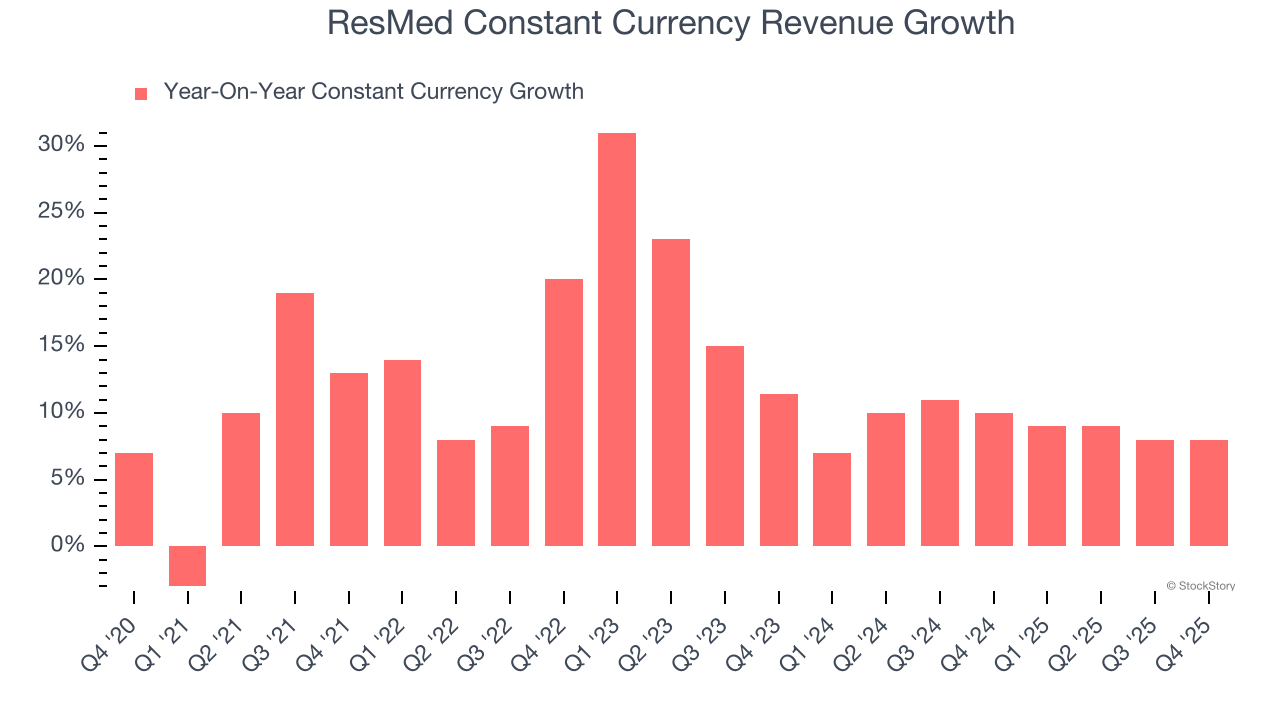
This quarter, ResMed reported year-on-year revenue growth of 11%, and its $1.42 billion of revenue exceeded Wall Street’s estimates by 1.6%.
Looking ahead, sell-side analysts expect revenue to grow 7.7% over the next 12 months, a slight deceleration versus the last two years. Despite the slowdown, this projection is above the sector average and indicates the market is forecasting some success for its newer products and services.
Microsoft, Alphabet, Coca-Cola, Monster Beverage—all began as under-the-radar growth stories riding a massive trend. We’ve identified the next one: a profitable AI semiconductor play Wall Street is still overlooking. Go here for access to our full report.
Operating Margin
Operating margin is a key measure of profitability. Think of it as net income - the bottom line - excluding the impact of taxes and interest on debt, which are less connected to business fundamentals.
ResMed has been an efficient company over the last five years. It was one of the more profitable businesses in the healthcare sector, boasting an average operating margin of 29.7%.
Analyzing the trend in its profitability, ResMed’s operating margin rose by 5.4 percentage points over the last five years, as its sales growth gave it operating leverage. This performance was mostly driven by its recent improvements as the company’s margin has increased by 8.4 percentage points on a two-year basis. These data points are very encouraging and show momentum is on its side.
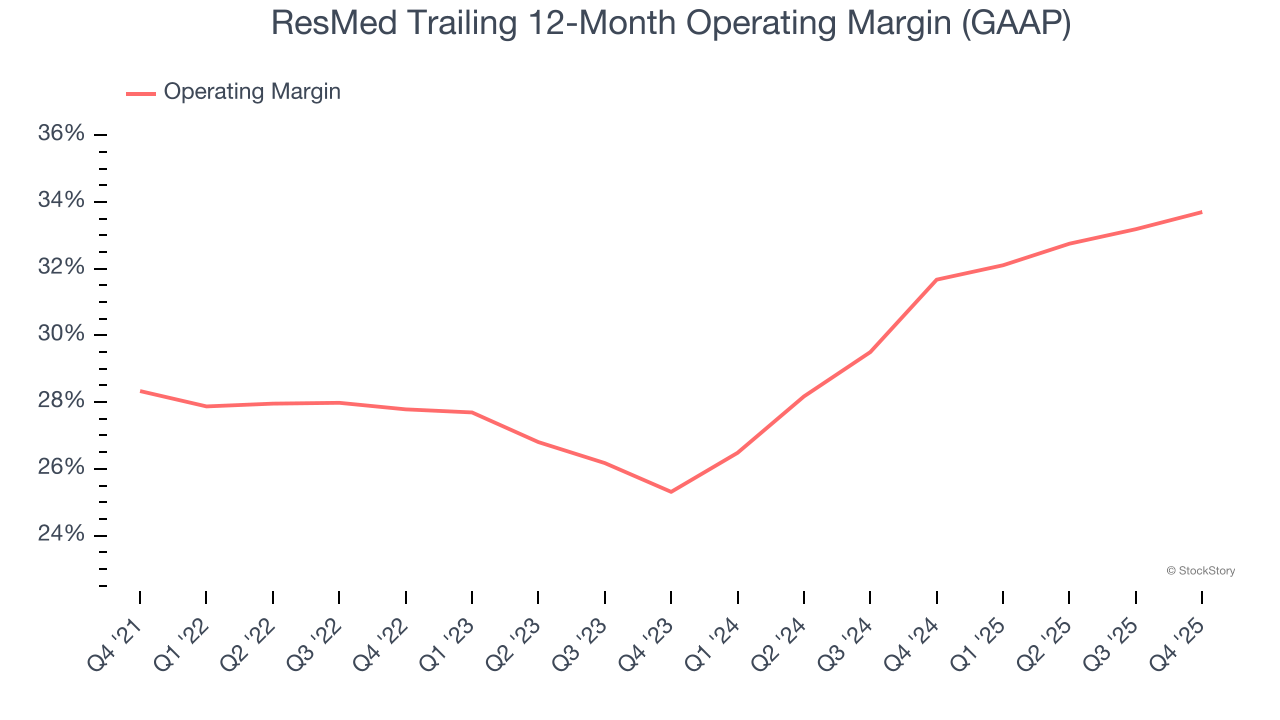
This quarter, ResMed generated an operating margin profit margin of 34.6%, up 2 percentage points year on year. This increase was a welcome development and shows it was more efficient.
Earnings Per Share
We track the long-term change in earnings per share (EPS) for the same reason as long-term revenue growth. Compared to revenue, however, EPS highlights whether a company’s growth is profitable.
ResMed’s EPS grew at a spectacular 14.2% compounded annual growth rate over the last five years, higher than its 11.8% annualized revenue growth. This tells us the company became more profitable on a per-share basis as it expanded.
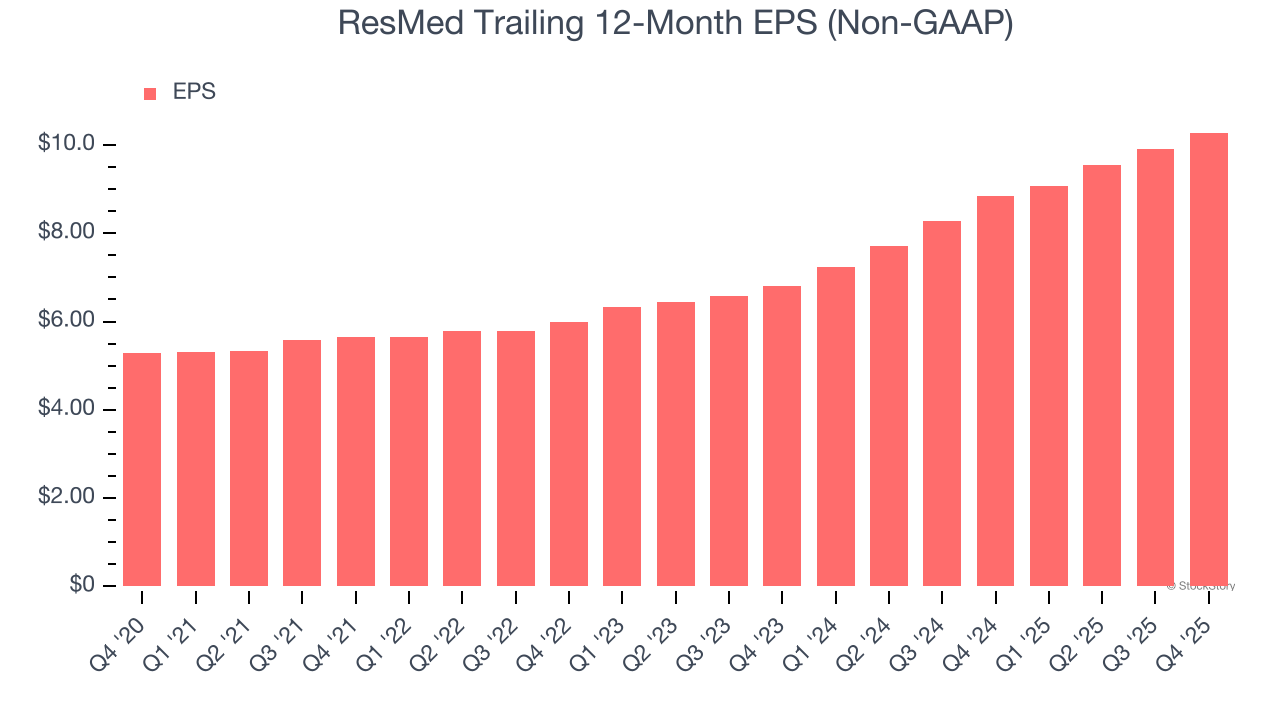
We can take a deeper look into ResMed’s earnings to better understand the drivers of its performance. As we mentioned earlier, ResMed’s operating margin expanded by 5.4 percentage points over the last five years. This was the most relevant factor (aside from the revenue impact) behind its higher earnings; interest expenses and taxes can also affect EPS but don’t tell us as much about a company’s fundamentals.
In Q4, ResMed reported adjusted EPS of $2.81, up from $2.43 in the same quarter last year. This print beat analysts’ estimates by 3.2%. Over the next 12 months, Wall Street expects ResMed’s full-year EPS of $10.28 to grow 11.8%.
Key Takeaways from ResMed’s Q4 Results
It was encouraging to see ResMed beat analysts’ revenue expectations this quarter. We were also glad its EPS outperformed Wall Street’s estimates. Overall, this print had some key positives. The stock traded up 2.5% to $264.04 immediately following the results.
Is ResMed an attractive investment opportunity at the current price? If you’re making that decision, you should consider the bigger picture of valuation, business qualities, as well as the latest earnings. We cover that in our actionable full research report which you can read here (it’s free).