The defense industry has reached a historic inflection point. As of January 8, 2026, the landscape for aerospace and defense contractors has been permanently reshaped by the unveiling of a staggering $1.5 trillion U.S. defense budget proposal. Among the "Big Prime" contractors, few are as uniquely positioned to capitalize on this fiscal surge as Northrop Grumman (NYSE: NOC).
With a portfolio that serves as the literal backbone of the U.S. nuclear triad and a pioneer in next-generation stealth technology, Northrop Grumman finds itself at the intersection of massive government spending and heightened geopolitical urgency. This deep-dive research explores the company’s trajectory, financial health, and the risks inherent in the most ambitious defense buildup since the Cold War.
Introduction
Northrop Grumman is a titan of the global security industry, specializing in aeronautics, space systems, and mission-critical defense electronics. While peers like Lockheed Martin (NYSE: LMT) dominate tactical aviation and General Dynamics (NYSE: GD) lead in naval dominance, Northrop Grumman has carved out an indispensable niche: the modernization of American strategic deterrence.
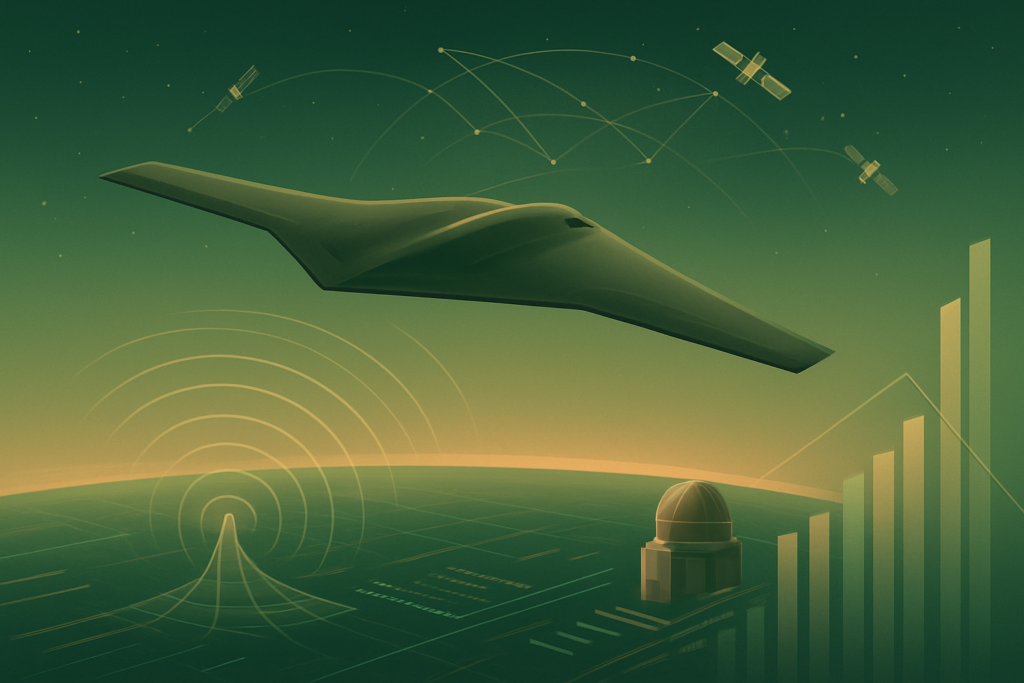
The company is currently in focus due to its dual roles in the B-21 Raider stealth bomber and the Sentinel Intercontinental Ballistic Missile (ICBM) program. Today’s news of a $1.5 trillion budget proposal—a nearly 50% increase from levels seen just two years ago—validates the company’s "pure-play" defense strategy. As the Pentagon shifts focus toward "Great Power Competition" with China and Russia, Northrop Grumman's high-tech, digital-first approach to warfare has made it a favorite among defense hawks and institutional investors alike.
Historical Background
The Northrop Grumman story is one of consolidation and technical audacity. The company in its current form was forged in 1994 when Northrop Corporation acquired the Grumman Corporation for $2.1 billion. Northrop, founded in 1939, was a pioneer in "flying wing" designs, a legacy that eventually birthed the B-2 Spirit stealth bomber. Grumman, meanwhile, was the legendary "Iron Works" of Long Island, famous for the F-14 Tomcat and the Apollo Lunar Module.
Throughout the late 1990s and early 2000s, the company continued to absorb critical tech players, including Litton Industries and TRW Inc., which provided the foundation for its massive Mission Systems and Space segments. In 2018, Northrop acquired Orbital ATK, a move that secured its dominance in solid rocket motors and solidified its role in the revival of the U.S. space program. These transformations shifted the company from a traditional aircraft manufacturer into a diversified technology powerhouse capable of managing the world's most complex "system-of-systems" programs.
Business Model
Northrop Grumman operates a diversified but highly integrated business model organized into four primary reporting segments:
- Aeronautics Systems: The home of the B-21 Raider and the Global Hawk/Triton autonomous systems. This segment focuses on stealth, survivability, and long-range strike capabilities.
- Defense Systems: Responsible for the Sentinel ICBM program and advanced tactical weapons. This segment focuses on the "Nuclear Triad" and integrated battle command.
- Mission Systems: The "intelligence" of the company, producing advanced sensors, electronic warfare tools, and cyber solutions. It provides the electronic infrastructure for nearly every major U.S. military platform.
- Space Systems: Specializes in satellites and launch vehicles. This is currently the company’s fastest-growing segment, driven by the U.S. Space Force’s push for resilient orbital networks.
The company’s revenue is almost entirely derived from government contracts (roughly 85% from the U.S. government). This provides high revenue visibility through a massive backlog, which reached a record $93 billion in early 2025.
Stock Performance Overview
Northrop Grumman has historically been a standout performer for long-term shareholders, characterized by resilience during market downturns.
- 1-Year Performance: As of January 8, 2026, NOC is trading near $577.01, representing a roughly 36% return over the past year. This outperformance was fueled by the successful flight tests of the B-21 Raider and the subsequent production acceleration.
- 5-Year Performance: Investors have seen a total return of approximately 124%. The stock benefited from a flight to safety during the 2022–2024 inflationary period and a global re-armament trend following the invasion of Ukraine.
- 10-Year Performance: Over the last decade, NOC has nearly tripled in value (up ~273%), significantly outperforming the broader S&P 500. This decade was defined by aggressive dividend growth and massive stock buybacks, though recent regulatory shifts have tempered the latter.
Financial Performance
In fiscal year 2025, Northrop Grumman reported revenues between $41.7 billion and $42.5 billion. While the top line showed healthy mid-single-digit growth, the bottom line was pressured by a $477 million pre-tax loss provision taken early in the year on the B-21 Raider’s Low-Rate Initial Production (LRIP). This "learning curve" charge is common in fixed-price defense contracts but initially spooked some value investors.
By Q4 2025, however, the financial narrative shifted. The company raised its full-year EPS guidance to a range of $25.65 to $26.05 as production efficiencies improved. The company’s balance sheet remains solid, though it carries roughly $14 billion in long-term debt. Free cash flow has lagged slightly behind peers as the company reinvests heavily into capital expenditures for the Sentinel and B-21 production lines, but the $1.5 trillion budget proposal suggests a massive cash infusion is on the horizon.
Leadership and Management
Since January 2019, Northrop Grumman has been led by Kathy Warden, Chair, CEO, and President. Warden is widely regarded as one of the most effective leaders in the defense sector, known for her "Digital Engineering" mandate. This strategy uses advanced modeling and simulation to design platforms in a virtual environment before cutting metal, a process credited for bringing the B-21 Raider to flight status faster than any previous stealth aircraft.
Warden’s leadership style emphasizes operational excellence and human capital. Under her tenure, the company has navigated a "critical" cost breach on the Sentinel program by working transparently with the Pentagon, eventually securing a restructured "Milestone B" that kept the program alive. Her focus on "speed and capacity" is now the company’s rallying cry in the face of the $1.5 trillion budget windfall.
Products, Services, and Innovations
Northrop Grumman’s portfolio is a roster of the most advanced technology on (and off) the planet:
- B-21 Raider: The world’s first sixth-generation aircraft. It is designed to be the "backbone" of the Air Force's long-range strike capability, capable of penetrating the most advanced air defenses.
- Sentinel (LGM-35A): The replacement for the aging Minuteman III ICBM. This $141 billion program is the largest land-based nuclear modernization effort in history.
- Integrated Battle Command System (IBCS): A software-defined system that connects "any sensor to any shooter," allowing diverse defense systems to talk to each other on the battlefield.
- Space Assets: Northrop is a lead developer of the "Proliferated Warfighter Space Architecture," a network of low-earth orbit satellites designed to track hypersonic missiles.
Competitive Landscape
In the high-stakes world of defense primes, Northrop Grumman competes primarily with Lockheed Martin (NYSE: LMT), Boeing (NYSE: BA), and General Dynamics (NYSE: GD).
Unlike Lockheed, which relies heavily on the F-35 program, Northrop is more specialized in "strategic" assets. While Boeing has struggled with commercial quality issues and cost overruns on the KC-46 tanker, Northrop has managed to maintain a "pure-play" defense reputation that has largely avoided commercial contagion. Its primary competitive edge lies in Stealth and Mission Electronics, where it frequently acts as a subcontractor even to its rivals, providing the "brains" (sensors and radar) for their platforms.
Industry and Market Trends
The aerospace and defense sector in 2026 is driven by three macro trends:
- The Pacific Pivot: The need to counter China’s rapid naval and aerial expansion has shifted funding toward long-range bombers and space-based surveillance.
- Digital Warfare: Modern combat is increasingly defined by software, AI, and cyber capabilities rather than just "metal and engines." Northrop's digital-first design process is the new industry standard.
- Nuclear Modernization: After decades of neglect, the U.S. is in the midst of a total refresh of its nuclear triad, a cycle that will last into the 2040s.
Risks and Challenges
Despite the bullish budget news, Northrop Grumman faces significant risks:
- Fixed-Price Contract Inflation: Many of its large programs were signed under fixed-price terms. If labor or material costs spike, the company must absorb the losses, as seen with the B-21 charges in 2025.
- Sentinel Execution: The Sentinel program remains technically and politically fragile. Any further cost overruns could lead to renewed calls in Congress to cancel the program in favor of sea-based deterrents.
- Regulatory Caps: New executive orders in 2026 have targeted defense contractor payouts, threatening to cap stock buybacks if companies do not meet specific R&D reinvestment targets.
- Labor Shortages: The demand for high-clearance aerospace engineers exceeds supply, driving up wage expenses.
Opportunities and Catalysts
The $1.5 trillion budget proposal is the ultimate catalyst. Specifically, the proposed $25 billion "Golden Dome" missile shield represents a massive new market for Northrop’s Mission Systems segment. Additionally, the B-21 program is moving from development (low margin) to production (higher margin). As the Air Force targets a fleet of at least 100 Raiders, the "tail" of sustainment and upgrades will provide decades of high-margin recurring revenue.
Investor Sentiment and Analyst Coverage
Wall Street sentiment remains "Moderately Bullish." As of early 2026, approximately 70% of analysts covering NOC have a "Buy" or "Strong Buy" rating, with price targets ranging from $620 to $685. Institutional ownership is high at 83%, with major positions held by Vanguard, State Street, and Capital Group.
While some "growth" funds have trimmed positions due to the buyback caps, "value" and "macro" funds have increased stakes, viewing Northrop as a sovereign-backed tech play with a nearly impenetrable moat.
Regulatory, Policy, and Geopolitical Factors
The geopolitical environment is the primary tailwind for NOC. The ongoing stalemate in Ukraine, coupled with tensions in the South China Sea, has created a bipartisan consensus in Washington for sustained high defense spending.
However, policy risk is rising. The current administration has signaled a "tough on contractors" stance, demanding more transparency in pricing and higher quality standards. Investors must watch for "The One Big Beautiful Bill Act" (OBBBA), a 2026 supplemental funding bill that includes specific clauses requiring contractors to prioritize "domestic sourcing" over profit margins.
Conclusion
Northrop Grumman (NYSE: NOC) stands as a pivotal architect of 21st-century national security. The $1.5 trillion budget proposal released today serves as a powerful validation of the company's long-term strategy to dominate the "strategic" and "space" domains of modern warfare.
While the company must navigate the treacherous waters of fixed-price contract risks and increasing regulatory scrutiny of shareholder returns, its technological "moat"—built on decades of stealth and electronic warfare expertise—is nearly impossible for competitors to bridge. For investors, Northrop Grumman offers a rare combination of government-backed stability and high-tech growth potential. As the B-21 Raider takes to the skies in greater numbers, NOC is not just a defense company; it is a critical component of the American strategic posture in an increasingly uncertain world.
This content is intended for informational purposes only and is not financial advice.