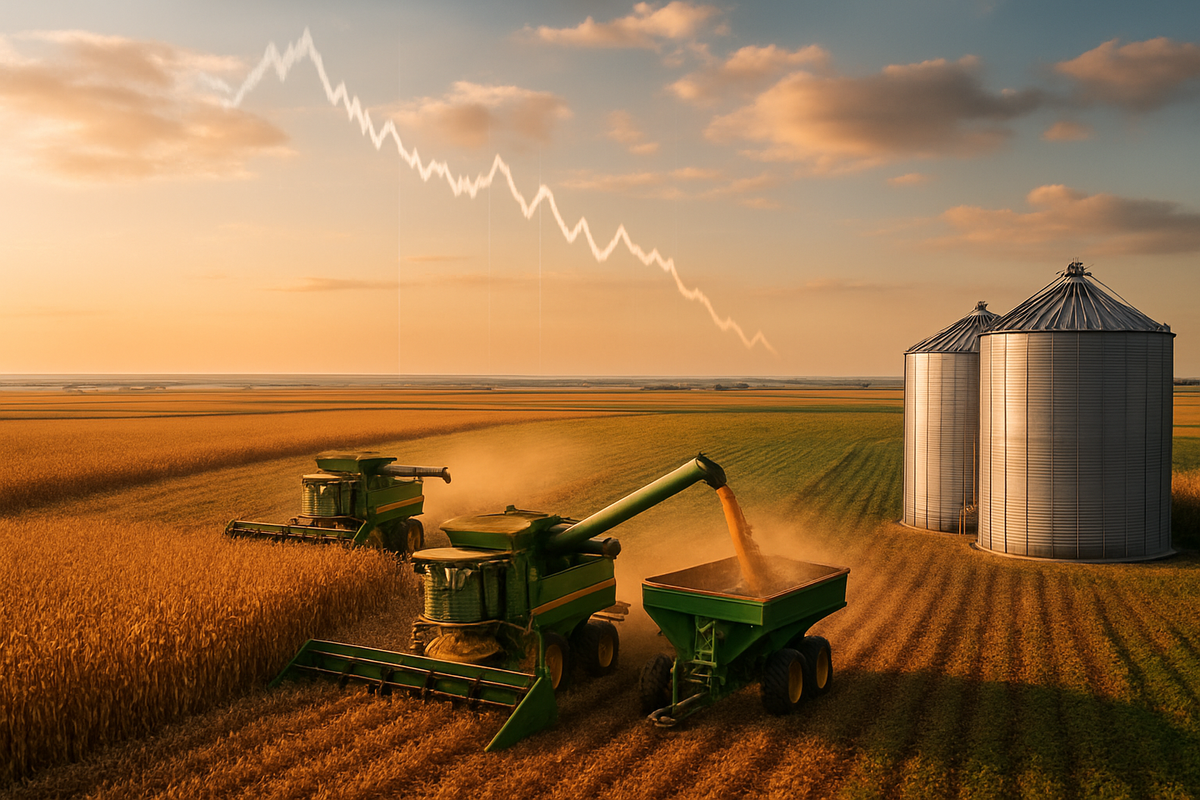
As of March 2026, the global agricultural landscape has undergone a tectonic shift, moving from the scarcity-driven highs of the early 2020s into a period of deep price suppression. A "wall of supply" resulting from consecutive record-breaking harvests in the United States and Brazil has forced corn and soybean prices into double-digit percentage declines. This transition, fueled by a normalization of global weather patterns following years of volatile La Niña disruptions, has fundamentally altered the economics of the "Grain Belt," creating a challenging environment for producers while offering a reprieve to livestock processors.
The immediate implications are stark: corn has struggled to maintain a floor above $4.00 per bushel, a level not seen consistently since the pre-pandemic era, while soybeans have retreated toward the $10.00 mark. For the American farmer, these figures represent a fourth consecutive year of tightening margins, as the cost of inputs like fertilizer and equipment remains stubbornly high relative to the falling value of their yields. This "margin squeeze" is now rippling through the broader economy, impacting everything from tractor sales to global shipping logistics.
A Perfect Storm of Production and Predictability
The current downturn is the result of a multi-year trajectory that began in 2024 and reached a crescendo in the 2025/26 marketing year. After years of weather-related supply shocks, the global climate shifted toward a more predictable "normal." While a moderate La Niña event emerged in late 2025, it failed to deliver the catastrophic droughts seen in previous cycles. Instead, timely rains across the U.S. Midwest and a recovery in South American precipitation patterns allowed for historic yields. In the 2025/26 season, the United States produced a staggering 16.8 billion bushels of corn, driven by an expansion to 98.7 million acres and record-setting yield-per-acre metrics.
Brazil, the primary competitor to the U.S. in the global market, has similarly flooded the world with supply. The Brazilian 2024/25 soybean crop reached a record 171.5 million metric tons, and early estimates for the 2025/26 cycle suggest a further expansion to 175 million metric tons. This dual-hemisphere production surge has eliminated the supply buffers that once kept prices inflated, leading to a cumulative decline of roughly 37% for corn and 26% for soybeans from their 2022 peaks.
Industry reactions have been swift and defensive. In early 2026, major grain elevators and logistics firms reported high levels of "on-farm storage," as farmers hold onto grain in hopes of a price rebound that has yet to materialize. This backlog has created a physical bottleneck, with domestic basis levels—the difference between the local cash price and the futures market—widening to historical extremes in parts of the Illinois and Iowa river corridors.
Winners and Losers in the Supply-Abundant Era
The impact of this price pressure is sharply bifurcated across the agricultural sector. Companies that facilitate the production and trade of raw commodities are facing significant headwinds. Deere & Company (NYSE: DE), the world's largest farm machinery manufacturer, has officially signaled that 2026 will mark the "bottom of the large ag cycle." With farmer sentiment at multi-year lows, the demand for high-end tractors and harvesters has plummeted, leading Deere to forecast a 15% to 20% decline in large agricultural equipment sales for the current fiscal year. The company’s net income has followed suit, falling nearly 29% as the "deferred replacement cycle" takes hold among debt-wary growers.
Similarly, the "ABCD" grain trading giants are navigating a margin desert. Archer-Daniels-Midland (NYSE: ADM) and Bunge Global SA (NYSE: BG) reported their weakest fourth-quarter profits since 2019 in February 2026. These firms, which thrive on market volatility and supply scarcity, are finding it difficult to extract profits from a market where supply is overly abundant and "crush margins"—the profit from processing soybeans into oil and meal—have been crushed by overcapacity and falling demand for biofuels.
Conversely, the protein sector is emerging as a primary beneficiary of the glut. Tyson Foods (NYSE: TSN) has seen its chicken and pork segments return to robust profitability as feed costs, which account for the majority of livestock production expenses, have plummeted. In early 2026, Tyson reported its fifth consecutive quarter of volume gains, with its chicken segment achieving operating margins near 11%. However, even this victory is tempered; Tyson’s beef segment continues to struggle due to a 75-year low in the U.S. cattle herd, proving that cheap feed cannot immediately solve the long-term biological constraints of cattle inventory.
Broader Significance and Historical Precedents
This current market environment mirrors the "long tail" of the 2012-2014 agricultural cycle, where a period of extreme drought and high prices was followed by a multi-year slump as global production capacity over-adjusted. The broader significance of the 2026 price pressure lies in its intersection with shifting energy policies. The rapid expansion of renewable diesel capacity in the U.S. was predicated on $12.00-$14.00 soybeans; at current prices, the economic viability of many smaller processing plants is being called into question, leading to a consolidation wave in the biofuel sector.
Furthermore, the competitive dynamic between the U.S. and Brazil has reached a new stage of intensity. Brazil’s infrastructure improvements, particularly in its northern ports, have allowed it to maintain a dominant share of the Chinese market even as U.S. prices fell. This has forced U.S. policymakers to reconsider export incentive programs and domestic support levels, as the traditional "Safety Net" of the Farm Bill is increasingly stressed by the low-price environment.
Historically, periods of "normalization" like this often lead to a reduction in planted acreage in the following year. However, the 2026 data suggests that fixed costs for many large-scale operations are so high that farmers are opting to "plant their way out" of the crisis, maintaining high production levels to cover debt obligations, which paradoxically keeps prices suppressed for longer.
The Road Ahead: 2026 and Beyond
Looking toward the remainder of 2026, the market is searching for a "black swan" event to break the downward trend. Short-term possibilities include a significant escalation in geopolitical tensions that could disrupt Black Sea shipping routes or a sudden, severe weather shift in the Northern Hemisphere's upcoming planting season. However, without such an intervention, the market is likely to remain in a "trough" phase. Strategic pivots are already underway, with companies like Corteva (NYSE: CTVA) focusing on biologicals and seed treatments that promise higher yields with lower traditional chemical inputs, aiming to help farmers lower their break-even costs.
In the long term, the agricultural sector may see a shift in land values. After years of record-high prices for tillable acres, the "cap rates" on farmland are beginning to compress. This could lead to a cooling of the institutional investment fervor that has characterized the farmland market over the last decade, potentially providing an opening for younger or expanding operators, provided they can navigate the current credit crunch.
Conclusion and Market Assessment
The early 2026 agricultural market is a testament to the incredible productivity of the modern global food system and the relentless nature of the commodity cycle. The key takeaway for investors and observers is that "weather normalization" can be just as disruptive to the financial markets as a drought, albeit in the opposite direction. While consumers may eventually see relief in grocery prices—particularly in meat and dairy—the producers and equipment providers are in a period of necessary consolidation and belt-tightening.
Moving forward, the market will be defined by the "bottoming" process. Investors should keep a close watch on the USDA's upcoming acreage reports and any shifts in the La Niña intensity, which could signal the start of the next supply contraction. For now, the "Grain Glut" remains the dominant narrative, and the path to recovery will likely be a slow, multi-season process of demand catching up to an unprecedented supply.
This content is intended for informational purposes only and is not financial advice.