As of March 6, 2026, the artificial intelligence landscape has shifted from a period of cautious consolidation to one of aggressive, hardware-driven expansion. An internal memo from OpenAI CEO Sam Altman, recently leaked and reported by CNBC, has sent shockwaves through the financial markets by confirming that ChatGPT has returned to a blistering growth trajectory. The memo reveals that the flagship AI platform has surpassed 800 million weekly active users, growing at a rate of more than 10% month-over-month—a significant acceleration after the "plateau" concerns that dominated headlines in late 2024.
This resurgence is not merely a software success story; it is a catalyst for an unprecedented infrastructure arms race. The immediate market reaction has been a surge in high-performance computing and power-management stocks, as investors digest the sheer scale of the physical resources required to sustain OpenAI’s momentum. Central to this narrative is a staggering $300 billion data-center commitment involving Oracle Corporation (NYSE: ORCL), a deal that highlights both the immense potential and the high-stakes financial risks inherent in the current AI supercycle.
The Memo Heard Round the World: ChatGPT’s Second Wind
The CNBC report centered on a series of internal Slack messages sent by Sam Altman to OpenAI’s global workforce in February 2026. In these communications, Altman detailed a "return to hyper-growth" following a strategic pivot in late 2025. This pivot involved pausing several peripheral projects, such as specialized health AI agents and a personal assistant codenamed "Pulse," to focus engineering talent on the core efficiency and reliability of ChatGPT. The results appear to be paying off: Altman reported that GPT-5.3-Codex, the company's latest coding-specific model, saw an explosive 50% week-on-week growth in user activity following the release of a dedicated desktop application for Apple computers.
The timeline leading to this moment was defined by a year of skepticism. Throughout 2025, analysts questioned whether the "law of large numbers" would finally catch up to OpenAI, leading to a cooling of the AI fever. However, the memo suggests that the introduction of real-time multi-modal capabilities and a pilot program for subtle, clearly labeled advertisements within ChatGPT responses has unlocked new user segments and revenue streams. Furthermore, rumors are swirling of a massive new funding round that could value the company at nearly $300 billion, providing the capital necessary to fuel Altman’s trillion-dollar infrastructure ambitions.
Industry reactions were swift. Within hours of the CNBC report, shares of major AI infrastructure providers saw increased volatility as the market recalibrated the "terminal value" of the AI sector. The memo confirmed what many had suspected: OpenAI is no longer just a research lab but a massive industrial consumer of energy and silicon. This realization has shifted the focus from the "intelligence" of the models to the "capacity" of the clouds that host them, placing companies like Oracle and NVIDIA (NASDAQ: NVDA) at the center of the fiscal storm.
Winners and Losers: The High Cost of the $300 Billion Contract
The most dramatic beneficiary and risk-bearer in this scenario is Oracle Corporation (NYSE: ORCL). The reported $300 billion contract between OpenAI and Oracle, signed in late 2025, represents the largest commercial cloud agreement in history. Under the terms of the five-year deal, slated to go into full effect in 2027, Oracle will provide approximately $60 billion per year in computing power. While this cements Oracle’s status as a top-tier cloud contender, the financial strain is evident. Oracle has seen its debt load swell to over $108 billion, and the company is currently navigating a painful restructuring, including the layoff of 30,000 employees, to reallocate capital toward a projected $50 billion capital expenditure (capex) budget for 2026.
Conversely, NVIDIA (NASDAQ: NVDA) continues its reign as the undisputed winner of the AI era. With a market capitalization now hovering around $4.45 trillion, the company’s Blackwell architecture remains the gold standard for the high-density clusters OpenAI requires. As OpenAI’s growth accelerates, NVIDIA’s order book for its next-generation chips is reportedly filled through 2027. Similarly, Vertiv Holdings Co (NYSE: VRT) has emerged as a critical winner; the company’s stock hit all-time highs this month as its liquid cooling solutions became an absolute requirement for the massive power densities demanded by the OpenAI-Oracle "Stargate" data centers.
Microsoft Corporation (NASDAQ: MSFT), while still OpenAI’s primary strategic partner, finds itself in a more nuanced position. While Azure AI continues to grow at a healthy 39% clip, Microsoft's stock has faced pressure due to investor fatigue over the company’s own massive capex requirements, which hit $37.5 billion in the most recent quarter. The diversification of OpenAI’s workloads to Oracle and Google Cloud suggests a more fragmented ecosystem where Microsoft must now compete more fiercely for the very models it helped incubate. The "loser" in this current environment may well be any firm unable to secure the power and cooling capacity necessary to compete at this new, gargantuan scale.
Wider Significance: The 'Stargate' Era of Industrial AI
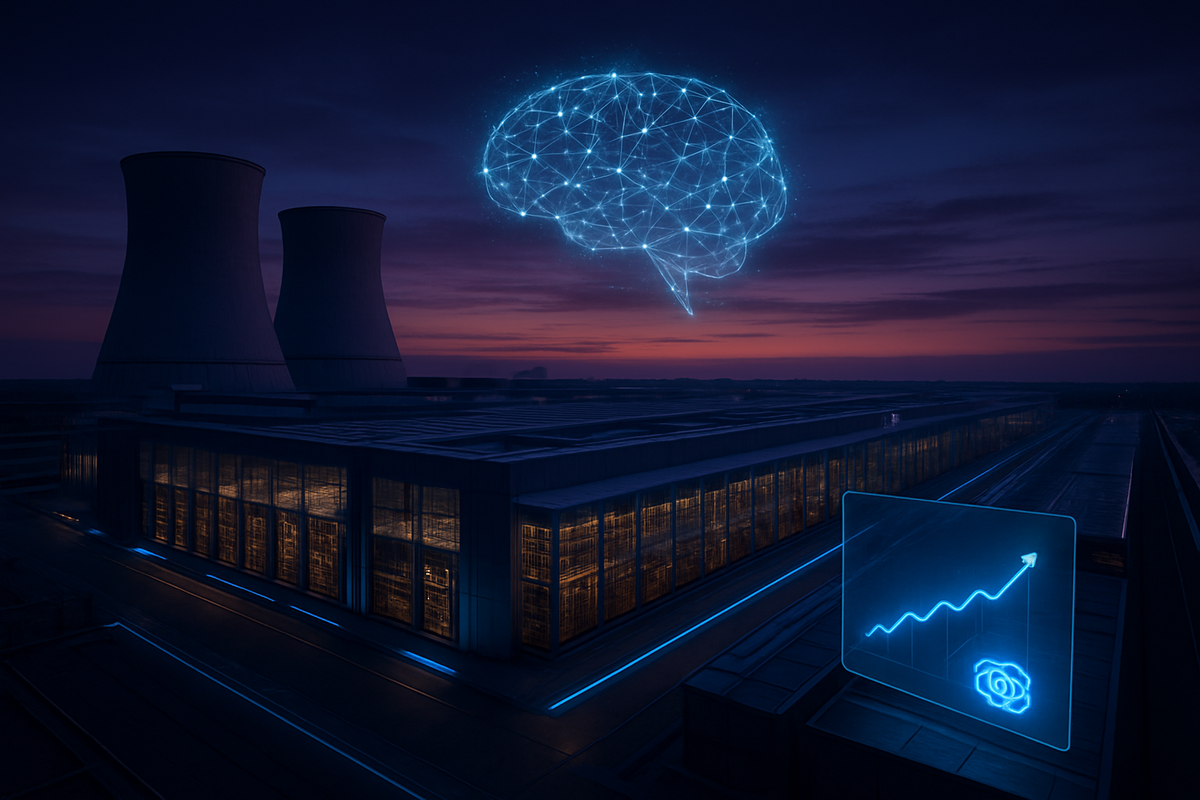
The OpenAI-Oracle partnership is a cornerstone of the broader "Project Stargate" initiative, a $500 billion joint venture that includes SoftBank and MGX. Formally unveiled in early 2025, Stargate represents a paradigm shift in how data centers are conceived. No longer just buildings full of servers, these are planned as 4.5-gigawatt industrial complexes—roughly equivalent to the power output of four large nuclear reactors. This shift signifies that AI has moved beyond a software trend into a matter of national infrastructure and energy policy.
The regulatory implications of such massive energy consumption are beginning to surface. As OpenAI and its partners seek to build capacity equivalent to the power used by 4 million homes, local and federal governments are wrestling with the trade-offs between AI leadership and grid stability. This mirrors the historical precedent of the mid-20th-century build-out of the U.S. electrical grid or the interstate highway system, where private enterprise and public policy collided. The sheer scale of these projects has also invited antitrust scrutiny, as the "Stargate" coalition effectively creates a monopoly on the most advanced computing resources on the planet.
Furthermore, the introduction of ads within ChatGPT, as mentioned in Altman's memo, marks the end of the "subsidized growth" phase of generative AI. By seeking to monetize its 800 million users through traditional advertising models, OpenAI is signaling a shift toward sustainable profitability. This pivot will likely force competitors like Google to accelerate their own AI-integrated search features, potentially leading to a total transformation of the digital advertising market, which has been dominated by traditional search links for over two decades.
What Comes Next: Scaling the Unscalable
In the short term, the market will be laser-focused on Oracle’s ability to execute its $50 billion capex plan without further damaging its credit rating. The "cash crunch" mentioned in recent reports suggests that the path to $300 billion in revenue is paved with significant liquidity challenges. If Oracle successfully brings the first 1.5 gigawatts of "Stargate" capacity online by late 2026, it could redefine the company's legacy. If it falters, however, the fallout could drag down the entire AI infrastructure sector, as OpenAI would be forced to scramble for alternative compute providers.
Long-term, the industry is watching for the "GPT-6" moment. Many analysts believe the return to growth cited in Altman's memo is a precursor to a model that requires an order of magnitude more compute power than anything currently in existence. This suggests that the $300 billion Oracle contract might actually be an underestimate of OpenAI's total needs through the end of the decade. Strategic pivots toward custom silicon (OpenAI’s rumored "Tigris" chip project) and direct investment in nuclear energy (via Altman’s interest in Helion) are likely to be the next major headlines.
Potential scenarios also include a cooling of investor enthusiasm if the "ads-in-AI" model fails to generate significant average revenue per user (ARPU). If the massive $500 billion infrastructure investment does not yield a proportional increase in corporate productivity or consumer spend, the data center stocks currently trading at record multiples could face a severe "Hype Cycle" correction. For now, however, the momentum remains firmly on the side of the builders and the power providers.
Conclusion: The New Reality of the AI Market
The leaked OpenAI memo serves as a definitive confirmation that the "AI winter" predicted by some skeptics has been averted by a renewed focus on core product growth and massive infrastructure scaling. With ChatGPT reaching 800 million users and OpenAI securing a $300 billion compute pipeline through Oracle, the industry has entered a phase of industrialization that dwarfs the initial "chatbot" phase of 2023. The financial markets are now rewarding those companies that provide the physical backbone—power, cooling, and silicon—to this digital revolution.
For investors, the key takeaway is that the AI trade has evolved into an "infrastructure and energy" play. While software companies struggle with monetization and competition, the providers of the underlying capacity, such as NVIDIA (NASDAQ: NVDA) and Vertiv (NYSE: VRT), are the primary gatekeepers of growth. Oracle (NYSE: ORCL) stands as the most high-risk, high-reward bet in this landscape, carrying a massive debt load in exchange for a front-row seat to the future of computing.
Moving forward, the market will closely monitor the "Project Stargate" milestones and the actual rollout of ChatGPT’s advertising features. The ability of OpenAI to maintain 10% monthly growth will be the ultimate barometer for whether the hundreds of billions of dollars flowing into data centers are a wise investment or a historic overextension. In this new era, the "intelligence" of the AI is only as good as the power plant and the cooling fan behind it.
This content is intended for informational purposes only and is not financial advice.