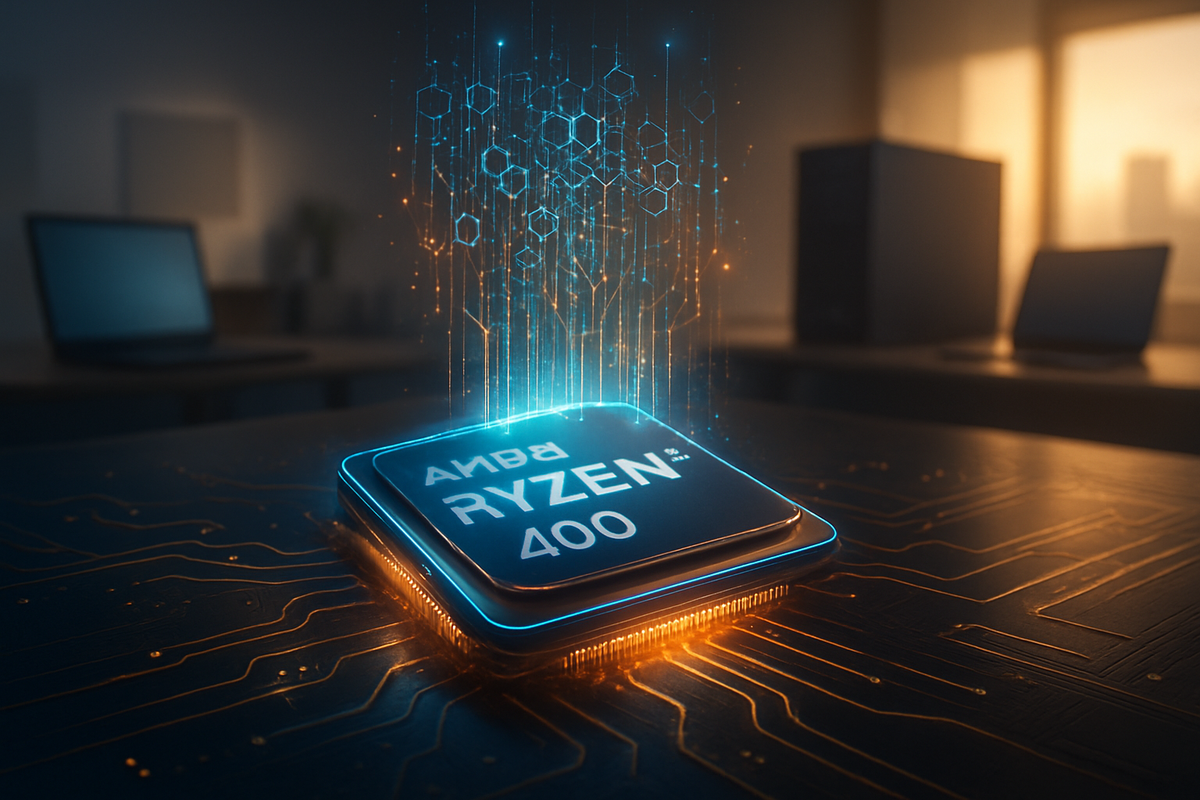
SANTA CLARA, CA – Advanced Micro Devices, Inc. (Nasdaq: AMD) has officially moved to colonize the next frontier of the personal computing market, announcing a sweeping expansion of its Ryzen AI 400 series processors. Following a high-profile series of reveals at the Mobile World Congress (MWC) 2026 earlier this week, the semiconductor giant is now aggressively pushing its specialized AI hardware beyond premium laptops and into the high-volume mainstream desktop and corporate enterprise sectors. This strategic pivot aims to capture the burgeoning demand for "endpoint compute," where artificial intelligence tasks are processed locally on a user's device rather than in the cloud.
The expansion marks a critical turning point for the industry as it enters the "volume phase" of the AI PC era. By introducing the first dedicated Neural Processing Units (NPUs) to the mainstream desktop market via its long-standing AM5 socket, AMD is effectively setting a new baseline for what constitutes a modern computer. For investors and consumers alike, the message is clear: the non-AI-capable PC is fast becoming a relic of the past, as AMD seeks to outmaneuver rivals Intel Corp (Nasdaq: INTC) and Qualcomm Inc (Nasdaq: QCOM) through a combination of raw processing power and platform longevity.
A New Architecture for the Local AI Era
The Ryzen AI 400 series, internal codenamed "Gorgon Point" and "Krackan Point," represents the most significant architectural leap for the company since the original Zen debut. Utilizing a sophisticated blend of Zen 5 and Zen 5c CPU cores, the chips are paired with the new XDNA 2 NPU architecture. According to technical specifications released during MWC 2026, these processors deliver between 50 and 60 Trillions of Operations Per Second (TOPS) of dedicated NPU performance. This comfortably exceeds the requirements for Microsoft Corp (Nasdaq: MSFT) and its "Copilot+ PC" certification, ensuring that even entry-level systems can handle sophisticated local Large Language Models (LLMs) and real-time generative AI tasks.
The timeline for this rollout has been surgical. Following the initial mobile launch at CES in January 2026, AMD used the March 2nd MWC stage to unveil the Ryzen AI PRO 400 series—a lineup specifically hardened for corporate environments—and the Ryzen AI 7 450G and 5 440G desktop APUs. These desktop parts are particularly significant as they allow IT managers to deploy a unified AI software stack across an entire corporate fleet, from ultra-portable laptops to powerful office workstations. Initial market reactions have been overwhelmingly positive, with major original equipment manufacturers (OEMs) like HP Inc (NYSE: HPQ), Lenovo Group Ltd (HKEX: 0992), and Dell Technologies Inc (NYSE: DELL) confirming dozens of new system designs slated for release in the second quarter of 2026.
Winners, Losers, and the Battle for the Enterprise
In the wake of AMD's expansion, the competitive landscape has shifted dramatically. AMD (Nasdaq: AMD) emerges as a primary winner, successfully leveraging its "chiplet" manufacturing advantage to scale AI hardware more cost-effectively than its peers. By maintaining the AM5 desktop socket for these new AI chips, AMD has secured a "loyalty win" from consumers and enterprise clients who can upgrade existing hardware without the expense of new motherboards. Furthermore, Microsoft (Nasdaq: MSFT) stands to benefit as a more powerful installed base of AI-capable hardware accelerates the adoption of its premium Copilot services.
Conversely, Intel (Nasdaq: INTC) faces a challenging defensive battle. While Intel’s upcoming "Panther Lake" chips promise formidable mobile gaming performance, the company has been slower to integrate high-performance NPUs into its mainstream desktop lineup, leaving a vacuum that AMD is now filling. Qualcomm (Nasdaq: QCOM) also faces increased pressure; while its Snapdragon X2 Elite remains the leader in power efficiency and raw NPU TOPS (hitting up to 80), it continues to grapple with "software friction" regarding legacy x86 application compatibility—a hurdle that AMD’s native Zen 5 architecture completely avoids.
The Significance of the Endpoint Compute Pivot
The expansion of the Ryzen AI 400 series is more than a simple product refresh; it is a fundamental shift in the philosophy of computing. For the past decade, the industry trend has been "Cloud First," with heavy lifting done on remote servers. However, rising data center costs, privacy concerns, and the need for zero-latency responses have triggered a move back toward "Endpoint Compute." AMD's strategy acknowledges that for AI to be truly pervasive, it cannot rely solely on an internet connection. By placing 60 TOPS of AI performance in the hands of a standard office worker, AMD is enabling a new class of "Privacy-First AI" where sensitive corporate data never leaves the local machine.
This shift mirrors the historical transition from centralized mainframes to personal computers in the 1980s. Just as that era created new software giants, the "Endpoint AI" era is expected to trigger a massive refresh cycle. Analysts at Gartner and Counterpoint Research suggest that by the end of 2026, over 60% of all PC shipments will be AI-capable. AMD's aggressive pricing—pushing AI-ready laptops toward a $499 entry point—is a direct attempt to force this transition and starve competitors of market share in the high-volume value segment.
What Lies Ahead: The Roadmap to 2027
Looking forward, the short-term focus for AMD will be the successful execution of its Q2 2026 shipping schedule. The market will be watching closely for any supply chain bottlenecks, particularly given the high demand for advanced 3nm and 4nm nodes required for these chips. A potential "strategic pivot" may also be on the horizon with the rumored "Ryzen AI Max+" (codenamed Strix Halo) workstation chips. These parts, expected later this year, are rumored to feature up to 128GB of unified memory, directly challenging Nvidia Corp (Nasdaq: NVDA) in the local AI development and creative professional space.
The long-term challenge for AMD remains software ecosystem maturity. While the hardware is now capable, the "killer app" for the AI PC—beyond simple chatbots and image generation—is still in its infancy. Investors should monitor the progress of AMD's "ROCm" and "Ryzen AI" software suites, as the company’s ability to attract independent software vendors (ISVs) will ultimately determine if this hardware expansion translates into long-term earnings growth.
The Bottom Line for Investors
AMD’s expansion of the Ryzen AI 400 series is a bold, well-timed strike at the heart of the PC market. By standardizing high-performance AI hardware across both mobile and desktop platforms, the company has effectively redefined the "modern PC." The move reinforces AMD's position as a nimble innovator capable of challenging both Intel’s legacy dominance and Qualcomm’s mobile-first ambitions.
As we move through 2026, the primary metric for success will be OEM adoption and "shelf space" at major retailers. If AMD can maintain its lead in desktop AI and successfully bridge the gap to enterprise-wide deployments, it may well secure a dominant share of the most significant PC upgrade cycle in a generation. For now, the "AI Everywhere" vision is no longer a roadmap—it is a reality sitting on the desktop.
This content is intended for informational purposes only and is not financial advice.