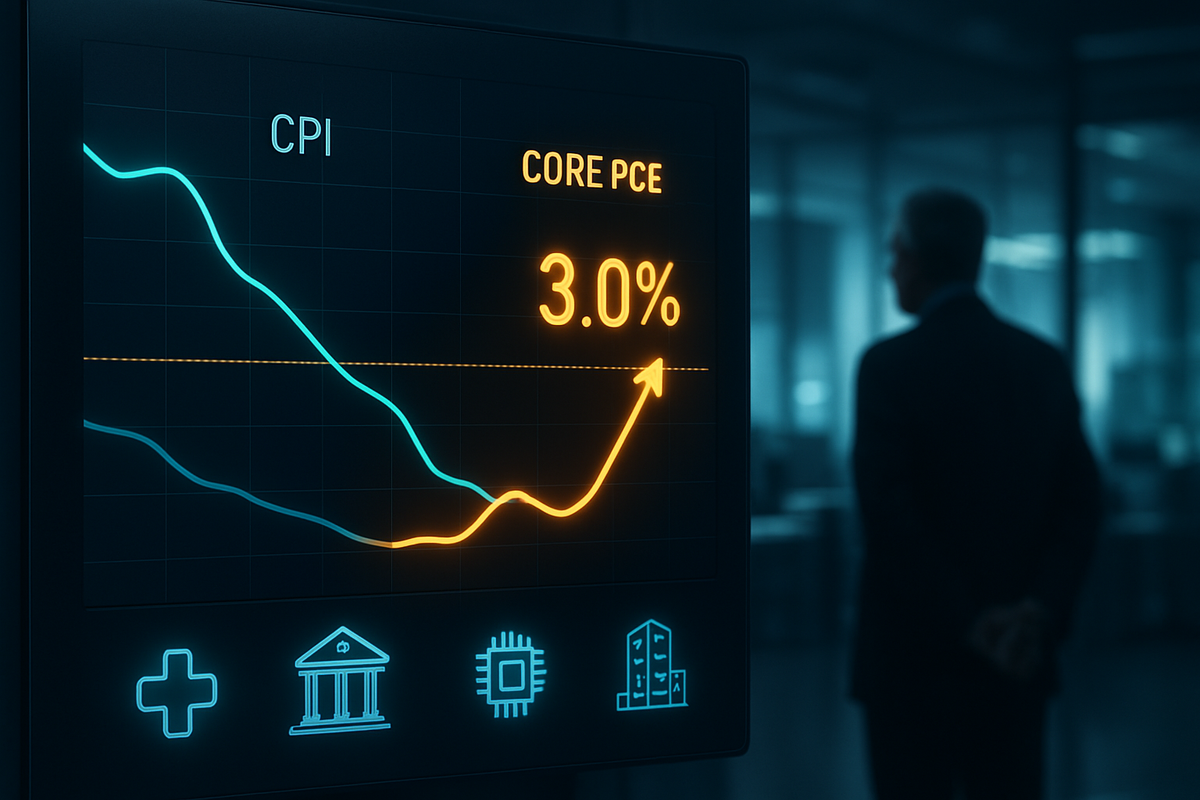
The financial markets were jolted this week as the Federal Reserve’s preferred inflation metric, the Core Personal Consumption Expenditures (PCE) price index, unexpectedly climbed to 3.0% on an annualized basis. This surge in "early 2026" data marks a stark departure from the Consumer Price Index (CPI), which has continued to show signs of cooling, creating a "divergence dilemma" for policymakers. As of March 18, 2026, the dream of a rapid series of interest rate cuts has effectively evaporated, replaced by a "hawkish pause" that has sent Treasury yields to their highest levels in months.
The immediate implication for the market is a massive repricing of risk. For much of late 2025, investors had bet on a "soft landing" scenario where falling shelter costs would drag all inflation metrics toward the Fed's 2% target. However, the 3.0% Core PCE print suggests that underlying price pressures in the services sector—particularly healthcare and insurance—are far more entrenched than previously realized. The disconnect between what consumers see at the grocery store (CPI) and what the Fed tracks in the broader economy (PCE) is now the single most important narrative for global capital markets.
The Weighting Wedge: Why PCE and CPI are Parting Ways
The jump to 3.0% Core PCE is not a fluke of volatile energy prices, but rather a reflection of the structural "weighting wedge" between the two major inflation indices. While the CPI is heavily influenced by shelter costs, which account for roughly 34% of its basket, the PCE gives housing a much smaller weight of approximately 15%. Throughout 2025 and into early 2026, rental markets have finally begun to normalize, providing a downward "drag" on the CPI. However, the PCE's larger focus on healthcare, which comprises nearly 17% of its index, has captured a different reality: a massive spike in medical labor costs and insurance premiums following a series of nationwide healthcare worker strikes in 2025.
This timeline of divergence began in late Q4 2025, when "supercore" inflation—services excluding energy and housing—began to accelerate. While the Bureau of Labor Statistics reported cooling headline inflation in January and February of 2026, the Bureau of Economic Analysis (BEA) caught the hidden heat in its PCE release. Key stakeholders, including Federal Reserve Chair Jerome Powell and the FOMC, are now forced to reckon with a labor market that appears to be "hoarding" workers. Despite a slight uptick in the unemployment rate to 4.4%, wage growth has remained stuck at 3.5%, providing a permanent "inflation floor" that the PCE is more sensitive to than the CPI.
Market reaction was swift and unforgiving. Upon the release of the data, the 10-year Treasury yield surged as traders realized the Fed would likely hold the federal funds rate in the 3.75%–4.00% range for the duration of 2026. The iShares 20+ Year Treasury Bond ETF (NASDAQ: TLT) saw significant selling pressure as the "higher for longer" narrative was cemented into the 2026 outlook.
Winners and Losers in a High-PCE Environment
In this environment of persistent "supercore" inflation, the traditional defensive playbook is being rewritten. Healthcare giants like UnitedHealth Group (NYSE: UNH) and HCA Healthcare (NYSE: HCA) have emerged as unexpected winners. Because the PCE heavily weights third-party payments and medical insurance premiums—which have been adjusted upward to reflect rising labor costs—these companies are seeing sustained revenue growth that tracks directly with the inflation the Fed is trying to fight. Similarly, large-cap financial institutions like JPMorgan Chase & Co. (NYSE: JPM) are benefiting from the "higher for longer" interest rate environment, which maintains their net interest margins at levels far higher than the pre-2022 era.
Conversely, growth-oriented technology stocks and interest-rate-sensitive sectors are facing a renewed valuation squeeze. Companies like Snowflake Inc. (NYSE: SNOW) and even retail behemoth Amazon.com, Inc. (NASDAQ: AMZN) have seen their forward earnings discounted at higher rates as the "neutral rate" of interest (R-star) is perceived to be moving higher. The tech sector, which thrived on the hope of 2026 rate cuts, must now adjust to a reality where capital remains expensive.
Real estate investment trusts (REITs) are also under intense pressure. Prologis, Inc. (NYSE: PLD) and American Tower Corp. (NYSE: AMT) are struggling with a "double whammy": the cooling CPI (which includes the shelter component) suggests slower rent growth, while the high PCE keeps the cost of refinancing their massive debt loads elevated. Consumer staples are not immune either; Procter & Gamble Co. (NYSE: PG) and Walmart Inc. (NYSE: WMT) are reporting "inflation fatigue" among low-to-middle income consumers who are no longer willing to accept the price hikes that characterized the 2022-2024 period, even as the companies' own labor and input costs remain high due to PCE-tracked service inflation.
The Significance of the "Supercore" Resistance
The 3.0% PCE print is more than just a data point; it represents a fundamental shift in the post-pandemic economic cycle. This event mirrors the "stop-go" inflation patterns of the 1970s, where inflation appeared to be beaten down in goods and housing, only to resurface in the service-oriented backbone of the economy. By early 2026, it has become clear that the "last mile" of the inflation fight is the hardest. The divergence from CPI highlights that while "stuff" (goods) and "space" (housing) are getting cheaper, "people" (services) are still getting more expensive.
This trend has significant regulatory and policy implications. The Federal Reserve's credibility is on the line. If they cut rates based on cooling CPI, they risk a secondary flare-up in PCE that could unanchor long-term inflation expectations. Conversely, if they stay restrictive to crush the PCE, they risk an over-correction in the housing market and a deeper recession than intended. This "policy trap" is the primary reason why market volatility has spiked in March 2026.
Furthermore, this divergence is rippling through the corporate world via "labor hoarding." Companies, having struggled to find workers in 2023 and 2024, are now reluctant to lay off staff even as demand softens. This keeps wage pressure high, which feeds directly into the PCE’s medical and professional services components, creating a self-reinforcing loop that traditional monetary policy struggles to break.
The Road Ahead: A Hawkish Pause and the New Neutral
Looking toward the summer of 2026, the most likely scenario is a prolonged "Hawkish Pause." The Federal Reserve is expected to remove any remaining signals of rate cuts from its upcoming "Dot Plot" in May. For investors, this means a strategic pivot away from high-beta growth stocks and toward companies with strong "organic" pricing power—those that can pass on costs without relying on a broad inflationary environment.
Strategic adaptations will be required for small and mid-cap companies that are reliant on floating-rate debt. The "market opportunity" in the second half of 2026 may lie in distressed debt and specialized credit, as the "higher for longer" environment finally begins to strain the balance sheets of over-leveraged firms. We may also see a shift in the AI narrative; instead of AI being a "growth at any cost" play, the focus will likely shift to "AI for productivity," as companies desperately seek ways to lower the service-sector labor costs that are driving the Core PCE.
Summary and Final Assessment
The jump to 3.0% Core PCE in early 2026 has served as a wake-up call for a market that had become complacent in its expectations for Fed easing. The key takeaway is that the inflation battle has moved from the supermarket and the car dealership to the hospital and the insurance office. The divergence from a cooling CPI has created a complex landscape where headline figures no longer tell the full story, and the "Supercore" components of the PCE are now the ultimate arbiters of monetary policy.
Moving forward, the market will likely remain in a state of "restrained volatility." Investors should watch for the Fed’s May 2026 meeting and any updates to the "neutral rate" of interest. The lasting impact of this PCE jump is the realization that the 2% inflation target may be much further away than the CPI suggests. In the coming months, the focus will stay firmly on the labor market; until wage growth slows significantly, Core PCE is likely to remain the thorn in the side of the bulls.
This content is intended for informational purposes only and is not financial advice