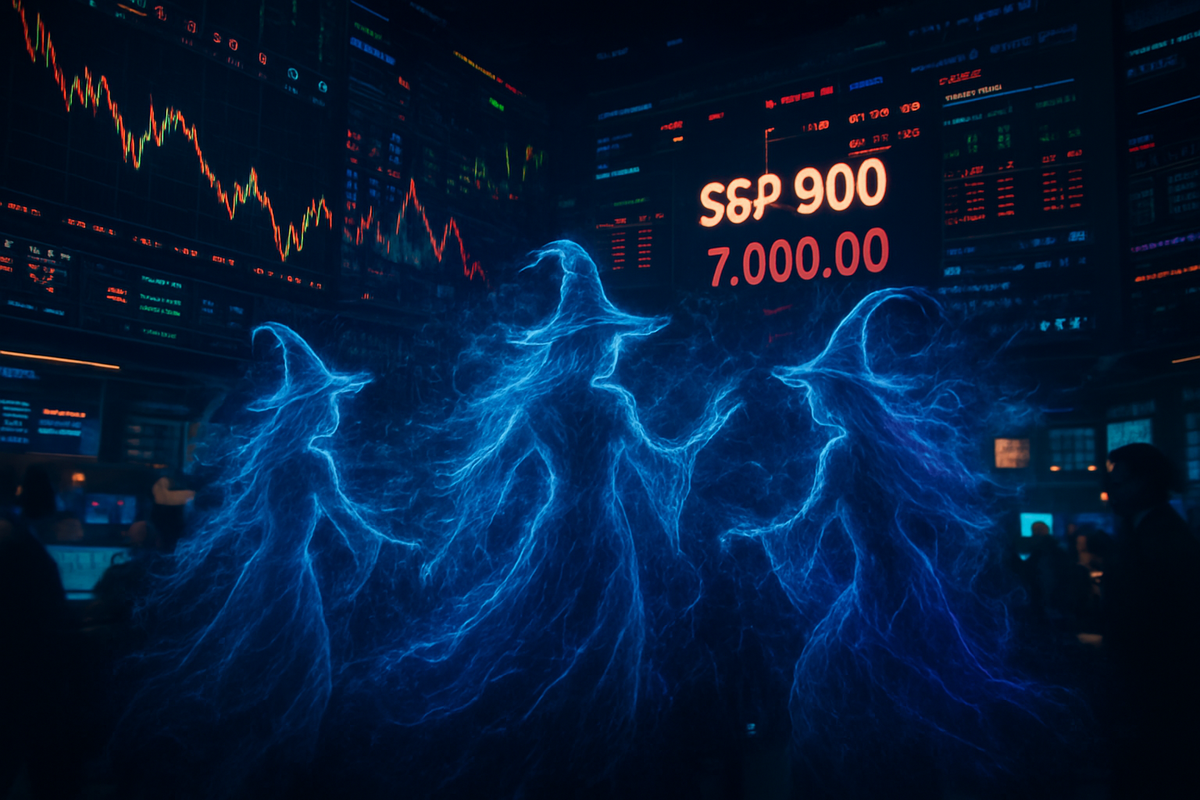
The final trading session of this week is shaping up to be a perfect storm of market-moving catalysts. On Friday, March 20, 2026, the financial markets will face the simultaneous impact of "Triple Witching"—the quarterly expiration of stock options, stock index options, and stock index futures—and the massive quarterly rebalancing of the S&P 500 index. This convergence, occurring against a backdrop of historic Federal Reserve leadership transitions and high-stakes artificial intelligence announcements, is expected to generate record-breaking trading volumes and intense price volatility.
Investors are being warned to brace for the "Triple Witching Hour," the final sixty minutes of trading between 3:00 PM and 4:00 PM ET, when institutional traders will scramble to roll over or close out billions of dollars in derivative positions. Historically, these sessions see double the average daily trading volume, but the inclusion of the S&P 500 rebalancing adds an additional layer of mandatory execution that could lead to significant "pinning" of stock prices or sudden, violent breakouts.
The Mechanics of a Market Collision
The events of March 20 are the culmination of a high-stakes month for the S&P Dow Jones Indices. Following the official announcement on March 6, 2026, the index provider detailed a significant overhaul of its flagship indices to better reflect the current dominance of the AI infrastructure and communications sectors. While the changes technically take effect before the opening bell on Monday, March 23, the practical reality is that the massive passive index funds—which manage trillions of dollars—must execute their trades at the closing price on Friday, March 20, to ensure they track the index accurately.
This rebalancing occurs just as the market processes the results of the March 17-18 FOMC meeting. With Jerome Powell’s term as Fed Chair nearing its end in May, the nomination of the hawkish Kevin Warsh as his successor has sent shockwaves through the bond and equity markets. This "Warsh Shock" has introduced a level of monetary policy uncertainty not seen in years, making the expiration of futures and options contracts on March 20 even more critical as traders hedge against a potential pivot toward higher interest rates. Furthermore, the week has been dominated by the NVIDIA (NASDAQ: NVDA) GTC 2026 conference, which has kept the technology sector in a state of heightened sensitivity.
Identifying the Winners and Losers of the Rebalance
The March 2026 rebalancing highlights a clear preference for the "backbone" of the digital economy. The most notable additions to the S&P 500 include Vertiv Holdings (NYSE: VRT), a leader in data center cooling systems, and Lumentum Holdings (NASDAQ: LITE), which specializes in optical networking. Joining them are Coherent (NYSE: COHR) and EchoStar (NASDAQ: SATS), the latter having been promoted from the S&P MidCap 400. These companies are expected to see massive inflows as index-tracking funds are forced to buy their shares by the Friday close.
On the other side of the ledger, several former market darlings are being removed from the benchmark index, likely leading to forced selling and downward price pressure. Match Group (NASDAQ: MTCH), Molina Healthcare (NYSE: MOH), Lamb Weston Holdings (NYSE: LW), and Paycom Software (NYSE: PAYC) are all being dropped from the S&P 500. Additionally, a major shakeup in the S&P 100—the index of the most elite US companies—will see semiconductor giants Micron Technology (NASDAQ: MU), Lam Research (NASDAQ: LRCX), and Applied Materials (NASDAQ: AMAT), along with GE Vernova (NYSE: GEV), added to the list. They replace long-standing household names like PayPal Holdings (NASDAQ: PYPL), American International Group (NYSE: AIG), MetLife (NYSE: MET), and Target (NYSE: TGT).
A Wider Shift in Market Sentiment and Policy
This week's volatility is about more than just a calendar quirk; it represents a broader structural shift in the global economy. The aggressive rotation from consumer-facing "Value" names like Target and PayPal into AI infrastructure plays like Vertiv and Lam Research signals that institutional investors are betting on a long-term build-out of the "AI Industrial Complex." This shift is occurring just as the S&P 500 hovers near the critical 7,000 level, a psychological barrier that has acted as a ceiling for much of the first quarter of 2026.
The historical precedent for such a convergence—Triple Witching combined with a major index rebalance and a Fed leadership change—is rare. Market analysts at major firms like Goldman Sachs have noted that the S&P 500 has been "coiling like a spring." The mandatory liquidity needs of March 20 could serve as the catalyst for a major technical move. Furthermore, the "Warsh Shock" suggests that the era of predictable, dovish monetary policy may be coming to an end, leading to a "re-pricing" of risk that will likely manifest during the high-volume environment of the Triple Witching hour.
Navigating the Post-Witching Landscape
What comes next will depend largely on where the major indices settle at the closing bell on Friday. If the S&P 500 can decisively break and hold above the 7,000 mark during the rebalancing chaos, it could signal a fresh leg of the bull market. Conversely, if the expiration of derivative contracts triggers a sell-off, the market may face a "hangover" on Monday, March 23, as the new index constituents begin their first full week of trading under increased scrutiny and higher institutional ownership.
For the companies being added, the inclusion is a seal of approval that often leads to lower cost of capital and higher liquidity. For those being removed, the challenge will be to maintain investor interest without the "automatic" bid of index funds. Strategically, we may see a pivot toward more defensive positioning by retail investors as the Fed transition proceeds. The coming months will likely see increased volatility in the semiconductor and utility sectors as the market continues to price in the massive energy demands of AI data centers.
Final Takeaways for Investors
The events of March 20, 2026, represent one of the most complex trading environments in recent memory. The combination of Triple Witching, the S&P 500 rebalancing, and the impending shift in Federal Reserve leadership creates a "triple threat" of volatility. The key takeaway for investors is that price action on this Friday may be driven more by the mechanics of index tracking and derivative expirations than by the underlying fundamentals of the companies involved.
Moving forward, the market’s health will be judged by how well it absorbs this massive injection of liquidity and how it reacts to the new monetary regime under a potentially more hawkish Fed Chair. Investors should watch the 7,000 level on the S&P 500 closely and monitor the performance of the newly added "AI backbone" stocks like Vertiv and Lumentum. The "Witching" might bring turbulence, but it also marks a new chapter for the world’s most watched stock index.
This content is intended for informational purposes only and is not financial advice.