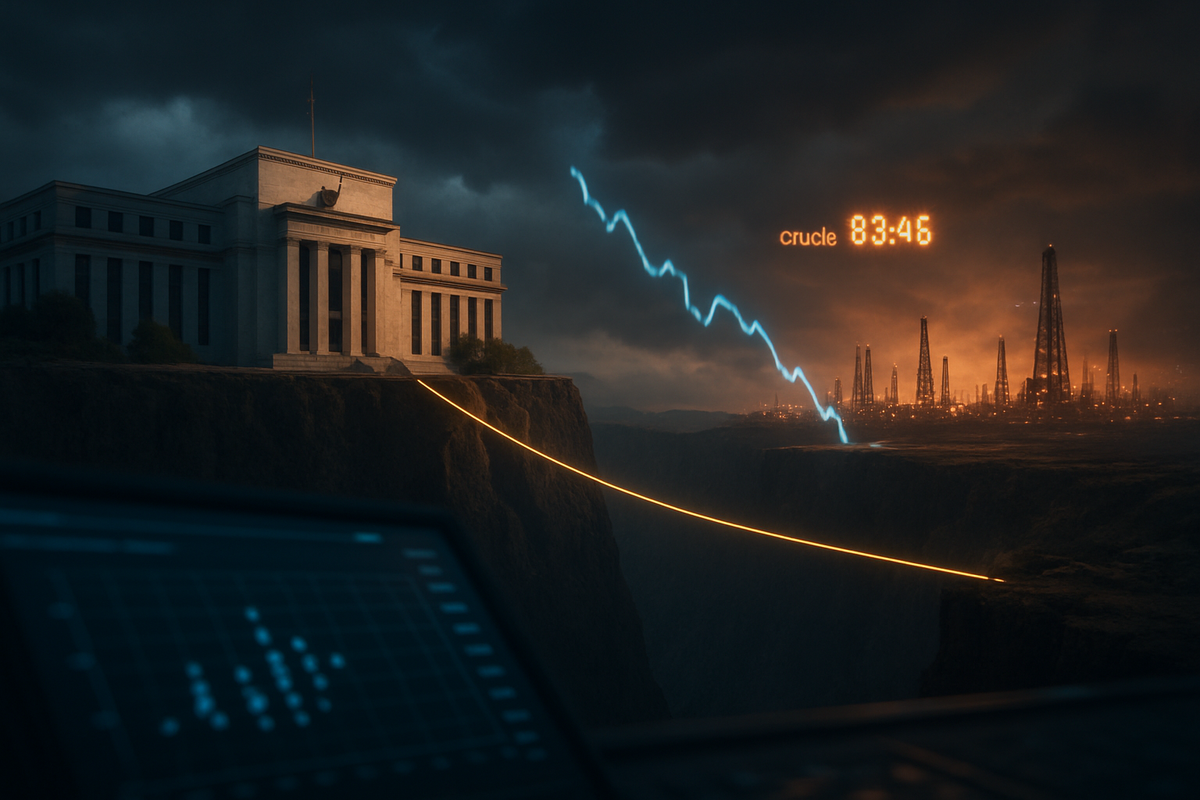
As the Federal Open Market Committee (FOMC) prepares to convene for its March 17–18, 2026, policy meeting, the global financial landscape is fraught with a degree of uncertainty not seen since the post-pandemic recovery. With the federal funds rate currently sitting at a range of 3.5% to 3.75%, market participants and institutional investors are bracing for a "hawkish hold"—a decision to keep rates steady while signaling that the era of monetary easing may be indefinitely paused. This meeting is particularly significant as it represents one of the final acts of Jerome Powell’s tenure as Chair, just two months before his term concludes on May 15.
The immediate implications for the market are stark. A sudden geopolitical flare-up in the Middle East has sent Brent crude oil prices soaring past the $100 per barrel mark, threatening to re-ignite inflationary pressures that the Fed spent years trying to extinguish. Coupled with a sharp deceleration in U.S. GDP growth at the tail end of 2025, the central bank faces a classic stagflationary dilemma: how to combat rising energy-driven prices without tipping an already cooling economy into a recession. The release of the updated Summary of Economic Projections (SEP) this Wednesday will be the definitive guide for how the Fed intends to navigate this narrow path.
The Collision of Crises: Energy Spikes and Stalling Growth
The road to this March meeting began with a series of conflicting economic signals in late 2025. After the Fed successfully implemented three consecutive rate cuts to normalize policy, the narrative of a "soft landing" was challenged by a dismal Q4 2025 GDP reading of just 0.7% growth. This slowdown was initially viewed as a temporary cooling after a robust summer, but the landscape shifted violently in early 2026. A significant escalation in Middle Eastern hostilities, specifically involving the closure of the Strait of Hormuz, has disrupted global supply chains and sent energy benchmarks like Brent crude to an intraday peak of $119.50 earlier this month.
Current market expectations, according to Fed Funds Futures, have pivoted from pricing in multiple cuts for 2026 to a "higher for longer" reality. Stakeholders including the U.S. Treasury, major commercial banks, and global trade partners are looking to the Fed for stability. The FOMC is expected to maintain the 3.5%–3.75% range, but the real story will lie in the "dot plot." Analysts at JPMorgan Chase & Co. (NYSE: JPM) and The Goldman Sachs Group, Inc. (NYSE: GS) suggest the Fed will likely revise its year-end inflation forecast for 2026 upward to 3.5%, a move that would effectively erase the possibility of any further rate relief in the first half of the year.
Winners and Losers: A Divided Corporate Landscape
The current economic cocktail of high energy prices and high interest rates is creating a clear divide among public companies. The most immediate beneficiaries are the domestic energy giants. Exxon Mobil Corporation (NYSE: XOM) and Chevron Corporation (NYSE: CVX) have seen their stock prices buoyed by the rally in crude, as higher realizations on production outweigh the broader economic malaise. Furthermore, the rising cost of natural gas, now trading near $4.00 per MMBtu, has benefited integrated energy firms that are capitalizing on record-high LNG exports to a fuel-starved Europe and Asia.
Conversely, the "losers" in this environment are increasingly visible. The airline industry is facing a double-edged sword of rising fuel costs and slowing consumer demand. Delta Air Lines, Inc. (NYSE: DAL) and other major carriers have already begun lowering guidance for the spring quarter as jet fuel prices track the surge in oil. Similarly, consumer discretionary staples like Amazon.com, Inc. (NASDAQ: AMZN) and Apple Inc. (NASDAQ: AAPL) are at risk; as gasoline prices climb toward an average of $4.50 per gallon in some regions, the "energy tax" on American households is expected to sap the spending power needed to drive tech and retail growth. For these companies, a hawkish Fed that refuses to cut rates is a further weight on their valuations.
The Policy Pivot and the Powell Legacy
The significance of this meeting extends beyond the immediate rate decision. It marks a transition of power at the world's most influential central bank. With Kevin Warsh nominated to succeed Jerome Powell, the market is closely watching for any shift in communication strategy. Warsh is historically seen as more of a hawk than Powell, and his potential influence on the committee's thinking is already being felt. The broader trend of "greenflation"—the rising cost of the energy transition—combined with the massive energy demands of AI data centers, has created a structural floor for inflation that the Fed can no longer ignore.
Historically, the Fed has looked through energy spikes as "transitory" events, but the persistence of high costs in 2026 is forcing a rethink. The historical precedent of the 1970s oil shocks looms large; the Fed is desperate to avoid the mistake of easing too soon only to see inflation expectations become "de-anchored." This explains why the upcoming SEP is expected to show a rise in the terminal rate projection, signaling to the market that the "neutral" rate of interest may be higher than previously thought in a post-globalization, energy-constrained world.
Looking Ahead: The Path to September
In the short term, the market is bracing for volatility following Wednesday’s announcement. If the Fed's dot plot shows a median expectation of zero cuts for the remainder of 2026, we could see a further sell-off in the Nasdaq and a spike in the 10-year Treasury yield. However, a "strategic pivot" remains possible if GDP growth continues to crater toward zero. Economists will be watching the unemployment projections in the SEP; if the Fed nudges its year-end unemployment forecast toward 4.6%, it may be an admission that the labor market is finally cooling under the weight of restrictive policy.
The potential for a "September Surprise" remains the base case for some optimistic traders, who believe that by late summer, the energy shock will have subsided and the Fed will have the cover to provide one 25-basis-point cut before the year's end. However, the more likely scenario is a prolonged pause. Companies will need to adapt by prioritizing debt reduction and operational efficiency, as the "cheap money" era of the early 2020s feels like a distant memory in the face of 2026's economic realities.
Conclusion: Watching the Dots
The March 2026 FOMC meeting is a watershed moment for a central bank caught between a slowing domestic economy and a global energy crisis. The key takeaways for investors will not be the rate hold itself, but the revisions to the Summary of Economic Projections and Powell’s tone during the press conference. The Fed's commitment to its 2% inflation target is being tested by geopolitical forces beyond its control, and the "higher for longer" mantra has never been more relevant.
Moving forward, the market will remain hyper-sensitive to any de-escalation in the Middle East or further signs of a consumer slowdown. For investors, the next several months should be a period of cautious positioning. Watching the interaction between the 10-year yield and energy prices will be critical, as these two factors currently hold the keys to the Fed's next move. As Powell prepares to hand over the reins, he is leaving a central bank that is once again on the front lines of a global struggle for economic stability.
This content is intended for informational purposes only and is not financial advice.