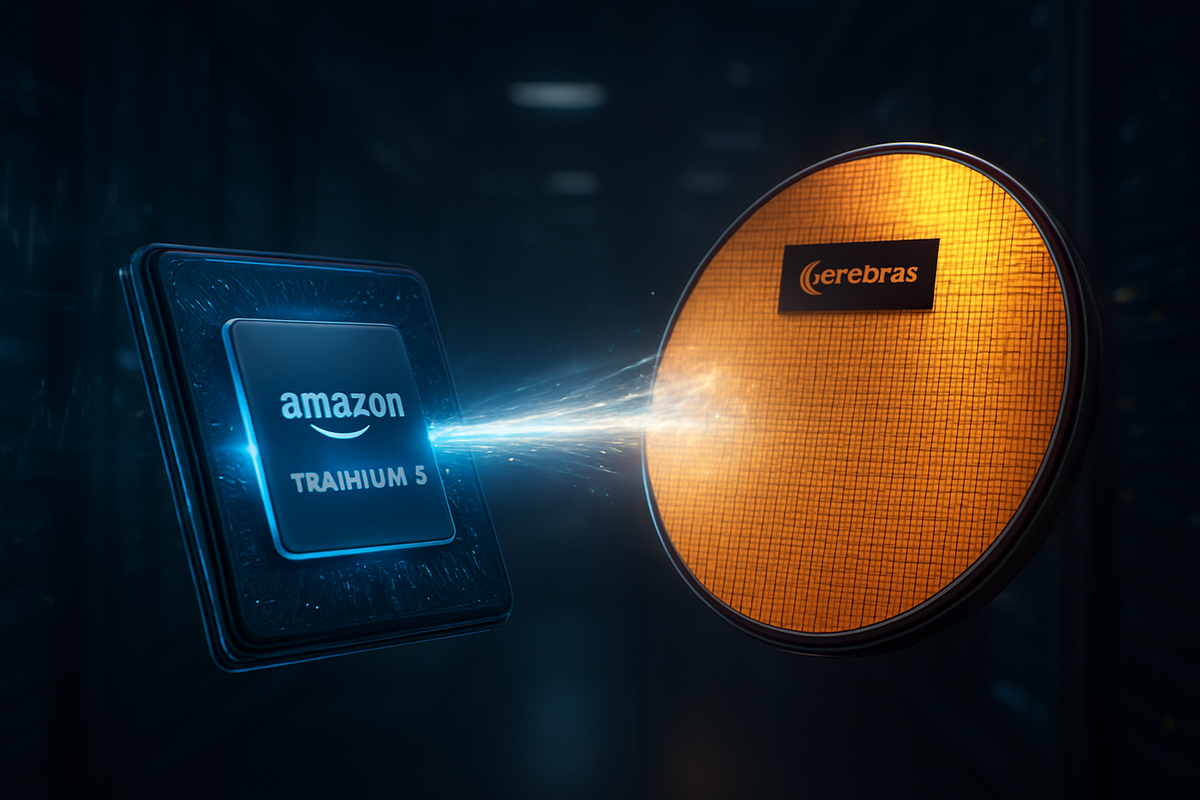
In a landmark announcement that marks a potential turning point in the AI hardware wars, Amazon Web Services (AWS), a division of Amazon.com, Inc. (NASDAQ: AMZN), and chip unicorn Cerebras Systems have unveiled a multi-year strategic partnership focused on "disaggregated inference." This novel architectural approach aims to shatter the "memory wall" that has plagued traditional graphics processing units (GPUs) and offers a direct challenge to the market dominance of Nvidia Corporation (NASDAQ: NVDA). By splitting the complex process of running large language models into two specialized hardware stages, the duo claims they can deliver inference speeds up to 21 times faster than Nvidia’s current Blackwell systems.
The immediate implications for the market are profound. As enterprises shift from training massive models to deploying them at scale, the cost and latency of "inference"—the act of the AI generating a response—have become the primary bottlenecks. By leveraging Amazon’s custom Trainium3 silicon alongside Cerebras’s massive wafer-scale engines, AWS is positioning itself as the premier destination for high-performance, low-cost AI, potentially siphoning high-margin workloads away from Nvidia’s ubiquitous ecosystem.
A Technical Marriage: Separating Prefill and Decode for Maximum Efficiency
The partnership introduces a heterogeneous architecture that treats the two phases of AI inference—the "prefill" and the "decode"—as separate engineering problems requiring different solutions. In the prefill stage, the AI ingests and processes the user's prompt, a task that is highly parallel and compute-intensive. This will be handled by AWS’s newly minted Trainium3 chips, built on a cutting-edge 3-nanometer process. Once the prompt is "understood," the system must generate a response word-by-word, a phase known as "decode" that is notoriously slowed down by the speed at which data can move from memory to the processor.
To solve the decode bottleneck, the partnership utilizes the Cerebras CS-3 system, powered by the Wafer-Scale Engine 3 (WSE-3). Unlike traditional chips, the WSE-3 is the size of a dinner plate and keeps the entire AI model's "weights" directly on the silicon. This eliminates the need for High-Bandwidth Memory (HBM) modules, allowing for data transfer speeds that are orders of magnitude faster than what is possible on a standard GPU. The two systems are tethered by AWS’s proprietary Elastic Fabric Adapter (EFA) and orchestrated via the latest version of the AWS Neuron SDK, which manages the "zero-copy" handoff of data between the Amazon and Cerebras hardware.
Industry reactions have been swift. Analysts note that this is the first time a major cloud provider has successfully integrated a third-party non-GPU accelerator so deeply into its core infrastructure. The timeline for this collaboration began in late 2024 as a series of pilot programs, accelerating through 2025 as AWS sought to reduce its reliance on Nvidia’s expensive and supply-constrained Blackwell (B200) and Blackwell Ultra (GB300) chips. Today’s announcement on March 13, 2026, cements this architecture as a flagship offering within the Amazon Bedrock platform.
Market Dynamics: Winners, Losers, and the High Stakes of Custom Silicon
Amazon (NASDAQ: AMZN) stands as the primary winner in this shift. By diversifying its hardware stack, AWS can offer lower prices to customers while maintaining higher margins, as it avoids the "Nvidia tax" on a significant portion of its infrastructure. Furthermore, AWS gains a unique selling point for its proprietary models, such as the Amazon Nova 2, which will run exclusively on this disaggregated stack to provide near-instantaneous responses for "agentic" AI tasks.
Cerebras Systems is the other clear victor. The partnership provides a massive validation of their "wafer-scale" approach just as the company prepares for its highly anticipated IPO. Currently in the middle of a roadshow led by Morgan Stanley (NYSE: MS), Cerebras has seen its private valuation soar to $23 billion following a $1 billion Series H round in February. Securing AWS as a primary partner, alongside a rumored $10 billion deal with OpenAI, positions Cerebras as the most formidable challenger to the traditional GPU status quo.
Conversely, the "disaggregated" trend poses a strategic threat to Nvidia (NASDAQ: NVDA). While Nvidia remains the king of AI training, its "monolithic" GPU architecture—where the same chip handles both prefill and decode—is increasingly seen as less efficient for specific inference tasks. Additionally, traditional memory manufacturers like Micron Technology (NASDAQ: MU) and SK Hynix (KRX:000660) could face headwinds if the Cerebras model of "on-chip memory" gains broader adoption, as it bypasses the need for the massive HBM stacks that have driven record profits for memory makers over the last two years.
Beyond the Monolith: The Shift Toward Disaggregated AI Architectures
This event fits into a broader industry trend toward specialization. For the past decade, the general-purpose GPU was the undisputed tool for all AI tasks. However, as models have grown to trillions of parameters, the industry is reaching the physical limits of how much memory and compute can be packed into a single standard-sized chip. The Amazon-Cerebras partnership proves that the future of the data center may not be a row of identical racks, but a "disaggregated" factory where different silicon handles different parts of the thought process.
The ripple effects are already being felt across the competitive landscape. Oracle (NYSE: ORCL) has signaled interest in similar specialized clusters, and Microsoft Azure is rumored to be fast-tracking its own "Maia" chip revisions to support disaggregated workloads. Historically, this mirrors the evolution of the early internet, where general-purpose servers eventually gave way to specialized hardware for load balancing, storage, and security.
From a regulatory perspective, this move may actually ease some pressure on the industry. By creating a viable alternative to Nvidia, Amazon and Cerebras are providing a "market-based solution" to the concerns of a hardware monopoly that have been raised by trade commissions globally. It demonstrates that the AI market is still capable of radical innovation and that the "Nvidia moat" is not impenetrable.
The Road Ahead: IPOs, Keynotes, and the Next Frontier of Compute
In the short term, all eyes will be on the Cerebras IPO, expected to hit the markets in Q2 2026. A successful debut would provide the capital necessary for Cerebras to scale its manufacturing and challenge Nvidia on more fronts. Meanwhile, the tech world is bracing for Nvidia’s GTC 2026 keynote on March 16. CEO Jensen Huang is widely expected to respond to the disaggregated threat by showcasing the "Vera Rubin" platform (VR200), which reportedly features its own form of "NVLink Fusion" to allow for more flexible hardware configurations.
Strategically, the next phase of this battle will be fought over "Agentic AI." As AI models are expected to work autonomously for hours—performing research, writing code, and executing tasks—the cost per token becomes the most critical metric. If the Amazon-Cerebras partnership can consistently deliver 50% lower operational costs, as early benchmarks suggest, we may see a mass migration of AI startups away from standard GPU clouds and toward specialized inference engines.
Final Verdict: A New Standard for Generative AI Performance
The partnership between Amazon and Cerebras is more than just a business deal; it is a declaration that the era of the one-size-fits-all AI chip is coming to an end. By successfully disaggregating the inference process, AWS has demonstrated a path toward scaling AI that is faster, cheaper, and more efficient than the traditional GPU path. This move successfully leverages Amazon's scale and custom silicon expertise with Cerebras’s radical engineering to create a competitive "moat" that will be difficult for rivals to replicate quickly.
For the market, this signals a transition from the "build-out" phase of AI—where companies bought every chip they could find—to the "optimization" phase, where architectural efficiency determines the winners. Investors should closely watch Nvidia’s response at GTC next week and the pricing of the Cerebras IPO. The performance of the first "disaggregated" clusters on Amazon Bedrock over the coming months will likely dictate the hardware roadmap for the rest of the decade.
This content is intended for informational purposes only and is not financial advice.