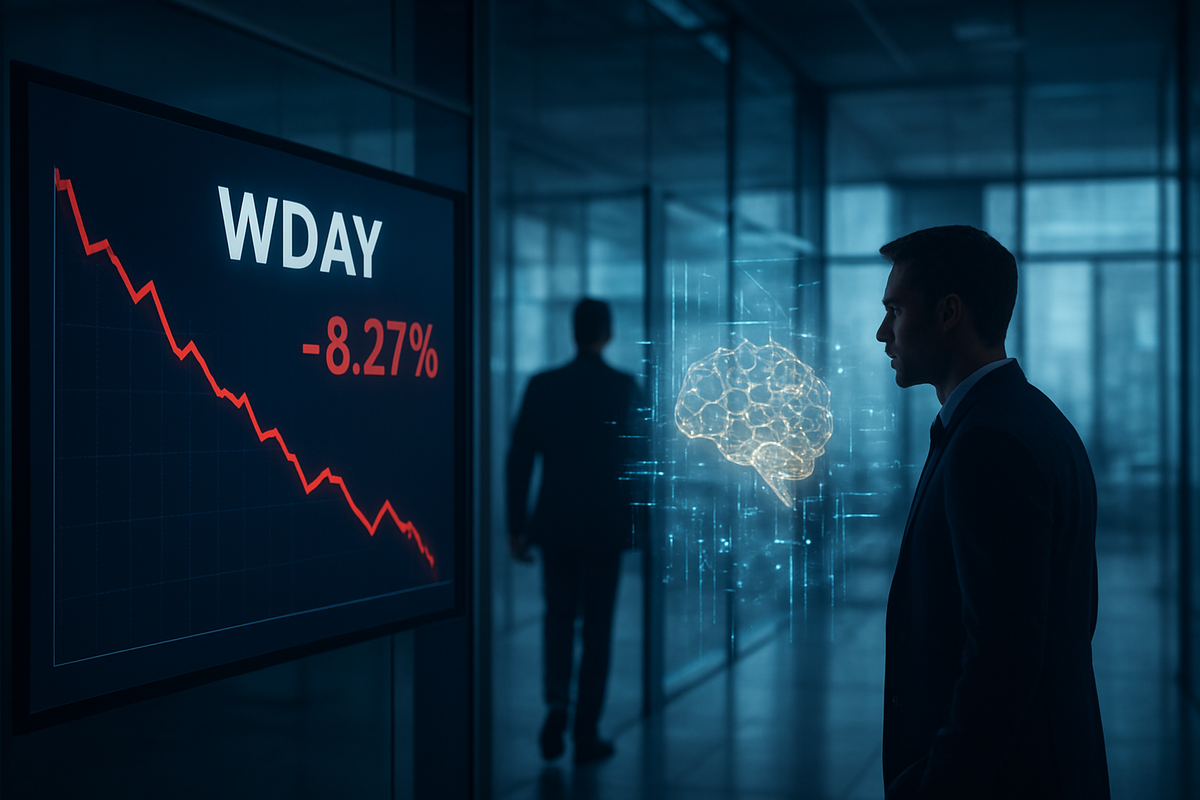
The enterprise software landscape was sent into a tailspin on Monday as Workday (NASDAQ: WDAY) announced a dramatic leadership overhaul, seeing co-founder Aneel Bhusri return to the helm as Chief Executive Officer. The move, which effectively ends the two-year tenure of Carl Eschenbach, triggered an immediate and sharp sell-off in the markets. By the closing bell on February 9, 2026, Workday shares had plummeted more than 8%, hitting a fresh 52-week low as investors grappled with the sudden departure of a leader once hailed as the architect of the company’s operational maturity.
The leadership shakeup comes at a precarious moment for the Pleasanton-based human capital management giant. Beyond the executive suite, the company also confirmed a fresh round of job cuts, reducing its global workforce by approximately 2%. This double-hit of executive instability and corporate streamlining has raised urgent questions about Workday’s ability to defend its market share against increasingly aggressive AI-native competitors and legacy rivals who have successfully modernized their cloud offerings.
A Sudden Pivot in the C-Suite
The announcement on February 9 caught Wall Street off guard, marking the end of Carl Eschenbach’s brief era as the sole leader of the company. Eschenbach, who joined as co-CEO in late 2022 and took the reigns fully on February 1, 2024, will transition to a role as a strategic advisor. While the board characterized the move as a planned evolution to navigate the "pivotal AI era," the market’s reaction suggested a lack of confidence in the timing. WDAY shares fell 8.27% to open at $149.67, eventually bottoming out near $147.35 during intraday trading.
The timeline leading to this leadership "reset" suggests growing internal pressure. Despite Eschenbach’s success in scaling Workday’s EMEA business to over $1 billion in annual recurring revenue, the stock has significantly underperformed the broader tech sector over the past 12 months. Activist investors, who reportedly took a multi-billion dollar stake in the company in late 2025, have been vocal about the need for higher margins and a clearer roadmap for AI monetization. The 2% workforce reduction announced just days prior on February 4 was seen as a precursor to today’s news, signaling a desperate need to align the company's cost structure with its slowing subscription growth.
Winners and Losers in the Enterprise Cloud War
In the immediate wake of Workday’s turbulence, its primary competitors appear to be the primary beneficiaries. SAP (NYSE: SAP) and Oracle (NYSE: ORCL) have both seen their cloud ERP suites outpace Workday in recent quarters. SAP, in particular, has successfully migrated a massive portion of its on-premise base to the cloud, with growth rates nearly double those of Workday’s in 2025. As Workday deals with internal restructuring, these legacy giants are likely to capitalize on the uncertainty to lure away large enterprise clients who prioritize platform stability over founder-led vision.
The "losers" in this scenario are undoubtedly the long-term Workday shareholders and the employees caught in the crossfire of restructuring. The 8% drop wiped out billions in market capitalization in a single session. For the roughly 400 employees impacted by the 2% layoff—mostly in non-revenue generating roles within Global Customer Operations—the news is a grim reminder of the "efficiency first" mandate currently gripping the SaaS sector. Furthermore, the reputational hit to Eschenbach, a seasoned veteran from Sequoia Capital and VMware, may lead to questions about whether "operational discipline" is enough to satisfy a board looking for a "visionary" pivot.
The 'Boomerang CEO' and the AI Existential Threat
Workday’s decision to bring back Bhusri fits into a larger, albeit controversial, industry trend: the "Boomerang CEO." Tech history is filled with founders returning to save their creations, from Steve Jobs at Apple (NASDAQ: AAPL) to Bob Iger at Disney (NYSE: DIS) and Howard Schultz at Starbucks (NASDAQ: SBUX). The rationale is almost always the same—a belief that only a founder possesses the cultural authority and creative risk-taking required to navigate a period of existential threat. In Bhusri’s case, that threat is Artificial Intelligence.
Bhusri has characterized the current AI shift as a "larger transformation than SaaS itself." This event signifies a broader industry trend where "System of Record" companies are struggling to transform into "Systems of Intelligence." While competitors like Salesforce (NYSE: CRM) have been aggressive in deploying AI agents that offer immediate ROI, Workday’s transition has been viewed as slower and more capital-intensive. The return of the founder is a high-stakes gamble that Bhusri can repeat his success of 2005, when he and Dave Duffield built Workday from the ashes of a hostile takeover of PeopleSoft.
The Road Ahead: Stabilization or Stagnation?
As Workday looks toward its full-year fiscal 2026 earnings report on February 24, all eyes will be on Bhusri to provide a concrete strategic roadmap. In the short term, the company must stabilize its stock price and reassure its 65 million users that the leadership change will not disrupt product delivery. The long-term challenge is far more daunting: Bhusri must successfully integrate the flurry of AI-focused acquisitions made in 2025, such as Sana Labs and Pipedream, into the "Workday Illuminate" platform to prove that the company is not becoming a legacy vendor.
The market will be watching for potential strategic pivots, including more aggressive M&A or perhaps a further sharpening of the workforce if margins do not improve by the second half of 2026. The primary scenario for success involves Bhusri using his product expertise to out-innovate the nimble AI startups currently eating at the edges of the HR and Finance software markets. Conversely, if the leadership change is seen merely as a nostalgic retreat rather than a forward-looking surge, Workday could become a prime target for private equity or a larger tech conglomerate looking to acquire a massive, though slowing, install base.
A Crucial Crossroad for an Industry Titan
The events of February 9, 2026, mark a defining moment in Workday’s history. The 8% stock decline is a clear signal from the market: sentiment has shifted from patience to skepticism. While the return of a beloved founder like Aneel Bhusri often provides a morale boost internally, it rarely offers an immediate fix for the structural pressures of a maturing industry and a rapidly evolving technological landscape.
Investors should remain cautious in the coming months, paying close attention to the February 24 earnings call and the company's ability to retain key engineering talent amidst the ongoing layoffs. The narrative of Workday is no longer just about cloud growth; it is now a story of survival and reinvention in the age of AI. Whether Bhusri can recapture the lightning in a bottle that launched Workday two decades ago remains the billion-dollar question for the enterprise software world.
This content is intended for informational purposes only and is not financial advice.