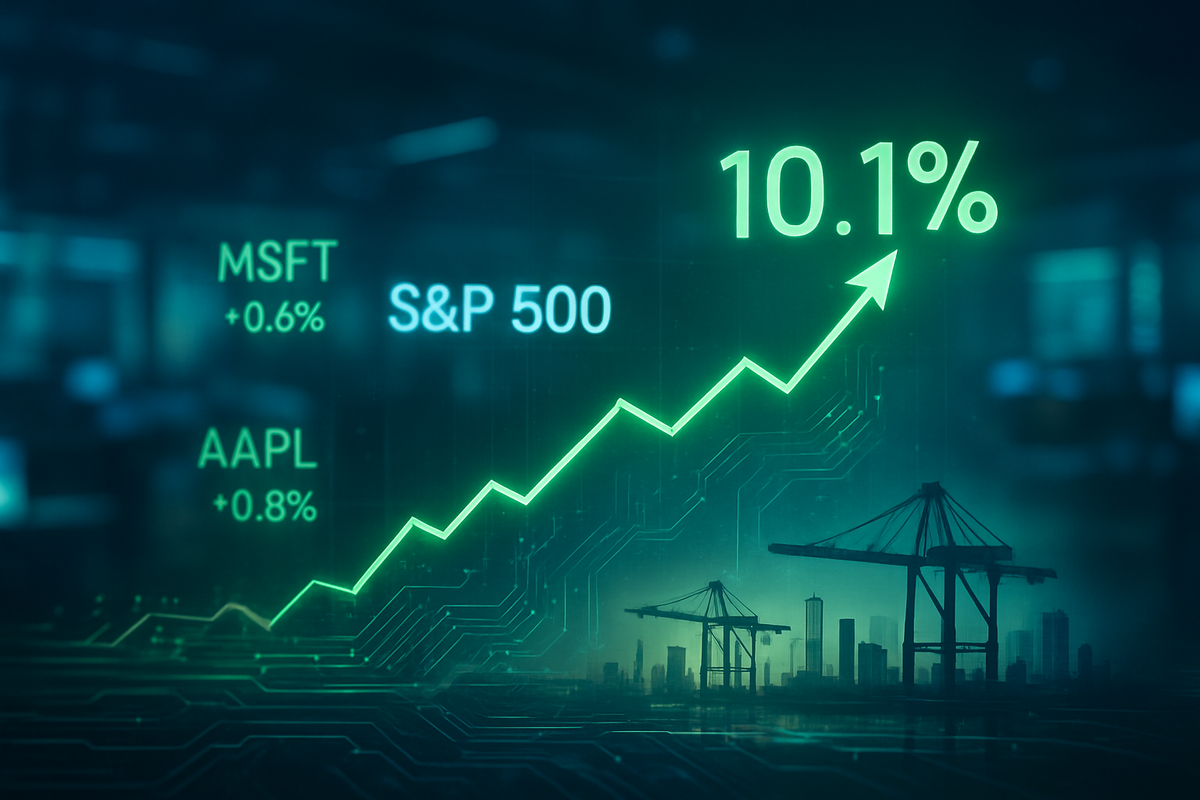
The fourth-quarter earnings season of 2025 has reached a fever pitch, delivering a resounding message of resilience to Wall Street. As of February 6, 2026, the S&P 500 has reported an aggregate year-over-year earnings growth of 10.1%, a figure that has silenced skeptics who feared a late-cycle slowdown. This double-digit expansion has been catalyzed by a staggering 25% surge in the Information Technology sector, underscoring the enduring power of the artificial intelligence (AI) revolution and its transition from a speculative trend into a fundamental profit driver.
The immediate implications of this performance are profound. For much of 2025, market participants were concerned that the "Magnificent Seven" dominance was creating a fragile, top-heavy market. However, the Q4 data suggests a healthy "broadening out" effect. While technology remains the primary engine, eight out of eleven sectors are now reporting year-over-year growth, providing the index with a sturdier foundation. This widespread profitability is offering a crucial buffer against persistent interest rate uncertainty, as strong corporate balance sheets mitigate the impact of "higher-for-longer" monetary policies.
The Q4 Surge: Data Centers and AI Monetization
The timeline of the current earnings cycle began in mid-January with the major banks, but the narrative shifted dramatically when the heavyweight technology and industrial firms took the stage. Initially, analysts expected a modest 8.3% growth rate for the S&P 500. However, as the reports from late January rolled in, the "blended" growth rate—which combines actual results with estimates for companies yet to report—quickly climbed to 10.1% and has since trended even higher toward 12.1%. The core of this outperformance has been the technology sector, where the "AI arms race" has moved into its second phase: monetization.
Key players like Microsoft (NASDAQ: MSFT) and Meta Platforms (NASDAQ: META) have set a high bar, reporting that their massive capital expenditures in AI are finally yielding measurable top-line growth. The reaction from the industry has been one of validation. In the final weeks of January, the S&P 500 hit several all-time highs as investors processed the fact that profit margins are not just holding steady but expanding. The current net profit margin for the index sits at a robust 13.2%, one of the highest levels on record, proving that American corporations have successfully navigated the inflationary pressures that dominated the previous two years.
Winners and Losers: A Tale of Two Economies
The clear victors of the Q4 season are the companies positioned at the intersection of digital and physical infrastructure. Microsoft (NASDAQ: MSFT) reported a blowout quarter with revenue reaching $81.3 billion, driven by a 40% jump in Azure cloud growth. Similarly, Apple (NASDAQ: AAPL) defied global supply chain jitters to post revenue of $143.8 billion, fueled by record-breaking demand for the iPhone 17. Perhaps most surprising was the strength in the industrial sector. Caterpillar (NYSE: CAT) emerged as a massive winner, posting an adjusted EPS of $5.16. The company’s record $51 billion backlog is largely due to the demand for massive generator sets required to power the very data centers that the tech giants are building. GE Aerospace (NYSE: GE) also joined the winner's circle, with orders up 74% as the global aviation and defense sectors continue to accelerate.
On the other side of the ledger, the Health Care and Energy sectors have struggled to maintain pace, becoming the primary "losers" of the cycle. UnitedHealth Group (NYSE: UNH) saw its shares plummet nearly 20% after reporting rising medical care ratios and a disappointing outlook for Medicare Advantage rates. Pfizer (NYSE: PFE) also faced a difficult quarter, reporting a GAAP net loss of $0.29 per share due to heavy restructuring charges and a $4.4 billion non-cash impairment. In the Energy space, even a revenue beat couldn't save ExxonMobil (NYSE: XOM) from a post-earnings slide; investors were spooked by falling year-over-year net income as global oil prices faced oversupply pressure, making the sector a rare laggard in an otherwise buoyant market.
Wider Significance: The AI Infrastructure Ripple Effect
This earnings cycle marks a pivotal moment in the current decade’s economic history. It confirms that AI is no longer just a "tech story" but a macro-economic catalyst that is boosting the Industrials and Utilities sectors. The 25% growth in Tech, coupled with the 25.6% growth in Industrials, suggests a synergy between software and hardware that hasn't been seen since the build-out of the early internet. This event fits into a broader trend of "re-industrialization," where the demand for high-tech manufacturing and energy-efficient infrastructure is creating a new class of market leaders.
Historically, such concentrated growth in one or two sectors often precedes a market correction. However, the current "broadening" suggests that the ripple effects are supporting the wider economy. Regulatory scrutiny remains a potential hurdle, particularly for Big Tech’s acquisition strategies, but the sheer scale of the Q4 earnings beats has, for now, overshadowed policy risks. For competitors, the message is clear: those who failed to invest in digital efficiency or AI integration during the 2023-2024 window are now finding themselves at a structural disadvantage, as evidenced by the widening gap between the sector leaders and laggards.
What Comes Next: All Eyes on the Next Frontier
Looking forward, the market’s attention is already pivoting toward the remainder of 2026. The most immediate catalyst will be the earnings report from NVIDIA (NASDAQ: NVDA) on February 25. As the primary provider of the chips that power the AI boom, NVIDIA’s results will serve as a definitive health check for the entire ecosystem. Short-term, the challenge for the S&P 500 will be maintaining its current valuation; with a forward P/E ratio of 22.2, the index is trading well above its 10-year average, leaving little room for error in the coming quarters.
Strategic pivots are likely as companies in laggard sectors like Health Care seek to replicate the efficiency gains seen in Tech. We may see a wave of consolidation in the Energy and Consumer Discretionary sectors as firms look to gain scale and protect margins. The primary scenario for the next six months is one of continued "stealth" growth, where the index continues to climb not because of a single sector's hype, but because of a collective improvement in operational efficiency and a stabilizing macroeconomic environment.
Summary and Investor Outlook
The Q4 2025 earnings season has been a landmark event for the S&P 500. With 10.1% overall growth and a 25% explosion in the tech sector, the market has demonstrated a remarkable ability to generate profit despite high interest rates. The key takeaway for investors is the transition from a tech-exclusive rally to a broader, more sustainable expansion that includes Industrials and Services. This shift suggests that the "bull market" has entered a more mature, yet still powerful, phase of its life cycle.
As we move deeper into 2026, the market appears positioned for continued gains, provided that inflation remains contained and the AI infrastructure build-out continues unabated. Investors should keep a close watch on the upcoming NVIDIA (NASDAQ: NVDA) report and any potential shifts in consumer spending, which remains the one "wild card" in an otherwise stellar corporate landscape. For now, the "earnings power" of Corporate America remains the undisputed champion of the market narrative.
This content is intended for informational purposes only and is not financial advice.