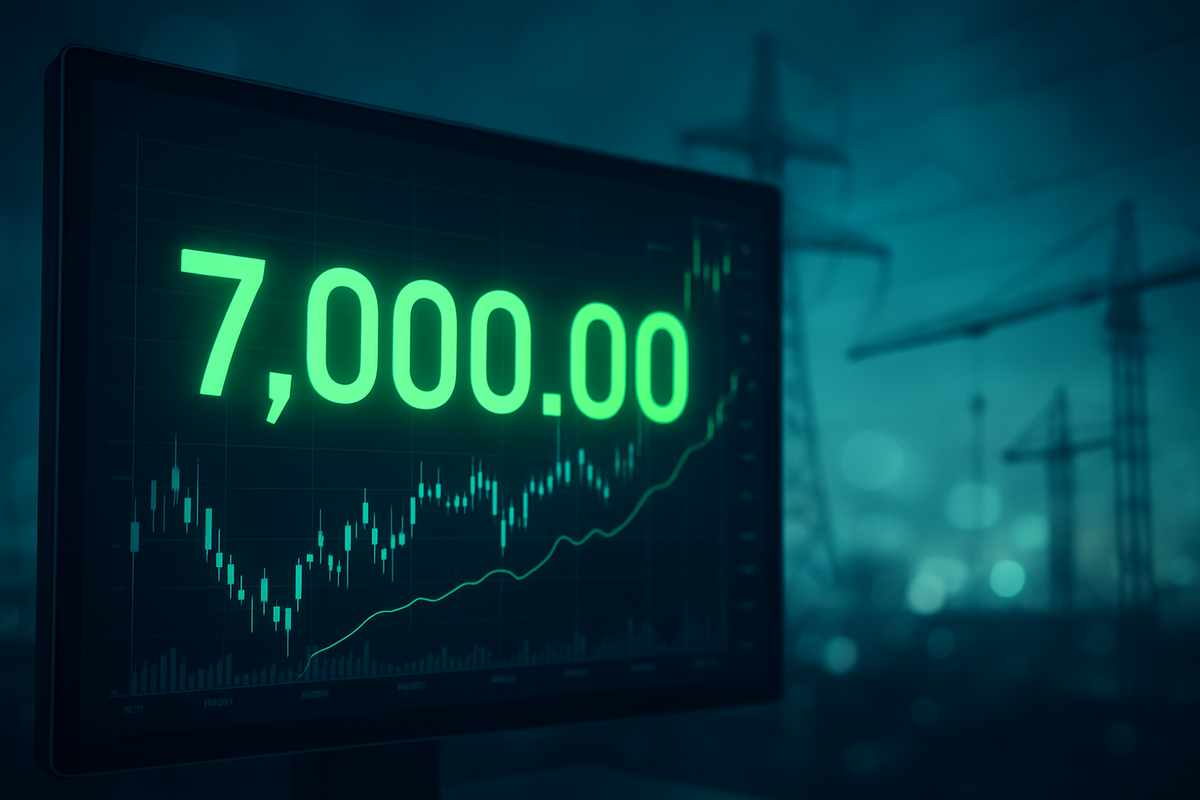
NEW YORK — In a milestone that once seemed years away, the S&P 500 (NYSEARCA: SPY) has officially breached the historic 7,000 level, marking a new frontier for American equity markets. This psychological and structural barrier was finally broken in late January 2026, culminating a relentless 14-month climb from the 6,000 mark reached in late 2024. As of February 25, 2026, the index continues to oscillate around this heavyweight level, signaling a market that is transitioning from a narrow, AI-driven sprint into a broader, industrially-supported marathon.
The breach of 7,000 is not merely a number on a screen; it represents a fundamental shift in investor psychology and the culmination of several overlapping economic cycles. While megacap technology firms provided the initial fuel for the ascent, the final push was powered by a "Great Rotation" into tangible sectors like Industrials and Utilities. However, as the index grapples with a "Gamma Wall" of derivatives at the 7,000 strike price, market participants are left questioning whether this milestone is a sustainable floor or a precarious ceiling in an era of shifting fiscal priorities and evolving AI capital expenditures.
The 14-Month Sprint: From 6,000 to the 7,000 Frontier
The journey to 7,000 began in earnest on November 11, 2024, when the S&P 500 first closed above 6,000. What followed was one of the most efficient 1,000-point gains in the history of the New York Stock Exchange. The timeline of this ascent was punctuated by several key catalysts, most notably the "One Big Beautiful Bill Act" (OBBBA) signed in July 2025. This massive fiscal package provided the liquidity and tax incentives necessary to extend corporate tax cuts and allow for immediate expensing of R&D, providing a second wind to a bull market that many feared was aging.
By October 2025, the index had reached 6,750, driven by a speculative "melt-up" in semiconductor valuations. NVIDIA (NASDAQ: NVDA) played a starring role, hitting a staggering $5 trillion market capitalization during that period. The final leg of the journey occurred during the second half of 2025 as the Federal Reserve initiated a "steady easing" cycle, delivering three consecutive 25-basis-point cuts that brought the federal funds rate down to a target range of 3.50%–3.75%. This accommodative posture, combined with resilient corporate earnings, allowed the S&P 500 to briefly touch an intraday high of 7,002.28 on January 28, 2026.
The reaction from Wall Street has been a mixture of jubilation and caution. While permabulls like Tom Lee of Fundstrat (who predicted this level back in late 2024) feel vindicated, many institutional "whale" investors have begun trimming their positions. The market’s inability to decisively hold a close above 7,000 throughout February 2026 highlights the technical resistance inherent at such a major psychological level. Traders point to a "Gamma Wall" where market makers are forced to hedge massive concentrations of call options, effectively pinning the index in a tight range between 6,850 and 6,980.
Winners and Losers: The Great Rotation in Play
The climb to 7,000 has not been a "rising tide lifts all boats" scenario. Instead, it has been defined by a stark divergence between the winners of the "AI Super-Cycle" and the laggards of the old economy. Among the clear victors, Meta Platforms (NASDAQ: META) stood out in late 2025, reporting record revenues that defied skeptical guidance on its $135 billion AI capex. Similarly, the Utilities sector (NYSEARCA: XLU) underwent a metamorphosis from a defensive bond-proxy to a high-growth AI infrastructure play. GE Vernova (NYSE: GEV) emerged as a standout performer, benefiting from the voracious power demands of the nation’s expanding data center footprint.
However, the "Magnificent Seven" leadership that characterized 2023 and 2024 has begun to fracture. Microsoft (NASDAQ: MSFT) saw its shares stall in late 2025 as Azure growth stabilized, missing the "whisper numbers" that institutional investors demanded. Apple (NASDAQ: AAPL) and Tesla (NASDAQ: TSLA) have faced even steeper challenges; Tesla, in particular, struggled as Cybertruck sales cooled by nearly 50% in 2025, forcing investors to shift their focus toward long-term Robotaxi and SpaceX-related catalysts. In the broader market, the Consumer Discretionary sector (NYSEARCA: XLY) has been the primary loser, with legacy brands like Nike (NYSE: NKE) and Lululemon (NASDAQ: LULU) trailing the S&P 500 by as much as 60% as consumer preferences shifted toward "experience over goods."
Financials (NYSEARCA: XLF) also faced a turbulent start to 2026. Despite a strong performance throughout 2025, the sector dropped nearly 7% in early February 2026. This pullback was driven by political uncertainty regarding proposed caps on credit card interest rates and a post-earnings "sell the news" event across the major money-center banks. In contrast, the S&P 500 Equal Weight Index (NYSEARCA: RSP) has begun to outperform its market-cap-weighted counterpart, signaling that the rally is finally broadening out to include mid-cap industrials and materials firms that are benefiting from the OBBBA infrastructure push.
Structural Shifts and Historical Precedents
The S&P 500 reaching 7,000 fits into a broader trend of "AI-driven productivity" that many economists compare to the 1990s internet boom, albeit at a much faster pace. The 14-month journey from 6,000 to 7,000 is almost identical in speed to the prior 1,000-point gain, suggesting a market that is moving in "hyper-drive." Historically, when the S&P 500 crosses such significant century marks, it often enters a period of high volatility as the market "tests" the new floor. The current environment mirrors the 1999-2000 period in its tech-concentration, but with a crucial difference: the current leaders are generating massive, tangible cash flows, unlike the speculative "dot-coms" of yesteryear.
Regulatory and policy implications are also looming large. The "One Big Beautiful Bill Act" provided the fiscal tailwind for this milestone, but it has also raised concerns about long-term deficit spending. As the Federal Reserve pauses its easing cycle in early 2026, the market is now forced to stand on its own feet without the constant promise of "lower for longer" rates. Furthermore, the rising dominance of private credit and multi-strategy "pod shops" like Point72 and Citadel—who moved aggressively into physical commodities and defensive positions in early 2026—suggests that the "smart money" is preparing for a shift from pure growth to value and volatility protection.
Geopolitical tensions also serve as a backdrop to this milestone. The "Tariff Shock" fears and potential trade escalations mentioned in recent institutional reports have kept a lid on the market's enthusiasm. While the 7,000 level is a cause for celebration, it also serves as a reminder of the "valuation gap" between the US and the rest of the world. With US equities trading at significant multiples compared to European and Emerging markets, the 7,000 level may prompt a global rebalancing of portfolios as investors look for more attractively priced opportunities outside of the S&P 500's top holdings.
What Comes Next: Consolidation or Correction?
Looking ahead, the market faces two primary scenarios. The bullish case, championed by those eyeing 7,200, relies on a "gamma squeeze" where a decisive move above 7,020 forces market makers to buy back futures, catapulting the index higher. This would likely require a strong Q1 2026 earnings season from the remaining tech titans and a continued expansion of market breadth. If the Equal Weight Index (RSP) continues to lead, it would suggest a healthy transition into a "cyclical bull market" that could last through the remainder of the year.
The bearish case focuses on the 6,800 "line in the sand." Technical analysts warn that a failure to hold this support level could trigger a 5–10% correction as the "AI hype" meets the reality of high capital expenditures and stabilizing growth rates. Strategic pivots will be required for investors who have been overweight in "software middlemen" like Salesforce (NYSE: CRM), which have struggled to prove their value in a world where hardware and raw power are currently king. The emergence of "defensive growth" in the Utilities and Industrials sectors suggests that the next phase of the market will favor companies with high-quality balance sheets and "moat-heavy" business models.
A New Frontier for Investors
The S&P 500's breach of 7,000 is a testament to the resilience of the American economy and the transformative power of the AI era. However, the milestone also marks a transition point where the easy gains of the "melt-up" may be behind us. Moving forward, the market will likely be defined by "selective cyclicality," where picking the right sectors—and even the right companies within those sectors—becomes more important than simply "buying the index." The "Great Rotation" from pure-play tech into infrastructure and power-related utilities is a trend that appears to have significant staying power.
For investors, the coming months will be a period of "wait-and-see." Key indicators to watch include the Federal Reserve's next move in its "wait-and-see" pause, the durability of the 6,800 support level, and whether the "One Big Beautiful Bill Act" continues to provide a meaningful lift to domestic industrials. While 7,000 is a historic achievement, the real test will be whether the market can turn this psychological ceiling into a structural floor for the next leg of the American bull market.
This content is intended for informational purposes only and is not financial advice.