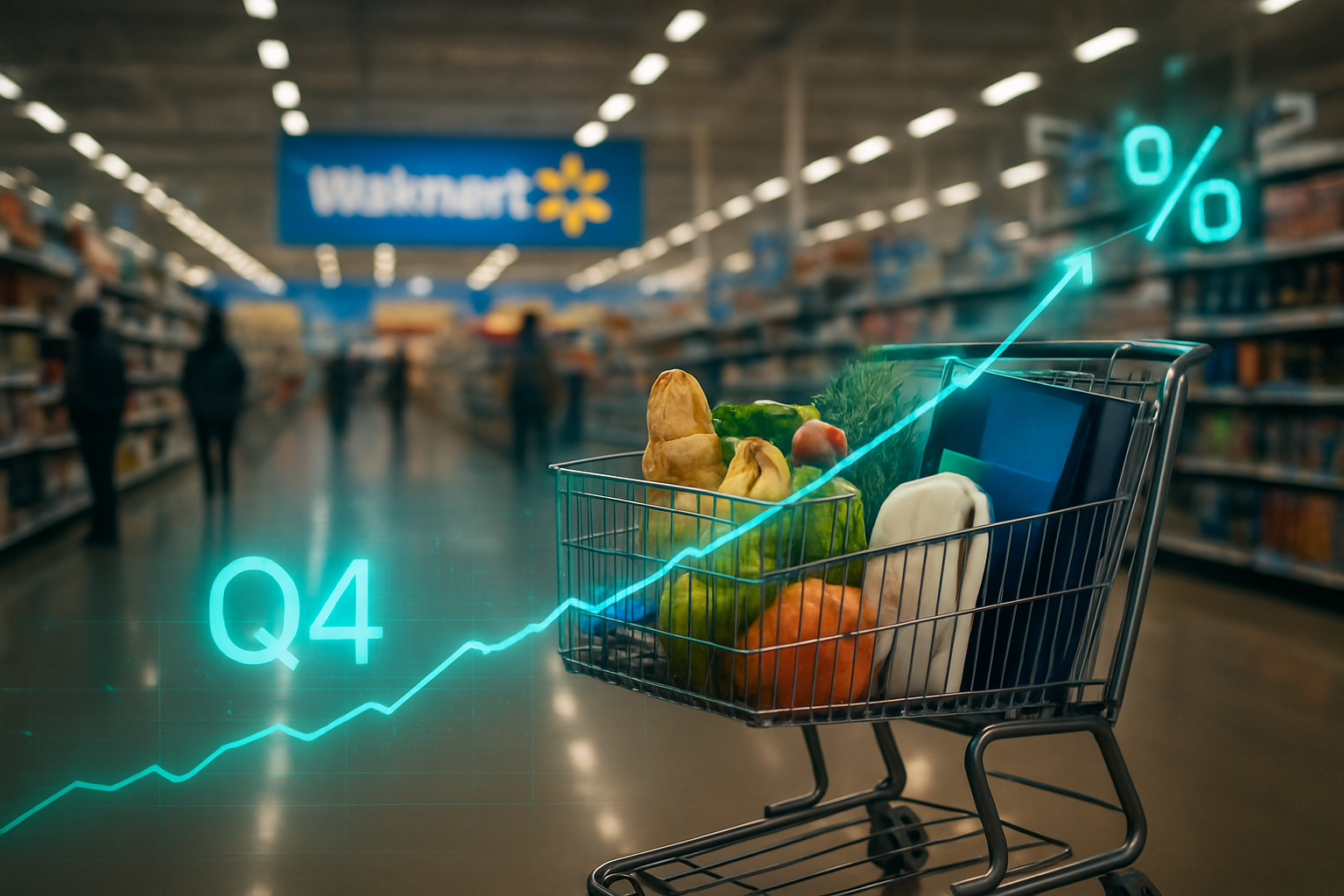
As the retail landscape braces for the final tallies of the fiscal year, all eyes are on Walmart (NYSE: WMT), which is scheduled to report its fourth-quarter 2026 earnings on the morning of February 19. Two days ahead of the release, the consensus among analysts is that the Bentonville giant has not only weathered the storm of cooling inflation but has fundamentally shifted its market position to capture a more affluent demographic. This report is widely seen as the definitive "pulse check" on the American consumer, coming off a holiday season where spending remained surprisingly robust despite high-interest rates and global economic uncertainty.
The stakes for this earnings release are historically high. Earlier this month, Walmart officially joined the exclusive $1 trillion market-capitalization club, a milestone that reflects investor confidence in its pivot toward high-margin services like advertising and automated logistics. However, with the stock trading at a premium valuation, the market is looking for more than just a beat on the top and bottom lines; investors are searching for reassurance that the consumer "trade-down" effect is a permanent structural shift rather than a temporary reaction to past inflationary pressures.
The Numbers Behind the Retail Powerhouse
Analysts are projecting a strong finish to the 2026 fiscal year for Walmart. The consensus estimate for adjusted earnings per share (EPS) sits at $0.73, representing a nearly 10% increase over the $0.66 reported in the same quarter last year. Revenue expectations are equally ambitious, with forecasts ranging between $188.6 billion and $190.5 billion. If these numbers hold, it would mark a year-over-year revenue increase of roughly 6%, a significant feat for a company of Walmart’s scale. U.S. comparable sales, excluding fuel, are expected to grow by approximately 4.1%, driven largely by a 4.1% surge in foot traffic observed throughout January 2026.
The timeline leading to this moment has been defined by Walmart’s aggressive capture of market share. Throughout late 2025 and into early 2026, the company reported that approximately 75% of its market share gains came from households with annual incomes exceeding $100,000. This demographic, traditionally the stronghold of more specialized retailers, has increasingly turned to Walmart for its "Everyday Low Price" (EDLP) promise on groceries and essentials. Key stakeholders, including new CEO John Furner, have attributed this success to a "store-as-hub" strategy, which has transformed 4,700 U.S. locations into sophisticated distribution centers capable of reaching 95% of the American population with same-day delivery.
Winners and Losers in the Value Shift
In the current environment, Walmart appears to be the undisputed leader, but the ripple effects across the sector are uneven. Amazon (NASDAQ: AMZN) remains a formidable rival, recently reporting a massive $213.4 billion in Q4 revenue. While Amazon’s scale is unmatched, its slight miss on earnings earlier this month suggests that its massive $200 billion capital expenditure plan for 2026—focused heavily on AI and AWS—might be putting temporary pressure on margins. Walmart, by contrast, is seeing its margins expand as its e-commerce division finally reached a critical threshold of profitability this year, bolstered by its high-margin advertising arm, Walmart Connect, which saw growth exceeding 30%.
On the losing end of this "value migration" is Target (NYSE: TGT). Set to report in early March, Target is facing a projected 10% year-over-year decline in EPS. The retailer has struggled to maintain momentum in discretionary categories like home goods and apparel, which have been hit harder by the cautious spending habits of the middle class. While Walmart’s January foot traffic jumped 4.1%, Target managed only a meager 0.7% increase. Meanwhile, off-price retailers like TJX Companies (NYSE: TJX) continue to win, acting as a secondary beneficiary for consumers who want brand-name products at Walmart-adjacent prices, with analysts expecting TJX to post double-digit earnings growth.
A Bellwether for the Macroeconomy
The broader significance of Walmart’s upcoming report lies in what it tells us about the "soft landing" of the U.S. economy. With national CPI (Consumer Price Index) cooling to 2.4% in January 2026, Walmart’s internal grocery inflation has dropped even further to roughly 1.3%. This suggests that the retail giant is effectively using its scale to force prices down, acting as a private-sector deflationary force. This trend is a critical indicator for the Federal Reserve and policy makers, as it demonstrates that while consumers are still spending, they are doing so with a heightened sensitivity to price that is keeping broader inflation in check.
Furthermore, Walmart’s integration of AI—specifically through its digital agent "Sparky"—marks a turning point in the industry. By automating 60% of its store freight handling through advanced distribution centers, Walmart is proving that the next phase of retail growth will be driven by operational efficiency rather than just physical expansion. This sets a high bar for competitors who lack the capital to invest in similar proprietary technology. Historically, Walmart’s performance has been a leading indicator for the health of the U.S. retail sector; if the company issues cautious guidance for fiscal 2027, it could signal a broader cooling of the U.S. economy.
What Lies Ahead: The Fiscal 2027 Outlook
Looking past the February 19 announcement, the most critical element will be Walmart’s guidance for the upcoming fiscal year. Management is currently expected to project an operating income growth of 11.3%, which significantly outpaces the company's historical growth algorithm of 4% to 8%. To sustain its $1 trillion valuation, Walmart must prove that its new revenue streams—advertising, data analytics, and membership fees from Walmart+—can continue to offset the thinner margins of its core grocery business.
In the short term, a "beat and raise" scenario could propel the stock to new all-time highs, but any signs of a slowdown in the "trade-down" demographic could lead to profit-taking. Strategic pivots are also on the horizon; as Walmart nears saturation in its "store-as-hub" model, the market will be looking for updates on its international expansion, particularly in India through Flipkart, and its ability to defend against a potential resurgence of specialized retailers if interest rates begin to decline further in late 2026.
Summary and Final Thoughts
Walmart’s Q4 2026 earnings will likely confirm its status as the "flight-to-safety" stock of the retail world. Key takeaways for investors will include the sustainability of high-income shopper loyalty, the continued profitability of the e-commerce segment, and the efficiency gains from AI-driven logistics. As we move into the middle of 2026, the retail landscape is becoming increasingly bifurcated: those who have mastered the "value + convenience" equation, like Walmart and Amazon, are pulling away from the pack.
Moving forward, investors should watch for any commentary regarding potential supply chain shocks or tariff updates, as these could disrupt the delicate balance of Walmart’s pricing strategy. However, with its current momentum, Walmart is not just participating in the economy—it is increasingly defining it. For the American consumer, the message is clear: the search for value has become a permanent habit, and for now, Walmart is the primary destination.
This content is intended for informational purposes only and is not financial advice.