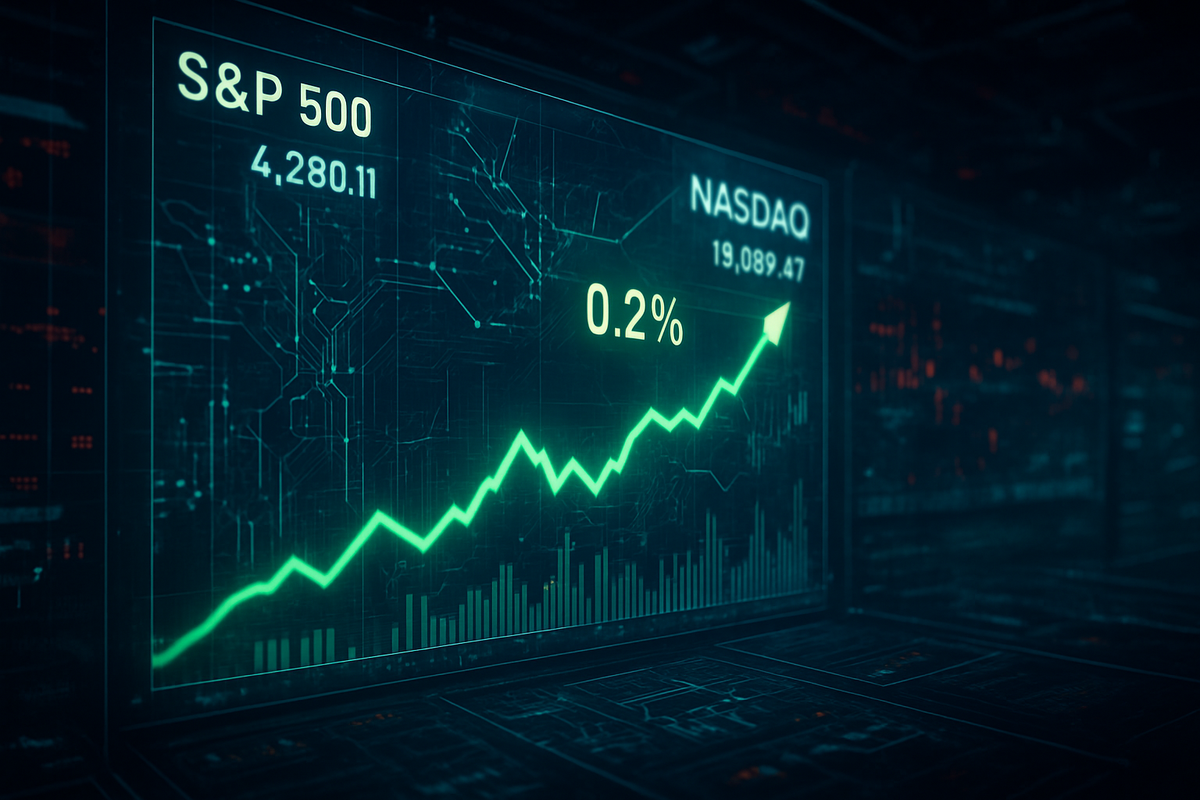
U.S. equity futures edged higher on Tuesday morning, February 17, 2026, as investors attempted to break a period of intense volatility that has rattled the technology sector. S&P 500 (INDEXSP: .INX) futures rose 0.2% to approximately 6,817 in early pre-market trading, signaling a cautious return of buyers following a long holiday weekend. The modest rebound comes at a critical juncture for Wall Street, as market participants grapple with the shifting landscape of artificial intelligence—moving from a period of unbridled optimism to a more clinical assessment of AI’s potential to disrupt traditional business models.
The stabilization follows a grueling stretch for tech-heavy indices. The Nasdaq Composite (INDEXNASDAQ: .IXIC) has endured a five-week losing streak, its longest period of sustained declines since 2022, as the market recalibrates the valuations of companies perceived to be at risk from "Agentic AI"—autonomous systems capable of replacing complex human workflows. While the Dow Jones Industrial Average (INDEXDJX: .DJI) futures gained a marginal 0.05% to approach the 49,500 mark, the focus remains squarely on whether the broader market can find a durable bottom after the S&P 500 and Dow logged weekly losses of over 1% in the prior session.
The 'AI Scaries' and the Search for a Market Bottom
The current market environment is being defined by what traders are calling the "AI Scaries." For much of 2024 and 2025, the narrative around artificial intelligence was one of universal growth; however, early 2026 has introduced a "surgical de-risking" phase. Investors are no longer buying the "AI tide lifts all boats" argument and are instead aggressively selling off companies whose core value propositions appear vulnerable to automation. This sentiment culminated in the Nasdaq’s recent 2% weekly slide, as high-multiple software stocks faced a wave of liquidations.
The timeline leading to this Tuesday rebound began in late January 2026, when several major Software-as-a-Service (SaaS) providers issued conservative guidance, citing longer sales cycles as enterprises pause to evaluate autonomous AI agents. This triggered a cascade of "valuation resets" across the sector. By the time markets closed for the Presidents' Day holiday, the tech sector was reeling from a realization that the "AI ROI Mandate" had arrived: only 14% of CFOs reported measurable returns on AI investments by the end of 2025, leading to a "show-me" story for the first quarter of 2026.
Stakeholders are now watching the 6,800 level on the S&P 500 as a key psychological support zone. The Tuesday morning uptick suggests that institutional buyers may see current levels as an entry point, particularly in "AI infrastructure" names that have been unfairly dragged down by the broader software rout. However, the flat performance of Nasdaq 100 futures—up only 0.01%—indicates that the tech sector is not yet out of the woods, as investors remain wary of further disruption in the services and software layers.
Winners and Losers in the Disruption Economy
The market's recovery is creating a stark divergence between "AI infrastructure providers" and "AI software integrators." NVIDIA (NASDAQ: NVDA) remains the primary beneficiary of the infrastructure build-out. Despite a 15% pullback from its 2025 highs due to general market froth, NVIDIA continues to see robust demand for its Blackwell and upcoming Rubin chip architectures. With hyperscalers like Amazon (NASDAQ: AMZN) and Meta Platforms (NASDAQ: META) projected to spend over $650 billion on data centers in 2026, NVIDIA’s hardware moat remains a safe haven for many.
Conversely, traditional SaaS giants are facing significant headwinds. Salesforce (NYSE: CRM) and Adobe (NASDAQ: ADBE) have seen year-to-date declines ranging from 15% to 20% as the market fears that autonomous AI agents could bypass the need for traditional enterprise software interfaces. Microsoft (NASDAQ: MSFT) has also felt the pressure; while its Azure cloud business remains a juggernaut, the stock has dipped 16% year-to-date as investors demand clearer evidence that its "Copilot" suite is translating into bottom-line growth rather than just increased capital expenditure.
Outside of pure tech, the "AI Scare Trade" has reached into the real estate and financial sectors. Commercial real estate stocks are sliding on fears that AI-driven remote work efficiencies will further erode office demand. In contrast, Alphabet (NASDAQ: GOOGL) has emerged as a surprising winner in early 2026. After being labeled a laggard in 2024, the success of its Gemini 3 model and its internal TPU chip production has positioned it as a vertically integrated powerhouse that is less reliant on external hardware than its peers.
Broader Significance: The Energy Crisis and Regulatory Walls
The current market volatility is not occurring in a vacuum; it is the result of several converging structural trends. Perhaps the most significant is the "Electricity Supply Crisis." As of early 2026, data center energy demand is on track to double, making energy providers and power-grid infrastructure companies—such as NextEra Energy (NYSE: NEE)—essential components of the AI ecosystem. The market is beginning to realize that the limit to AI growth may not be software or chips, but the physical reality of the power grid.
Furthermore, 2026 marks the first major enforcement cycle of the EU AI Act. Companies operating globally must now navigate a complex web of "high-risk" AI classifications, which has introduced new compliance costs and liability concerns. In the United States, the lack of federal AI legislation has led to a fragmented regulatory landscape, with states like California and Texas enacting their own transparency laws. These regulatory hurdles are contributing to the "valuation reset" as investors price in the cost of compliance and the risk of litigation over AI-generated content and autonomous decision-making.
Historically, this period mirrors the "dot-com" correction of the early 2000s, where the initial infrastructure build-out was followed by a shakeout of companies that failed to monetize the new technology. The difference in 2026 is the speed of the cycle. While the internet took a decade to reach maturity, the AI transition is happening in months, forcing the market to price in decades of disruption in a single earnings season.
What Comes Next: Strategic Pivots and Market Scenarios
Looking ahead to the remainder of 2026, the primary challenge for public companies will be demonstrating "AI-ready" data foundations. Investors are expected to shift capital away from companies that merely "bolt on" AI features and toward those that possess proprietary datasets that can be used to train specialized, high-margin autonomous agents. We are likely to see a wave of strategic pivots, where software companies transition into "agentic service providers," charging for outcomes rather than seats.
In the short term, the market will focus on the upcoming March earnings cycle to see if the AI ROI gap is narrowing. If major enterprises can show productivity gains from their 2025 investments, the Nasdaq could resume its climb toward the 30,000 mark by year-end. However, a "bear case" scenario remains possible if energy bottlenecks or regulatory crackdowns stall data center expansions. In such a scenario, the market could see a rotation back into "old economy" value stocks that provide a hedge against tech-driven volatility.
Summary for the Strategic Investor
The 0.2% rise in S&P 500 futures on February 17, 2026, is a welcome sign of stability, but it should not be mistaken for a return to the easy gains of the previous year. The "AI Disruption" era has entered a more mature, and more volatile, phase. Investors must now be as diligent about identifying the "disrupted" as they are about finding the "disruptors."
Moving forward, the key metrics to watch are hyperscaler CAPEX, national energy grid capacity, and the rollout of autonomous AI agents in the enterprise sector. The five-week losing streak for the Nasdaq may have been a necessary cleansing of hype, setting the stage for a more disciplined bull market centered on tangible results. For now, the market is catching its breath, but the underlying transformation of the global economy remains in full swing.
This content is intended for informational purposes only and is not financial advice.