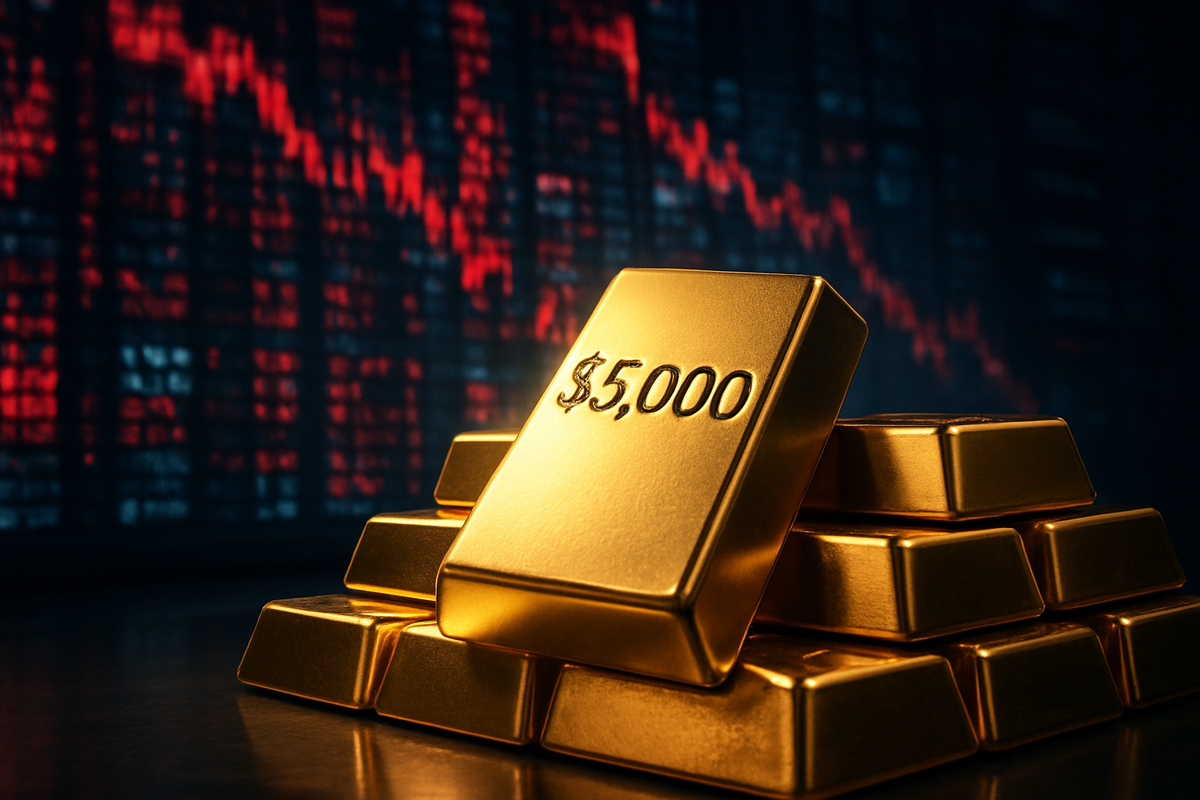
In a historic realignment of global financial markets, the price of gold has shattered the psychological $5,000 per ounce barrier, marking a monumental shift in investor sentiment. As of mid-February 2026, the precious metal has transitioned from a traditional safe-haven asset into the primary vehicle for capital preservation amidst a perfect storm of technological instability and geopolitical fragmentation. This record-breaking run reflects a profound "flight to quality" as institutional players move away from high-growth tech stocks and devaluing fiat currencies.
The immediate implications of this surge are being felt across all asset classes. While the tech-heavy Nasdaq struggles with a significant valuation reset, gold mining equities are seeing unprecedented margin expansion, and central banks in the global south are accelerating their pivot toward bullion-backed reserves. Analysts suggest that the breach of $5,000 is not merely a price spike but a "rebasing" of the global monetary order, signaling a definitive end to the era of low-volatility, dollar-dominant trade.
The Perfect Storm: A Timeline of the $5,000 Breakthrough
The journey to $5,000 began in earnest during the final quarter of 2025, driven by a series of systemic shocks. The primary catalyst was the emergence of the "SaaS-pocalypse" in early 2026, where a wave of AI-driven automation began to cannibalize the profit margins of traditional software-as-a-service providers. As investors realized that the massive $600 billion capital expenditure on AI infrastructure by companies like Microsoft (NASDAQ: MSFT) and Alphabet (NASDAQ: GOOGL) might not yield immediate returns, a massive rotation out of "Big Tech" and into "Hard Assets" commenced.
Geopolitics provided the structural foundation for this rally. On October 31, 2025, the BRICS bloc officially launched the pilot for "The Unit," a gold-backed international settlement currency. This move created a permanent, non-dollar demand for physical gold, as member nations like China, India, and Saudi Arabia sought to insulate their trade from US dollar fluctuations and potential sanctions. By the time gold crossed $4,500 in January 2026, central banks were no longer opportunistic buyers; they had become structural accumulators, purchasing over 1,000 tonnes annually for the third consecutive year.
The final push past $5,000 occurred this week, triggered by a breakdown in US-Iran nuclear negotiations and a concurrent 12% tumble in the stock of Cisco (NASDAQ: CSCO), which warned that rising component costs and hardware bottlenecks were stifling the AI recovery. The convergence of these factors—high-stakes geopolitical risk and the bursting of a perceived "AI infrastructure bubble"—sent gold prices vertical, briefly touching an intraday high of $5,119 per ounce.
Winners and Losers in the New Golden Era
The most direct beneficiaries of this surge are the major gold producers, whose balance sheets have been transformed overnight. Newmont Corporation (NYSE: NEM), the world’s largest gold miner, has seen its stock price soar as its All-In Sustaining Costs (AISC) remain anchored near $1,760 per ounce. At a $5,000 spot price, Newmont is enjoying gross profit margins exceeding 160%, a level of profitability unseen in the mining sector for decades. The company’s recent commencement of commercial production at the Ahafo North mine in Ghana has further bolstered its position as a primary beneficiary of the bull market.
Similarly, Barrick Gold (NYSE: GOLD) has emerged as a powerhouse, leveraging its high-grade "Fourmile" discovery in Nevada. With an AISC significantly lower than many of its peers—estimated between $1,460 and $1,560 per ounce—Barrick is generating record-breaking free cash flow. This has allowed the company to initiate aggressive share buybacks and increase dividends, drawing in income-seeking investors who previously favored tech dividends.
Conversely, the "losers" in this environment are the high-multiple technology giants that have dominated the last decade. Nvidia (NASDAQ: NVDA), despite its technological lead, has faced severe headwinds as parabolic memory-chip prices and cooling demand for expensive AI clusters have compressed margins. Meanwhile, the broader software sector, represented by the likes of Salesforce (NYSE: CRM), is battling a narrative of "technological obsolescence" as AI agents automate tasks that once required expensive seat-based subscriptions. For these companies, the $5,000 gold price represents a "cost of capital" warning, as investors demand higher yields and tangible assets over speculative future growth.
De-Dollarization and the AI Bubble: A Global Shift
This event is part of a broader trend toward "monetary sovereignty." The rise of gold is intrinsically linked to the weakening of the US Dollar Index (DXY), which has hovered around 97.00 as concerns over US debt sustainability reach a fever pitch. In 2026, gold is no longer just a hedge against inflation; it is a hedge against the "weaponization" of the dollar. The precedent set by the freezing of foreign reserves in 2022 has finally culminated in a diversified global reserve system where gold is the only neutral asset.
Furthermore, the current market dynamics mirror the dot-com bubble of 2000, but with a geopolitical twist. While the early 2000s crash saw capital move into defensive sectors like utilities, the 2026 "AI Wobble" is seeing capital flee the Western financial system entirely. The historical comparison is stark: in 1980, gold's brief peak represented a reaction to inflation, but in 2026, the $5,000 price point represents a fundamental "rebasing" of the global financial architecture.
Regulatory implications are also emerging. Several US lawmakers have proposed a "Gold Reserve Act of 2026" to stabilize the dollar, while European regulators are investigating the impact of the BRICS "Unit" on the Euro's stability. These policy shifts suggest that the volatility in the tech sector was merely the spark, while the underlying fuel for gold’s rise was a decade of fiscal expansion and shifting global alliances.
Navigating the Road to $6,000
Looking ahead, the short-term outlook remains volatile. Reaching $5,000 has already triggered some profit-taking, and technical corrections of 10-15% are expected as the Federal Reserve weighs more hawkish interest rate signals to combat the inflationary pressure of a weaker dollar. However, institutional analysts at firms like J.P. Morgan and Bank of America are already adjusting their models, with some suggesting that a further 0.5% shift of global foreign exchange reserves into gold could push the metal toward $6,000 by year-end.
The strategic pivot for investors will involve moving away from "paper gold" and toward physical ownership or Tier 1 mining equities. As geopolitical fragmentation continues, the reliability of supply chains and the physical delivery of bullion will become paramount. We may also see tech companies like Apple (NASDAQ: AAPL) or Tesla (NASDAQ: TSLA) begin to allocate portions of their massive cash reserves into gold to hedge against currency volatility—a move that would add even more momentum to the rally.
The Final Take: A New Asset Class Hierarchy
The surge of gold past $5,000 marks the end of the post-2008 financial era. The key takeaway for investors is that the "risk-free" status of sovereign debt is being questioned, and the "limitless growth" narrative of Silicon Valley is facing its first true existential threat from AI-driven deflation. Gold has reclaimed its throne as the ultimate arbiter of value in a world that is becoming increasingly divided and digitally unstable.
Moving forward, the market will be defined by a search for "tangibility." Whether it is energy, precious metals, or real-world infrastructure, the preference for hard assets over speculative software is likely to persist for the remainder of the decade. Investors should keep a close eye on the BRICS trade settlement data and the upcoming US fiscal reports in May 2026. The gold rush is far from over; it has simply entered a new, more expensive phase.
This content is intended for informational purposes only and is not financial advice