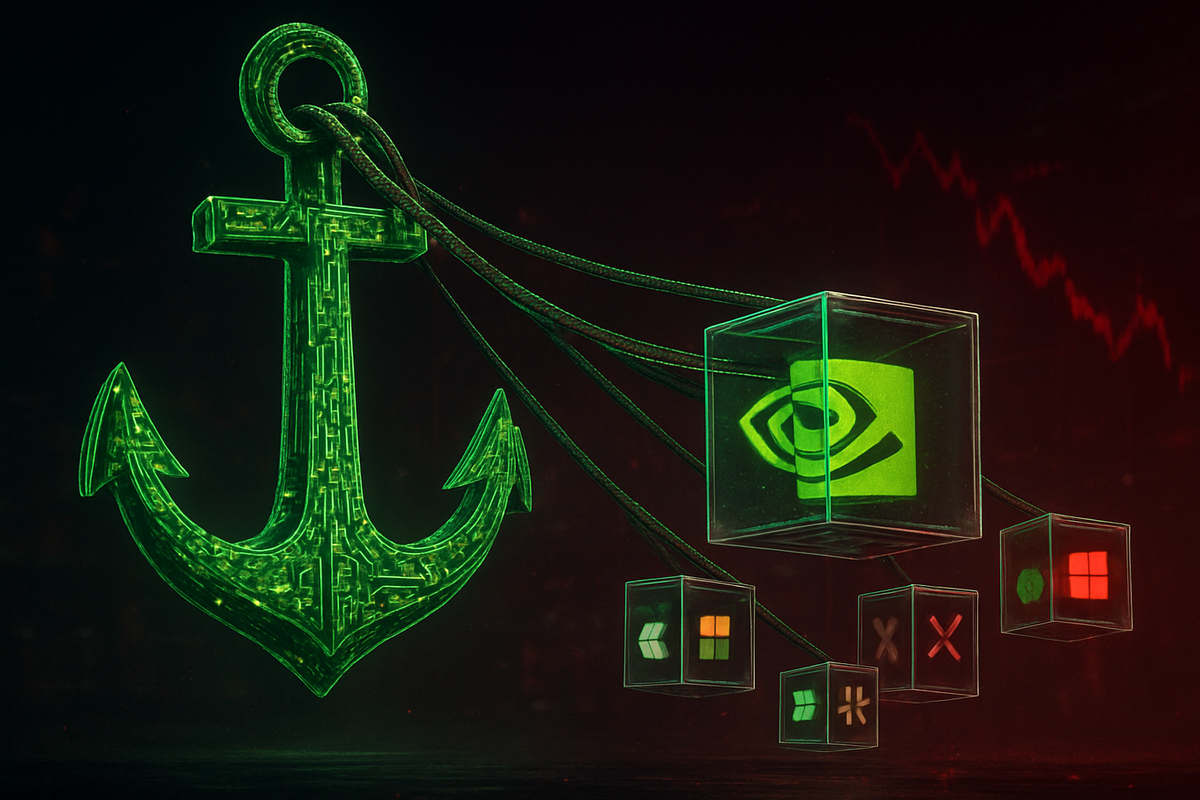
On Friday, February 13, 2026, the fragility of a highly concentrated stock market was laid bare as a 2.2% decline in Nvidia (NASDAQ: NVDA) single-handedly erased gains across dozens of other sectors. As the heaviest weighted company in the S&P 500 (NYSEARCA:SPY), Nvidia’s retreat acted as a massive gravitational pull, dragging the market-cap-weighted index into the red despite a relatively stable performance from the average American company.
This singular event has reignited a fierce debate among Wall Street analysts regarding "concentration risk." With Nvidia now commanding a historic lead in valuation, its daily fluctuations have become the primary pulse of the global economy, leaving passive investors increasingly vulnerable to the specific headwinds facing the semiconductor giant rather than the broader health of the corporate landscape.
The Friday Slump: A Perfect Storm of Macro and Micro Pressures
The 2.2% slide on Friday, February 13, was not a result of a single catastrophic failure but rather a convergence of three distinct pressures that have been building throughout early 2026. Early in the trading session, the release of the January Consumer Price Index (CPI) data showed inflation cooling to 2.4%, a figure that would normally buoy tech stocks. However, the optimism was quickly overshadowed by circulating reports from the Department of Commerce suggesting a definitive end to the "H200 Compromise"—a loophole that had allowed Nvidia to sell modified AI chips to the Chinese market. Analysts estimate that a total ban on these exports could shave billions from Nvidia’s upcoming 2026 revenue guidance.
Simultaneously, a broader "AI sell-off" began to take hold as several mid-cap Software-as-a-Service (SaaS) companies reported disappointing earnings, citing "AI cannibalization" where enterprise customers were diverting software budgets toward hardware infrastructure. This sparked fears that the massive capital expenditure being poured into Nvidia’s Blackwell architecture might be reaching a point of diminishing returns. By midday, the selling pressure intensified as algorithmic trading triggered stop-loss orders, accelerating the descent.
Key stakeholders, including major institutional holders like BlackRock and Vanguard, watched as Nvidia’s market capitalization—which had hovered near $4.45 trillion—contracted by nearly $100 billion in a single session. This move was particularly jarring because it occurred on a day when the equal-weighted S&P 500 actually finished slightly positive, highlighting a stark bifurcation in the market where the "Magnificent Seven" were no longer moving in lockstep with the rest of the economy.
Winners and Losers in the Wake of Concentration
The primary "loser" in Friday’s session was undoubtedly the passive investor tied to market-cap-weighted indices. Because Nvidia’s weight in the S&P 500 has swelled to over 7%, its 2.2% drop offset the combined gains of over 200 smaller companies within the index. This has led to a renewed interest in the Invesco S&P 500 Equal Weight ETF (NYSEARCA:RSP), which outperformed the standard index on Friday, providing a rare win for diversification-focused strategies. Other mega-cap peers like Broadcom (NASDAQ: AVGO) also felt the heat, finishing the day down 1.8% as the semiconductor sector faced a collective "revaluation" moment.
Conversely, the volatility provided a tactical opening for Nvidia’s primary competitors. Advanced Micro Devices (NASDAQ: AMD) and Intel (NASDAQ: INTC) saw uncharacteristic resilience during the afternoon session. As hyperscalers like Microsoft (NASDAQ: MSFT) and Meta (NASDAQ: META) look to de-risk their supply chains, AMD’s MI400 series and Intel’s Gaudi 4 platform are increasingly being viewed as essential "second source" alternatives. Investors are beginning to hedge their bets, betting that any regulatory or geopolitical blow to Nvidia will inevitably accelerate the adoption of rival silicon.
Furthermore, "Value" sectors—including Energy and Industrials—emerged as the day's surprising beneficiaries. As capital rotated out of overextended tech valuations, companies like Caterpillar (NYSE: CAT) and ExxonMobil (NYSE: XOM) saw modest inflows. This rotation suggests that while Nvidia’s dominance remains undisputed, the "smart money" is increasingly seeking refuge in tangible assets and cyclical sectors that are less susceptible to the specialized volatility of the AI hardware cycle.
The Wider Significance: A Market Tethered to One Titan
The events of February 13 highlight a historic shift in market structure. We are currently navigating a period of "extreme concentration" where the top 10 constituents of the S&P 500 account for nearly 40% of the total index market cap. This level of density surpasses the heights of the 1999 Dot-Com bubble and even the 2024 AI surge. In this environment, the S&P 500 has effectively become a "momentum fund" heavily leveraged toward a single technological trend: generative AI.
This concentration creates a "systemic feedback loop" where Nvidia’s success inflates the index, drawing in more passive capital, which in turn necessitates more buying of Nvidia stock. However, when the momentum stalls—as it did on Friday—the mechanism works in reverse. The ripple effect on competitors and partners is profound; as Nvidia goes, so goes the entire "AI Stack," affecting everyone from cloud providers like Alphabet (NASDAQ: GOOGL) to the power utility companies fueling data centers.
From a regulatory standpoint, the Friday slump may provide ammunition for those calling for stricter oversight of index concentration. While there is no immediate policy that can force a "breakup" of an index's weighting, the volatility of February 2026 is likely to prompt the SEC to look closer at the systemic risks posed by "single-stock dependency" in retirement accounts. Historically, such concentration has always preceded a period of "mean reversion," where the broader market eventually catches up or the leaders undergo a painful consolidation.
What Comes Next: Earnings, GTC, and Strategic Pivots
Looking ahead, all eyes are now fixed on February 25, when Nvidia is scheduled to report its Q4 2025/2026 earnings. The market is bracing for a "beat-and-raise" report, but the bar has been set exceptionally high. If Nvidia fails to provide an aggressive outlook for its new "Rubin" chip architecture, or if margins show further compression due to the ramp-up of Blackwell production, the February 13 drop could be a precursor to a much larger correction.
In the short term, Nvidia will likely use its upcoming GTC 2026 conference in March to shift the narrative from hardware sales to "Sovereign AI" and software services. The goal will be to prove that they are not just a chipmaker, but a foundational layer of the global digital economy. For investors, the challenge will be navigating this "transition phase" where AI training demand begins to normalize and the focus shifts toward "inference"—a field where competition is significantly more fierce and custom silicon from companies like Amazon (NASDAQ: AMZN) is gaining a foothold.
Strategic pivots are also expected from the "Hyperscalers." Having spent over $600 billion on AI capex in the last year, the pressure is on Microsoft and Meta to show that these investments are generating actual revenue. If the "AI payoff" remains elusive throughout the first half of 2026, we may see a significant reduction in orders for Nvidia’s high-end GPUs, a scenario that would necessitate a massive reallocation of capital across the entire tech sector.
Summary and Investor Outlook
The 2.2% decline of Nvidia on February 13 serves as a stark reminder that even the strongest companies cannot carry an entire market indefinitely. The event underscored the vulnerability of the S&P 500 to tech concentration, where a single company's geopolitical or regulatory headwinds can dictate the fate of millions of retirement portfolios. The key takeaway for the coming months is clear: the era of "blindly buying the index" may be entering a more treacherous phase.
Moving forward, the market remains in a state of "fragile strength." While the fundamentals of the AI revolution are still robust, the valuation math is becoming increasingly complex. Investors should closely monitor the "Magnificent Seven" earnings throughout February and watch for any further "rotation" into the equal-weighted index as a sign of a healthier, more diversified market.
As we move toward the spring of 2026, the primary watchwords will be "diversification" and "durability." Nvidia’s influence is a double-edged sword; it has been the engine of the greatest bull market of the decade, but on days like Friday, February 13, it becomes a heavy anchor. Whether the market can uncouple its destiny from a single ticker symbol remains the most important question for the remainder of the year.
This content is intended for informational purposes only and is not financial advice