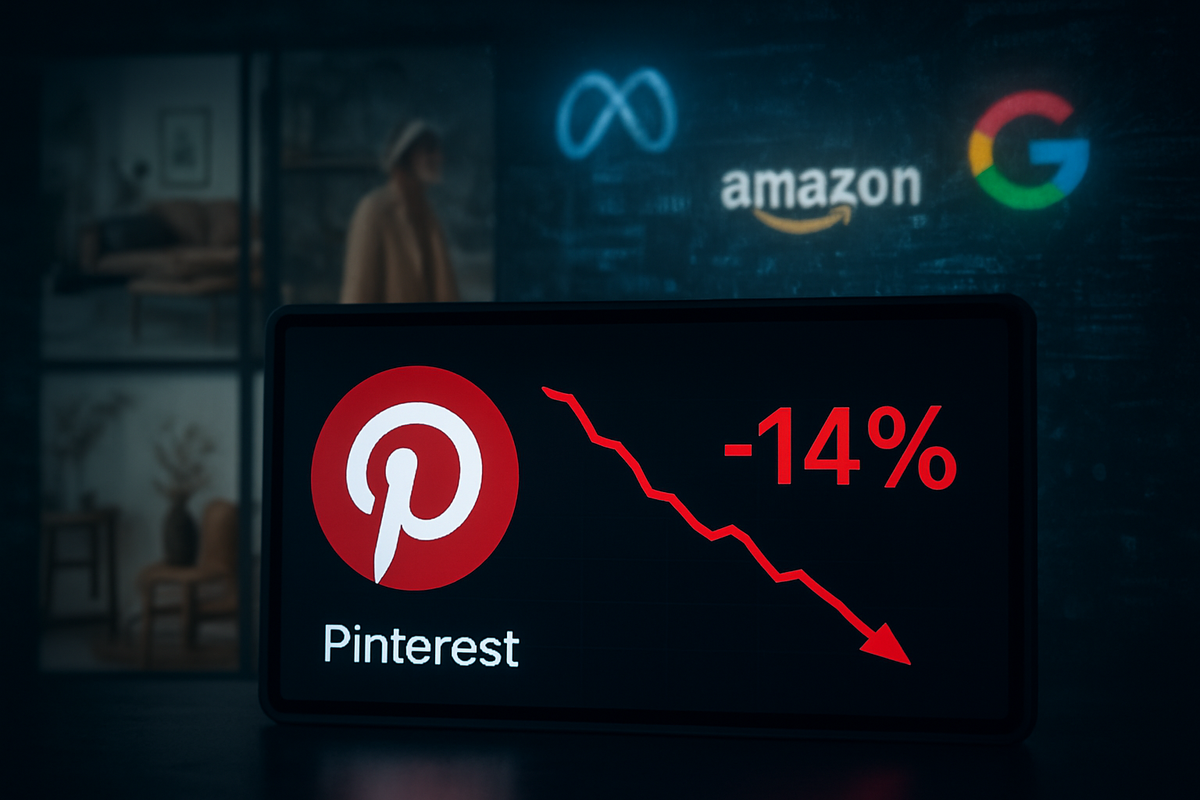
The digital "inspiration engine" is facing a cold reality check. Shares of Pinterest Inc. (NYSE: PINS) plummeted 14.2% in early trading on February 13, 2026, following a disappointing fourth-quarter earnings report and a cautious outlook for the year ahead. Despite achieving a record-breaking milestone in its global user base, the company struggled to translate that attention into the high-octane revenue growth that Wall Street has come to demand from social media giants.
The selloff marks one of the sharpest single-day declines for the San Francisco-based company in years, erasing billions in market capitalization. Investors were caught off guard not just by the slight revenue miss, but by a confluence of macroeconomic headwinds and internal restructuring efforts that suggest Pinterest’s path to profitability is becoming increasingly narrow. As the broader digital advertising market shifts toward automated, AI-driven performance marketing, Pinterest is finding itself in a defensive crouch, struggling to keep pace with the efficiency of its much larger rivals.
A Perfect Storm of Missed Targets and Macroeconomic Shocks
The catalysts for the slide were contained within Pinterest’s Q4 2025 financial disclosure, released after the bell on February 12, 2026. The company reported revenue of $1.319 billion, a 14% year-over-year increase that fell just short of the $1.33 billion consensus estimate. While missing revenue by a slim margin is often forgivable, the forward-looking guidance for Q1 2026—projecting revenue between $951 million and $971 million—was significantly below the $980.1 million analysts had modeled.
During the earnings call, management pointed to a "Tariff Shock" as a primary culprit for the soft forecast. The recent implementation of aggressive trade tariffs by the U.S. administration has caused a sudden pullback in advertising spend from major retailers in the home furnishings, apparel, and automotive sectors—three categories that form the backbone of Pinterest's ad revenue. Furthermore, the company is in the midst of a massive sales organization overhaul under Chief Business Officer Lee Brown, a transition that has reportedly led to "execution friction" and limited visibility into upcoming deal flows.
The earnings report also revealed the high cost of the AI arms race. Despite a January 2026 restructuring that saw Pinterest lay off 15% of its workforce, margins remained under pressure due to surging infrastructure costs. The company has significantly increased its investment in GPU capacity to power its new "Performance+" AI suite and "Pinterest Assistant," a move that has yet to yield the monetization lift investors were promised. While Monthly Active Users (MAUs) hit a record 619 million—up 12% year-over-year—the Average Revenue Per User (ARPU) growth remained sluggish at just 2%, signaling that the company is adding users faster than it can monetize them.
The Ad Wars: Giants Gain While Niche Platforms Pivot
The market reaction to Pinterest’s struggle highlights a growing divide in the digital advertising sector. Meta Platforms Inc. (NASDAQ: META), the parent company of Instagram and Facebook, continues to be the primary beneficiary of Pinterest’s volatility. Meta’s "Advantage+" AI ad suite has reached a level of maturity that allows it to capture "bottom-of-the-funnel" conversion dollars more effectively than Pinterest’s "inspiration-first" model. When retail budgets tighten due to tariffs, advertisers are gravitating toward Meta’s massive scale and predictive targeting rather than the discovery-based ads of smaller platforms.
Similarly, Alphabet Inc. (NASDAQ: GOOGL) has seen continued strength through its "Universal Commerce Protocol," which allows users to purchase products directly within Google Search results. This move effectively bypasses the "discovery" phase that Pinterest has spent a decade cultivating. Meanwhile, Amazon.com Inc. (NASDAQ: AMZN) remains a complex partner for Pinterest. While their third-party ad partnership provides Pinterest with high-quality inventory, analysts at major brokerage firms are beginning to view it as a "double-edged sword." By relying on Amazon to fill its ad slots, Pinterest may be forfeiting the chance to build its own end-to-end checkout ecosystem, effectively turning itself into a "top-of-funnel feeder" for Amazon’s dominant transactional engine.
Other niche players like Snap Inc. (NYSE: SNAP) are also feeling the heat, as the market increasingly demands "agentic commerce"—a system where AI agents negotiate and complete purchases autonomously. Platforms that cannot offer seamless, high-intent transactional data are being pushed to the periphery. The 14% slide in PINS shares reflects a broader investor sentiment that in an era of AI-driven efficiency, being a "nice-to-have" inspiration platform is no longer enough to sustain a premium valuation.
The Shift to Agentic Commerce and Performance Marketing
The challenges facing Pinterest are part of a broader structural shift in the global advertising landscape. By 2026, the industry has moved away from "brand awareness" toward "Performance-First" strategies. In an inflationary environment exacerbated by trade tensions, every advertising dollar is being scrutinized for immediate ROI. This has historically been a challenge for Pinterest, where users often "pin" items for future purchase rather than buying them on the spot.
This event mirrors the "Ad-pocalypse" of several years ago but with a modern twist: the transition to AI agents. These agents—such as OpenAI's "Shopping GPT"—do not browse pins; they look for structured data and direct APIs to execute orders. Pinterest’s reliance on static images and visual discovery, once its greatest moat, is becoming a liability in a world of machine-to-machine commerce. The company's attempt to counter this with its own AI initiatives has so far been viewed as a game of catch-up rather than a market-leading innovation.
Furthermore, the rise of Retail Media Networks (RMNs) from the likes of Walmart and Etsy has created a crowded middle ground. These retailers are now offering their own sophisticated ad platforms with first-party purchase data that Pinterest simply cannot match. The historical precedent for Pinterest’s current predicament can be found in the struggles of print magazines during the initial rise of social media; the "inspiration" medium must find a way to become the "transaction" medium, or risk becoming obsolete.
Navigating the 'Performance+' Future
What comes next for Pinterest will largely depend on the rollout and adoption of its Performance+ AI tools. Management has doubled down on the promise that these automated campaign features will eventually bridge the gap between discovery and purchase. In the short term, the market will be looking for signs that the sales reorganization is yielding results and that the tariff-related pullback in retail spending is stabilizing.
Strategic pivots may also be on the horizon. Analysts have long speculated that Pinterest could become an acquisition target for a major retailer or a larger tech conglomerate looking to bolster its visual search capabilities. If the stock remains depressed, the company may find itself forced into more aggressive partnerships—or a complete merger—to survive. Another possibility is a pivot toward "Creators," where Pinterest could incentivize its most popular users to act as personal shoppers, effectively humanizing the "agentic commerce" trend.
The biggest challenge remains the "Amazon trap." To reclaim its narrative, Pinterest must prove that it can drive direct checkout on its own platform without the Amazon crutch. If the company cannot show a path to significant ARPU growth in Europe and the "Rest of World" segments—where user growth is high but monetization remains in the pennies—the stock could face further downgrades in the second half of 2026.
A Testing Period for the Pin
Pinterest’s 14% slide is a sobering reminder that user growth is a hollow metric if it cannot be efficiently monetized in a shifting economic landscape. The combination of "Tariff Shock" and the rise of AI-driven performance marketing has created a "show-me" environment for the company. While the record 619 million users provide a massive canvas for potential growth, the brushes Pinterest is currently using—its ad tools and sales strategy—are being heavily scrutinized.
Moving forward, investors should watch for the company's Q1 2026 results and any updates on the "Performance+" adoption rates. The ability of the platform to maintain its Gen Z growth while simultaneously convincing big-box retailers that its ads provide a better ROI than Meta’s or Google’s will be the ultimate test. For now, Pinterest remains a platform with immense aesthetic value but a monetization model that is currently under construction in the middle of a storm.
This content is intended for informational purposes only and is not financial advice.