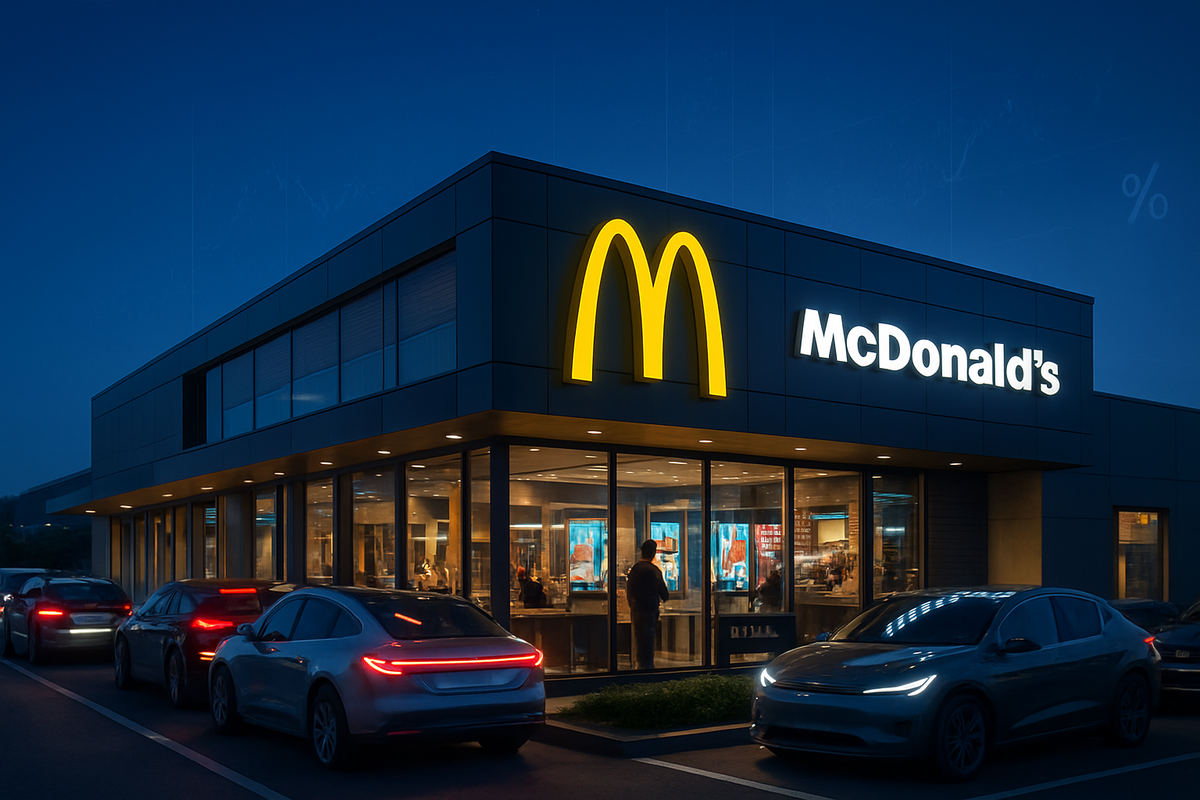
Following a tumultuous period of "fast-food fatigue" and inflationary pressure, McDonald’s (NYSE: MCD) has emerged from its fiscal 2025 fourth quarter as a definitive bellwether for the American economy. Two days ago, on February 11, 2026, the fast-food giant reported a "double beat" on revenue and earnings, signaling that its aggressive pivot toward deep value and digital loyalty is successfully capturing a shifting consumer class. While higher-income households are increasingly "trading down" from casual dining to the Golden Arches, the company’s latest data reveals a starkly divided consumer landscape where pricing strategy is now the primary battleground for survival.
The Q4 2025 results show a 6.8% increase in U.S. same-store sales, a significant recovery from the stagnation seen in late 2024. This growth was driven not by broad price hikes—which have slowed significantly—but by a calculated "Value Reset" and a surge in guest traffic. By leveraging its "McValue" platform and massive marketing partnerships, McDonald's has managed to reclaim market share from competitors who struggled to balance franchise profitability with consumer affordability. However, the data also serves as a warning: with restaurant inflation still outpacing grocery costs, the margin for error in the QSR (Quick Service Restaurant) space has never been thinner.
The Value Reset: Inside the Q4 Numbers and the Traffic Surge
McDonald’s reported consolidated revenue of $7.01 billion for the fourth quarter of 2025, a 10% year-over-year increase that comfortably cleared Wall Street’s $6.83 billion forecast. Adjusted earnings per share hit $3.12, reflecting a company that has managed to maintain an operating margin in the 45% range despite rising labor costs and a heavy discount mix. The timeline for this recovery began in mid-2025, following a period where lower-income consumers began "abandoning the chain" in favor of home-cooked meals. Management responded by evolving the temporary $5 Meal Deal into a permanent "McValue" menu, which anchored the brand’s identity back to affordability.
The quarter’s success was further bolstered by "Marketing Mastery," including high-profile collaborations like the Minecraft Movie promotion and a record-breaking "Grinch Meal" in December 2025. These events catalyzed the highest single sales day in the company’s history. Initial market reactions have been bullish, with the stock ticking upward as investors find comfort in McDonald’s ability to drive traffic in a high-interest-rate environment. However, the report also highlighted the capital-intensive nature of this growth; McDonald's corporate had to co-invest approximately $75 million in Q4 to support franchisees who are feeling the squeeze of thin margins on value-heavy orders.
Winners and Losers: A Widening Gap in the QSR Sector
The 2026 landscape is creating a clear divide between scale-advantaged leaders and those struggling to keep pace. McDonald’s (NYSE: MCD) remains the primary winner, using its $140 billion in systemwide sales to negotiate better supply chain costs and fund AI-driven automation that reduces labor dependency. In contrast, Wendy’s (NASDAQ: WEN) saw a staggering 11.3% plunge in U.S. comparable sales this quarter. Analysts attribute this to a lack of menu innovation and a failed attempt to move upscale just as the consumer was looking for discounts.
Other major players are seeing mixed results. Restaurant Brands International (NYSE: QSR), the parent company of Burger King, managed a modest 3.1% growth in the U.S., benefiting from its own "Reclaim the Flame" modernization program, but it still trails McDonald’s in digital engagement. Yum! Brands (NYSE: YUM), specifically through Taco Bell, continues to be a formidable value competitor, but McDonald’s remains the "safe haven" for families. The losers in this environment are the smaller, regional players and "fast-casual" chains that lack the digital infrastructure to compete with McDonald’s 210 million active loyalty members, whose personalized offers drive significantly higher visit frequency than traditional advertising.
The Macro View: Inflation, the K-Shaped Recovery, and the GLP-1 Factor
McDonald’s latest data provides a window into the "K-shaped" economic reality of early 2026. While "Food Away from Home" inflation has cooled to 4.0%, it remains double the rate of grocery inflation (2.1%). This "price gap" has fundamentally altered consumer behavior; the bottom 25% of earners are now "deep-value hunters," only visiting when digital coupons or specific value meals are available. Conversely, middle-to-high-income households are frequenting McDonald’s more often as they pull back from mid-tier sit-down restaurants, seeking the efficiency and predictable pricing of the drive-thru.
A new and significant variable in 2026 is the impact of GLP-1 weight-loss medications. With 12% of U.S. adults now using these treatments, the industry is seeing a tangible 5-6% reduction in per-user fast-food spending. McDonald’s has been proactive in this area, expanding "protein-forward" options and smaller, customizable portions—like the new "Big Arch" burger and snack wrap iterations—to cater to appetite-suppressed diners. This adaptability mirrors historical shifts, such as the company’s move toward salads in the early 2000s, but with much higher stakes given the current pace of medical adoption.
The Road Ahead: Automation and 50,000 Stores
In the short term, McDonald’s is expected to lean even more heavily into its "Accelerating the Arches" strategy. The company has set a target of 2,600 new restaurant openings for 2026, part of a broader goal to hit 50,000 global locations by 2027. Strategic pivots will likely focus on the "McCafé" beverage platform, aiming to capture the high-margin specialty coffee and boba market currently dominated by boutique chains. Technology will also play a central role, with franchise owners expected to spend between $100,000 and $250,000 per store on AI-enabled voice ordering and digital kitchen management tools to protect margins from rising minimum wages.
Market opportunities may also emerge from the potential consolidation of the QSR industry. As smaller competitors struggle with the high cost of digital transformation, McDonald’s could find opportunities to acquire real estate or technology partners. However, challenges remain: if the U.S. labor market softens significantly, the trade-down effect from casual dining may not be enough to offset a total pullback from the lower-income demographic that forms the brand's core.
Investor Watchlist: Summary of the 2026 Outlook
McDonald’s Q4 2025 performance proves that in an uncertain economy, scale and value are the ultimate competitive moats. The company has successfully navigated the "pricing cliff" of 2024 by reinventing its value proposition and doubling down on a digital-first strategy. Moving forward, the market appears stable for the Golden Arches, but the internal health of its franchise system remains a critical metric. If franchise margins continue to erode due to the "discount mix," corporate may be forced to provide further financial concessions.
Investors should watch for three key indicators in the coming months: the adoption rate of the "Big Arch" premium burger, the growth of the digital loyalty base toward the 250 million user goal, and any further divergence between restaurant and grocery inflation. As it stands in February 2026, McDonald’s is not just selling burgers; it is managing a sophisticated data and real estate empire that currently serves as the most reliable thermometer for the American consumer’s pulse.
This content is intended for informational purposes only and is not financial advice.