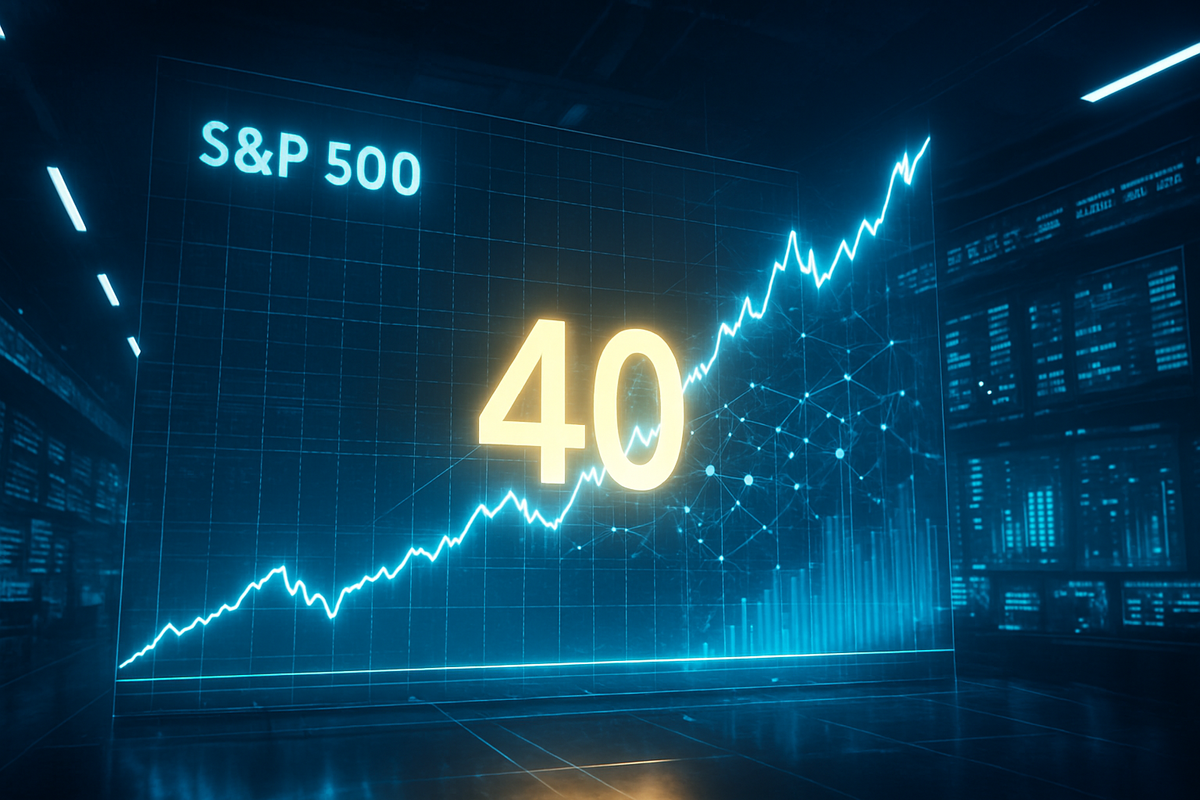
As of February 13, 2026, the S&P 500 (NYSE: SPY) has officially crossed a psychological and mathematical Rubicon. The Shiller CAPE ratio—a measure of the market’s price relative to ten years of inflation-adjusted earnings—surpassed the 40.0 mark this week, currently hovering at 40.6. This milestone is staggering in its rarity; in the 155-year history of the United States stock market, this level has been breached only once before, during the height of the dot-com bubble in December 1999.
The immediate implications for investors are polarized between euphoria and dread. While the momentum of the artificial intelligence revolution continues to drive major indices to record highs, the "40-club" has historically been a lonely and dangerous place. For many institutional analysts, the current valuation suggests that the market is pricing in near-perfect execution of AI productivity gains, leaving virtually no margin for error if corporate earnings fail to keep pace with the massive capital expenditures currently being deployed by Silicon Valley.
A Ghost of Markets Past: The 1999 Parallel
The ascent to a CAPE ratio of 40.6 did not happen overnight. It is the culmination of a three-year rally that began in earnest in 2023, fueled by the rapid commercialization of generative AI. To put this into perspective, the long-term historical average for the Shiller CAPE is between 16 and 17. The current reading is more than double that mean, eclipsing the 1929 "Black Tuesday" peak of 32.5 and the 2021 post-pandemic high of 38.5. Only the 1999 peak of 44.2 remains higher, a figure that served as the precursor to one of the most painful eras in financial history.
The "Lost Decade" that followed the 1999 peak remains the primary cautionary tale for today’s bulls. From January 2000 to December 2009, the S&P 500 delivered a negative annualized total return of approximately -1.1%. An investor who put money into the market at the turn of the millennium saw their purchasing power erode by more than 35% over ten years when adjusted for inflation. It took a staggering 4,739 days—nearly 13 years—for the index to reclaim and sustain its previous highs. The fear among market veterans is that by crossing 40 today, the market may be setting itself up for another prolonged period of stagnation, where stock prices must "wait" for earnings to eventually catch up to their inflated valuations.
The AI Titans: Winners and the Cost of Ambition
In this high-stakes environment, a handful of companies are carrying the weight of the entire market's valuation. NVIDIA (NASDAQ: NVDA), the undisputed "picks and shovels" leader of the AI era, continues to see high demand for its Blackwell architecture. However, even with a 1,200% surge in its stock price over the last few years, the company now faces the challenge of "consolidation" as investors demand proof that its revenue growth is sustainable beyond the initial infrastructure build-out.
Microsoft (NASDAQ: MSFT) and Alphabet (NASDAQ: GOOGL) are also at the center of this valuation debate. Microsoft has committed to a staggering $105 billion in capital expenditure this fiscal year to bolster its Azure AI and Copilot ecosystems. Alphabet has followed suit with a projected $185 billion in 2026 Capex. While these companies are the "winners" in terms of technological dominance, their share prices are increasingly sensitive to "Capex fatigue." If these multi-billion dollar investments do not translate into significant bottom-line growth within the next 12 to 18 months, these market leaders could transition from winners to the primary drivers of a wider market correction. Conversely, mid-cap companies that have failed to integrate AI effectively or lack the capital to compete are already being left behind, creating a stark "valuation gap" between the tech elite and the rest of the market.
The Productivity Paradox and the Bubble Debate
The core of the current market debate rests on whether we are in a traditional bubble or a "New Era" defined by unprecedented productivity gains. Analysts at Goldman Sachs (NYSE: GS) and Morgan Stanley (NYSE: MS) argue that the CAPE ratio of 40 is justified because AI is fundamentally different from the 1999 internet boom. They point to task-level productivity increases of 14% to 55% in sectors like software engineering and legal services. Unlike the dot-com era, where many companies had no revenue, today’s leaders are highly profitable with massive cash reserves.
However, bears like Jeremy Grantham of GMO warn that the current market exhibits all the "hallmarks of a bubble." They point to the "Productivity Paradox"—the idea that while individual tasks become faster, enterprise-wide efficiency often lags due to implementation hurdles. Recent data suggests that up to 95% of AI pilots in large corporations have struggled to reach full-scale production. If these efficiencies do not manifest in the broader S&P 500 earnings by late 2026, the justification for a 40x multiple collapses. This creates a precarious situation for the Federal Reserve and policymakers, as a valuation reset could significantly impact consumer confidence and pension fund stability.
Looking Ahead: The Road to 8,000 or a Reset?
The short-term outlook remains surprisingly bullish despite the high valuations. Many Wall Street strategists have set year-end targets for the S&P 500 as high as 7,500 to 8,100, assuming that AI monetization accelerates in the second half of 2026. For these targets to be hit, the market needs to see "near-perfect execution" from the Magnificent Seven and a broadening of the rally into the "S&P 493"—the rest of the companies in the index that have largely traded at more reasonable multiples.
In the long term, the market may require a "strategic pivot." If the Shiller CAPE remains at these extremes, the most likely outcome is a period of low or flat returns, similar to the 2000s, rather than a single catastrophic crash. Investors may need to shift their focus from capital appreciation to dividend-yielding stocks and value-oriented sectors that have been ignored during the AI frenzy. The key challenge for the remainder of 2026 will be navigating the transition from the "hype phase" of AI to the "earnings phase."
Investor Takeaway: Watching the Horizon
The S&P 500 crossing a Shiller CAPE of 40 is a historic alarm bell that cannot be ignored. While the technological advancements of 2026 are real and transformative, the price being paid for those future gains has reached a level seen only once before in a century and a half. The primary takeaway for investors is that the "easy money" of the AI rally has likely been made, and the market has entered a "show me" phase.
Moving forward, the market’s trajectory will depend entirely on whether corporate earnings can grow into these 1999-style valuations. Investors should keep a close eye on quarterly earnings reports from the major tech players, specifically looking for "return on AI investment" metrics. As we head into the second half of 2026, the question is no longer whether AI works, but whether it works well enough to justify the most expensive stock market in 25 years.
This content is intended for informational purposes only and is not financial advice