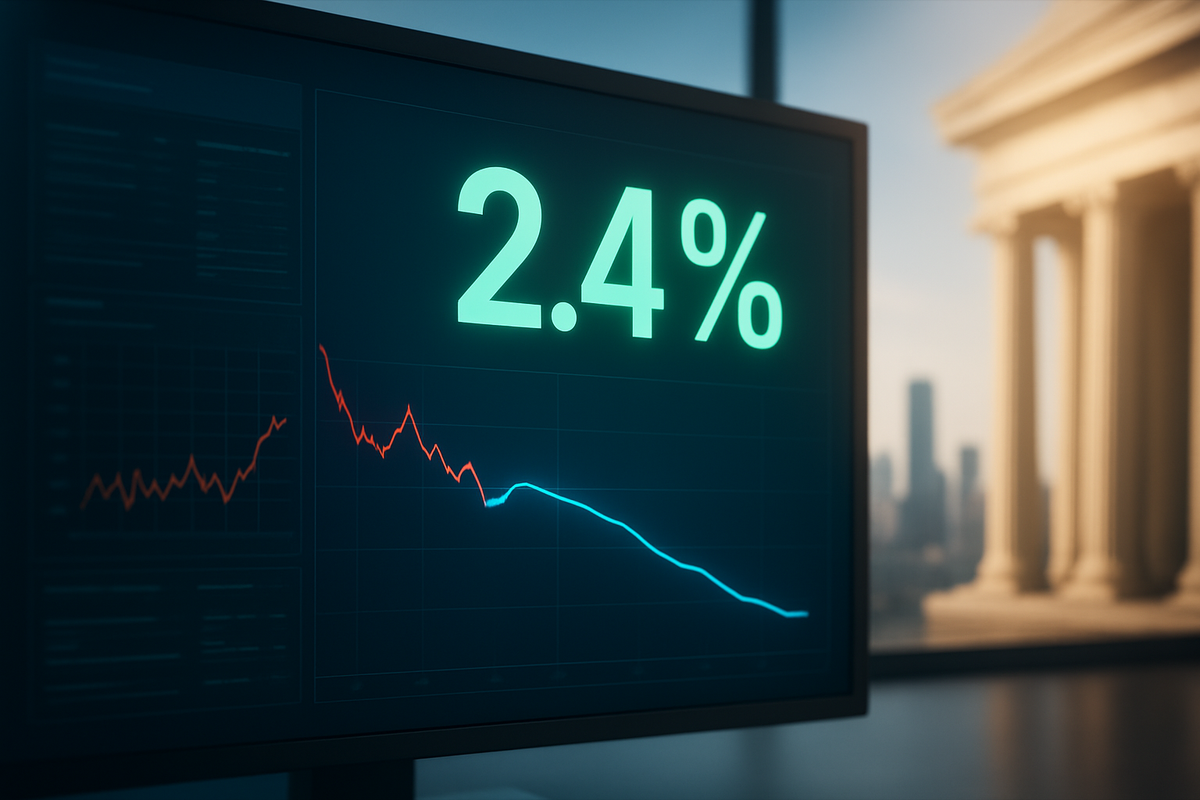
The U.S. economy received a long-awaited signal of stability this week as the Bureau of Labor Statistics released the January 2026 Consumer Price Index (CPI) report. The data showed that headline inflation slowed to an annual rate of 2.4%, coming in below the consensus economist expectation of 2.5%. This cooling trend marks a significant downshift from the 2.7% recorded in December 2025 and suggests that the Federal Reserve’s restrictive monetary policy is finally steering the economy toward a sustainable "soft landing."
The immediate market response was one of relief, characterized by a sharp decline in U.S. Treasury yields and a notable dampening of the CBOE Volatility Index. Investors, who had been bracing for "sticky" inflation due to recent labor market tightness, pivoted quickly toward a more optimistic outlook. The report has effectively calmed fears of a potential re-acceleration in prices, providing the Federal Reserve with much-needed breathing room as it navigates the final months of Chairman Jerome Powell's current term.
A Decisive Shift in the Inflation Narrative
The January CPI report, released on February 11, 2026, surprised many on Wall Street by showing broad-based disinflation across several key categories. While shelter costs remained a persistent contributor, significant price declines in energy and used vehicles helped pull the headline number lower. Core CPI, which excludes volatile food and energy prices, also showed signs of moderation, reinforcing the narrative that the post-pandemic inflationary era is entering its final chapter. This marks the lowest year-over-year inflation reading since the early 2020s, a milestone that Federal Reserve officials are likely to highlight in upcoming communications.
The timeline leading up to this release was fraught with uncertainty. Throughout late 2025, the 10-year Treasury yield had been volatile, peaking near 4.79% earlier in the year as fiscal deficit concerns and "higher for longer" rhetoric dominated the airwaves. However, as the fourth quarter of 2025 progressed, three consecutive 25-basis-point rate cuts by the FOMC began to take effect. By the time the January 2026 data was announced, the market was desperate for confirmation that these cuts had not reignited the inflationary fire. The 2.4% print provided exactly that confirmation.
Key stakeholders, including New York Fed President John Williams and Dallas Fed President Lorie Logan, have recently emphasized a data-dependent approach. Following the report, the 10-year Treasury yield eased further to 4.07%, its lowest level since early December. Market participants reacted by increasing bets on a potential rate cut in the second quarter of 2026, a shift from the "pause" many had anticipated for the first half of the year.
Winners and Losers in a Disinflationary Climate
The primary beneficiaries of the cooling CPI report have been high-growth technology companies and interest-rate-sensitive sectors. Apple Inc. (NASDAQ: AAPL) and Microsoft Corp. (NASDAQ: MSFT) saw their shares climb as the discount rate on future earnings—driven by lower Treasury yields—fell. Similarly, NVIDIA Corp. (NASDAQ: NVDA) continues to benefit from the dual tailwinds of lower borrowing costs and sustained demand for AI infrastructure, making it a top performer in the wake of the news. The Invesco QQQ Trust (NASDAQ: QQQ), which tracks the tech-heavy Nasdaq-100, surged nearly 1.8% in the session following the report.
Real estate investment trusts (REITs) also found a firm footing. Prologis, Inc. (NYSE: PLD), a global leader in logistics real estate, saw renewed investor interest as the prospect of lower long-term rates improves the outlook for property valuations and refinancing costs. Fixed-income investors were also among the "winners," with the iShares 20+ Year Treasury Bond ETF (NASDAQ: TLT) gaining ground as bond prices rose in inverse proportion to the falling yields.
Conversely, the banking sector faced a more complex reaction. While a calmer market environment is generally positive for wealth management and investment banking, the narrowing of the yield curve can pressure net interest margins. JPMorgan Chase & Co. (NYSE: JPM) and other large money-center banks saw modest gains but underperformed the broader tech sector as investors weighed the impact of lower lending rates against the benefit of a healthier overall economy. Some regional banks may also struggle if the rapid drop in yields leads to increased prepayments on existing high-yield loans.
The Broader Significance: Transitioning to the "New Normal"
This January CPI print is more than just a single data point; it represents a pivotal moment in the transition toward a neutral monetary policy. For the past two years, the global industry trend has been dominated by the fight against inflation, which at times threatened to trigger a recession. The move to 2.4% suggests that the "neutral rate"—where the Fed neither stimulates nor restricts the economy—may be within reach by the end of 2026. This aligns with the Fed’s December 2025 "dot plot," which signaled a gradual descent toward a 3.1%–3.4% target range.
The ripple effects of this cooling inflation are likely to be felt globally. As U.S. yields stabilize, the dollar’s relative strength may soften, providing relief to emerging markets that have struggled with dollar-denominated debt. Domestically, the policy implications are clear: the FOMC now has the flexibility to prioritize the "maximum employment" side of its dual mandate. This is a sharp contrast to the 2022-2023 period, where the sole focus was on crushing price increases at any cost.
Historically, this period draws comparisons to the "mid-cycle adjustments" of the 1990s, where the Fed successfully orchestrated a soft landing. By avoiding the pitfalls of over-tightening, the current administration and the Powell-led Fed appear to be threading a very narrow needle. However, regulatory eyes remain on fiscal spending, as the Congressional Budget Office continues to warn that large deficits could eventually put upward pressure on long-term yields, regardless of short-term CPI successes.
What Comes Next: The Road to the March FOMC Meeting
In the short term, all eyes will shift to the Personal Consumption Expenditures (PCE) price index, the Fed’s preferred inflation gauge, which is due later this month. If the PCE confirms the CPI's downward trend, the case for a 25-basis-point cut in June—or perhaps even as early as May—will become the dominant market narrative. Strategic pivots are already underway at major asset managers, who are shifting allocations from cash and short-term "money market" instruments back into longer-duration equities and bonds to lock in current yields.
The long-term challenge remains the transition of leadership at the Federal Reserve. With Jerome Powell’s term ending in May 2026, the political landscape will play a significant role in who takes the helm. Whether the next Chair is a "hawk" or a "dove" will determine if the Fed remains committed to the 2% target or if they will tolerate a "2-point-something" environment to support growth. Investors should prepare for potential volatility as the selection process intensifies in the spring.
Market opportunities will likely emerge in sectors that have been battered by high rates, such as small-cap stocks and green energy. However, challenges persist. If the labor market begins to show signs of excessive cooling alongside inflation, the Fed may have to act more aggressively than currently anticipated, which could introduce a new set of risks related to economic growth.
Closing Thoughts: A Milestone for Market Stability
The January 2026 CPI report marks a definitive win for those advocating for a patient, data-driven approach to monetary policy. By beating expectations and slowing to 2.4%, inflation has moved within striking distance of the Fed’s long-term goal without necessitating a spike in unemployment. The resulting calm in the Treasury market and the reduction in the VIX suggest that the "fear of the unknown" that gripped markets in 2024 is finally dissipating.
Moving forward, the market appears to be on a firmer footing, but vigilance is still required. Investors should watch for any signs of "re-inflation" in the services sector and monitor the Fed's rotating voting members, such as the hawkish Lorie Logan and the more dovish Anna Paulson, for clues on the internal debate within the FOMC. For now, the "normalization" of the U.S. economy remains the primary theme, offering a more predictable environment for long-term capital appreciation.
This content is intended for informational purposes only and is not financial advice.