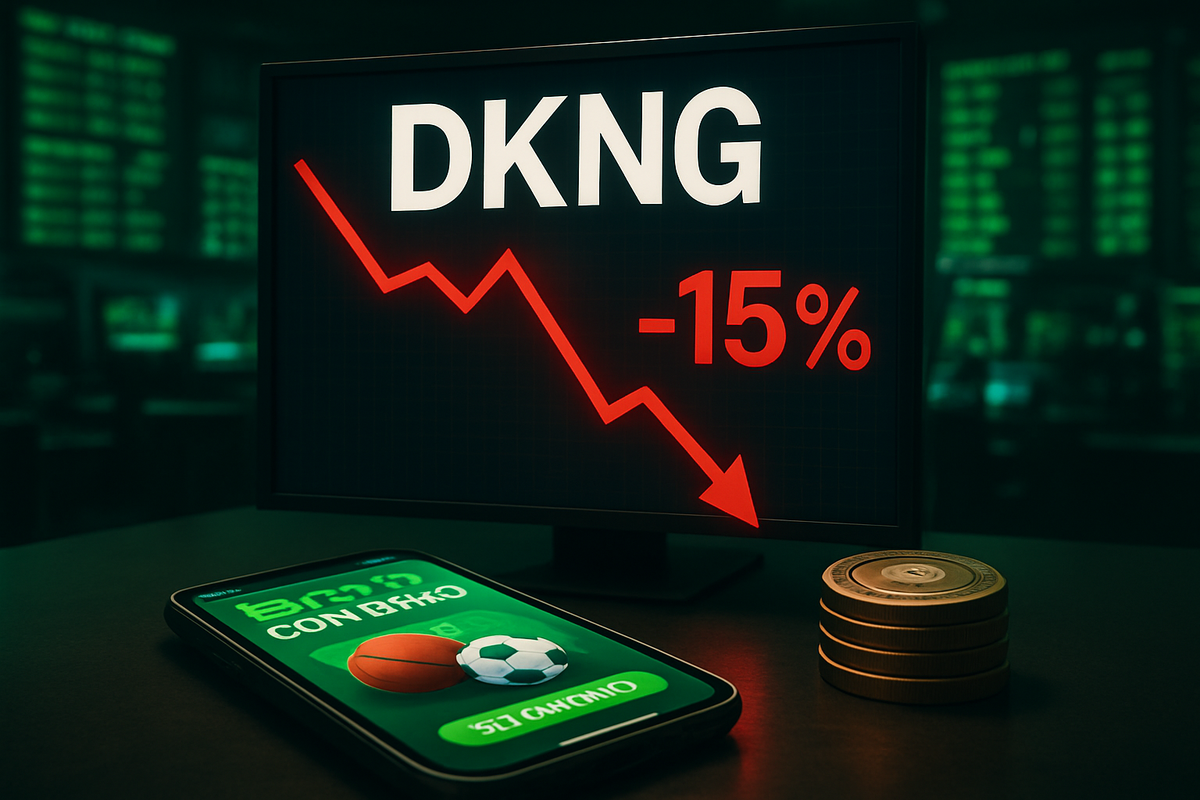
BOSTON — In a move that left Wall Street scratching its head, DraftKings (NASDAQ: DKNG) reported a blowout fourth-quarter performance today, February 13, 2026, featuring profits that nearly tripled analyst expectations. However, the celebration was short-lived as a "conservative" and disappointing revenue guidance for the 2026 fiscal year sent shares screaming lower. By mid-day trading, DraftKings stock had plummeted 15%, wiping out billions in market capitalization despite the company officially cementing its status as a profitable enterprise.
The disconnect between current performance and future expectations highlights a growing anxiety in the online sports betting (OSB) industry. While DraftKings proved it could finally squeeze significant profit from its massive user base, investors are now questioning the "ceiling" of the American gambling market. The shift from a growth-at-all-costs mindset to a focus on sustainable margins has met a new wall: aggressive state taxation and the rise of non-traditional prediction markets that are beginning to cannibalize the sports betting handle.
A Record-Breaking Quarter Overshadowed by 2026 Clouds
DraftKings’ Q4 2025 results were, by almost every traditional metric, a triumph. The company reported record quarterly revenue of $1.99 billion, a 43% increase year-over-year. More impressively, Adjusted EBITDA (earnings before interest, taxes, depreciation, and amortization) came in at a staggering $343.2 million—nearly triple the $118 million consensus estimate held by analysts going into the print. This surge helped DraftKings post its first-ever full year of net profitability, a milestone that just two years ago seemed a distant dream for the Boston-based operator.
The timeline leading to this moment was paved with strategic aggression. In December 2025, DraftKings successfully outbid rivals to become the exclusive odds provider for ESPN, effectively displacing Penn Entertainment (NASDAQ: PENN) and its struggling ESPN Bet brand. This move was expected to provide a massive top-of-funnel advantage for 2026. However, during the earnings call this morning, CEO Jason Robins issued a 2026 revenue guidance range of $6.5 billion to $6.9 billion, significantly missing the $7.3 billion mark that the street had baked into its models.
Initial market reaction was swift and brutal. Within minutes of the pre-market release, the stock fell from its $53.00 handle, bottoming out near $45.00. Traders pointed to the "lackluster" guidance and a $700–$900 million EBITDA forecast for 2026—which, while healthy, trailed the $1 billion-plus target many had hoped would follow the ESPN integration.
Winners and Losers in the Gaming Shake-up
DraftKings’ guidance cut sent ripples across the entire sector, forcing a re-evaluation of its peers. Flutter Entertainment (NYSE: FLUT), the parent company of FanDuel, saw its shares dip 4% in sympathy. FanDuel remains the market leader with roughly 40% market share, and while it has shown superior "structural hold" (profit per bet) compared to DraftKings, the realization that the "Big Two" are facing revenue headwinds suggests the entire industry might be nearing domestic saturation.
Conversely, some analysts see this as a potential floor for MGM Resorts International (NYSE: MGM) and its BetMGM joint venture. BetMGM has maintained a steady, if distant, third-place position. As DraftKings and FanDuel face the brunt of state tax hikes, BetMGM’s diversified portfolio of brick-and-mortar casinos provides a safety net that pure-play digital operators lack. Meanwhile, the clear loser continues to be Penn Entertainment. Having lost the ESPN partnership to DraftKings in late 2025, Penn has been forced to pivot back to its "theScore Bet" branding, and today's news suggests that even with the world’s largest sports media brand behind them, growing the OSB pie is getting exponentially harder.
The Taxman and the Prediction Market Pivot
The wider significance of DraftKings’ disappointing guidance lies in the shifting regulatory landscape. Throughout 2025, several key states moved to increase their "take" from gambling operators. Illinois implemented a tiered tax system reaching up to 40%, while New York has stubbornly held onto its 51% tax rate. These fiscal pressures have forced DraftKings to implement "surcharges" in high-tax states, a move that has clearly cooled consumer enthusiasm and lowered total betting volume.
Furthermore, the emergence of prediction markets like Polymarket and Kalshi has fundamentally altered the competitive landscape. These platforms, which allow users to bet on everything from Federal Reserve interest rate hikes to cultural events, have begun to siphon off high-value "sharp" bettors who traditionally spent their bankrolls on NFL or NBA spreads. In a strategic pivot announced during the call, DraftKings revealed it is investing heavily in its own "Predictions" vertical. While this could be a long-term winner, the high capital expenditure required to launch this product is a primary reason for the lowered EBITDA guidance for the coming year.
Looking Ahead: A Strategic Pivot to "Everywhere Betting"
In the short term, DraftKings must convince investors that the lower guidance is a "floor" rather than a trend. The company is expected to lean heavily into its new ESPN integration, hoping that a seamless "watch-and-bet" experience will lower user acquisition costs and offset the higher taxes. There is also the potential for legislative relief; a bill currently moving through the New York statehouse could potentially lower the 51% tax rate if more licenses are granted, which would provide an immediate and massive boost to DraftKings’ bottom line.
Long-term, the company is betting on the "gamification of everything." By moving beyond sports into general event predictions and doubling down on its iCasino segment—which typically carries much higher margins than sports betting—DraftKings is attempting to transform from a sportsbook into a comprehensive financial entertainment platform. Whether the market will afford them the time to make this transition remains the $10 billion question.
The Bottom Line for Investors
Today’s earnings report is a classic "good news, bad news" story. DraftKings has finally proven it can generate massive profits, but the path to continued high-double-digit growth has hit a regulatory and competitive wall. The 15% slide reflects a market that is no longer willing to pay a premium for "potential" and is instead demanding a clear roadmap to navigating a high-tax, saturated environment.
Moving forward, investors should keep a close eye on the "hold rates" in the first half of 2026. If DraftKings can demonstrate that its new "Predictions" vertical and ESPN integration can drive volume without massive marketing spend, the stock could recover its losses. However, for now, the message from the market is clear: the honeymoon period for online sports betting is over, and the era of the "grind" has begun.
This content is intended for informational purposes only and is not financial advice.