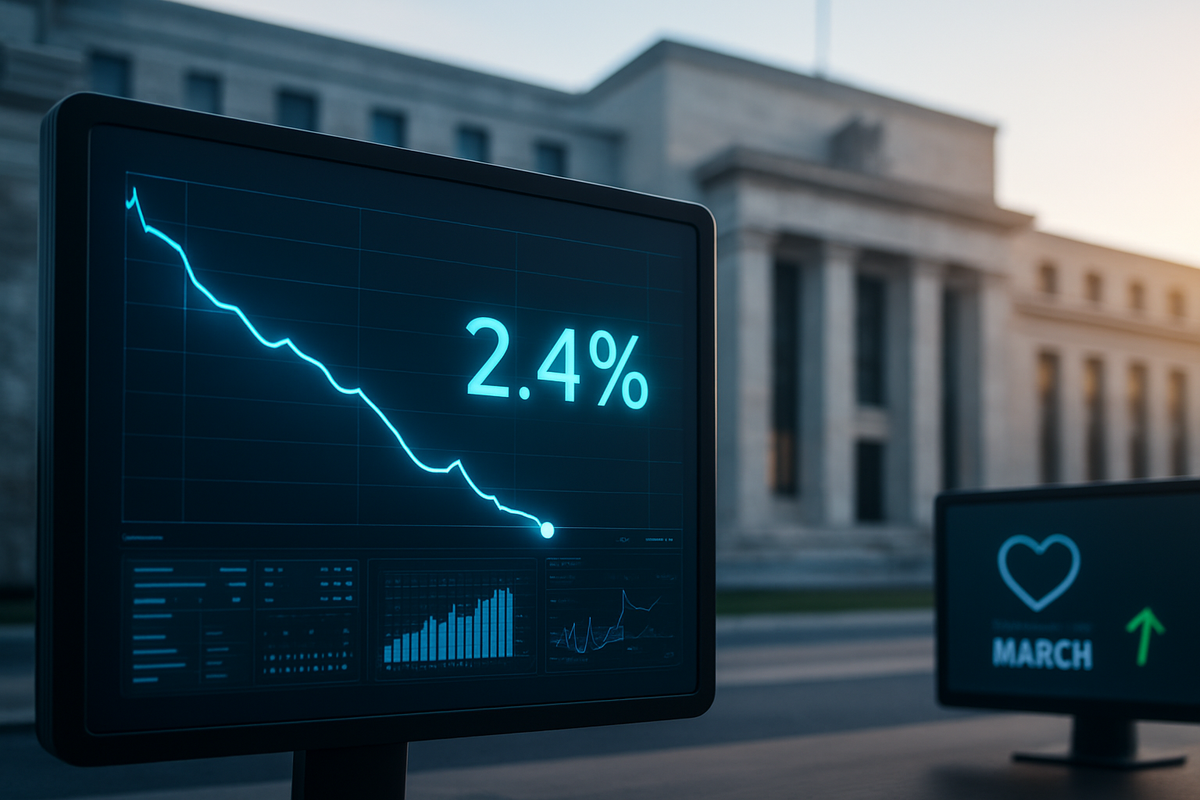
The U.S. Bureau of Labor Statistics delivered a long-awaited "Valentine’s Day eve" gift to the markets on Friday, February 13, 2026, reporting that consumer prices cooled more than expected in January. Headline inflation fell to 2.4% on a year-over-year basis, undercutting the 2.5% consensus forecast from Wall Street economists and marking the slowest annual pace of price increases since May 2025. The data has immediately reshaped the interest rate debate, providing the Federal Reserve with the "greater confidence" it has sought to begin easing its restrictive monetary policy.
The surprise cooling of the Consumer Price Index (CPI) has significantly boosted market expectations for a 25-basis-point interest rate cut at the Fed’s upcoming March meeting. Prior to the report, a blowout January jobs report had fueled fears that the central bank might keep rates in the 3.50%–3.75% range well into the summer. However, the 2.4% print has shifted the narrative, suggesting that "real" interest rates—adjusted for inflation—are now becoming overly restrictive for an economy that is finally seeing the "last mile" of its inflation fight coming to a close.
Detailed Coverage of the January 2026 CPI Event
The January CPI report was released after a two-day delay caused by a brief partial government shutdown earlier in the month, adding a layer of pent-up anxiety to the morning’s proceedings. When the data finally crossed the wires at 8:30 a.m. ET, it showed a 0.2% month-over-month increase in headline CPI, driven primarily by a 1.5% decline in energy costs. Gasoline prices alone plummeted 3.2% in January, providing a substantial tailwind for consumer discretionary spending. Core CPI, which strips out volatile food and energy components, rose 2.5% year-over-year, matching expectations and confirming that the underlying trend of disinflation remains intact.
The path to this moment has been a volatile one. Throughout the final quarter of 2025, investors grappled with "sticky" shelter costs and the potential inflationary impact of new trade tariffs. However, the January data suggests these pressures are being offset by productivity gains and a cooling global commodities market. While shelter remained the largest contributor to the monthly increase, rising 0.2%, even this historically stubborn category showed signs of stabilizing. The immediate market reaction saw the benchmark 10-year Treasury yield dip to the 4.06%–4.09% range, as bond traders moved to price in a more aggressive easing cycle for 2026.
Stakeholders ranging from retail traders to institutional hedge fund managers reacted with a "dovish tilt," though the euphoria was tempered by earlier week-to-date losses. The CME FedWatch Tool, which monitors interest rate probabilities, saw a sharp uptick in the odds of a March rate cut, as analysts argued that the Fed no longer needs to maintain "emergency-era" restraint with inflation now within striking distance of its 2% target. Federal Reserve Chair Jerome Powell, who is nearing the end of his term in May 2026, now faces a pivotal decision: lock in a "soft landing" with a March cut or wait for more data while risking an economic slowdown.
Market Winners and Losers: A Tale of Two Tapes
The cooling inflation data created a clear divide between "defensive" winners and "growth" laggards. Consumer staples emerged as the day's primary beneficiaries as investors sought stable yields. Retail giant Walmart Inc. (NYSE: WMT) and warehouse leader Costco Wholesale Corp. (NASDAQ: COST) saw modest gains as the data suggested their customer base would benefit from lower fuel costs and potentially lower borrowing rates for big-ticket items. Furthermore, Equinix, Inc. (NASDAQ: EQIX) defied broader tech weakness, surging over 10% on the back of strong data-center demand, which is seen as more resilient to interest rate fluctuations than speculative software plays.
Conversely, the "AI-driven" technology sector faced unexpected headwinds despite the favorable inflation news. Nvidia Corp. (NASDAQ: NVDA) slipped 2.34% as part of a broader rotation out of high-valuation "AI enablers" and into sectors with more immediate yield potential. Apple Inc. (NASDAQ: AAPL) was particularly hard hit, falling 5% to $261.73, though analysts attributed much of this to idiosyncratic factors, including delays in its highly anticipated Siri AI features and renewed regulatory scrutiny. For these tech titans, the relief of lower inflation was overshadowed by a "show-me" market that is increasingly demanding near-term profitability from massive AI capital expenditures.
The financial sector also faced significant pressure on the news. While lower rates are generally good for mortgage demand, the "higher-for-longer" volatility hit big banks like JPMorgan Chase & Co. (NYSE: JPM), The Goldman Sachs Group, Inc. (NYSE: GS), and Citigroup Inc. (NYSE: C), all of which saw shares drop roughly 5% in the aftermath of the report. Regional banks, represented by the SPDR S&P Regional Banking ETF (NYSEARCA: KRE), fell nearly 4% as investors fretted over the potential for a narrowing net interest margin (NIM) if the Fed cuts rates faster than the banks can adjust their own lending and deposit structures.
Analyzing the Wider Significance and Industry Trends
This January CPI print fits into a broader 2026 industry trend where macroeconomic "normalization" is the dominant theme. After years of post-pandemic price shocks and aggressive tightening, the U.S. economy appears to be entering a phase where inflation is no longer the primary threat. This shift has massive implications for policy, especially as the Federal Reserve prepares for a leadership transition. The recent nomination of Kevin Warsh to succeed Jerome Powell has introduced a more hawkish undertone to the market, but the 2.4% headline figure may force the incoming leadership to acknowledge that the "inflation monster" has been largely tamed.
Historically, this moment draws comparisons to the "mid-cycle adjustments" of the 1990s, where the Fed successfully lowered rates to sustain an expansion without reigniting inflation. The ripple effects of a March cut would be felt globally; as the U.S. begins to ease, other central banks—many of which have already started their own cutting cycles—will likely follow suit, providing a synchronized boost to global liquidity. However, the "Warsh Factor" remains a wildcard; if the incoming Chair views the current 2.4% as a temporary dip rather than a permanent trend, the "March vs. June" debate could continue to drive market volatility for weeks.
The policy implications also extend to the regulatory sphere. With inflation cooling, the political pressure on the Fed to support the labor market will likely intensify. The "blowout" jobs report from earlier in the week showed a 4.3% unemployment rate, which, while historically low, is higher than the levels seen in 2023 and 2024. If the Fed waits too long to cut rates, it risks a "policy error" where the lag effect of previous hikes finally breaks the back of the consumer, leading to a recession that could have been avoided.
Looking Ahead: Short-Term Pivots and Long-Term Possibilities
In the short term, all eyes will turn to the Personal Consumption Expenditures (PCE) price index, the Fed's preferred inflation gauge, which is due out later this month. If the PCE confirms the downward trend seen in the CPI, a March rate cut will become the "base case" for nearly all of Wall Street. Investors should prepare for a period of sector rotation, where the defensive "old economy" stocks that led today’s session may continue to outperform high-flying tech names as the market recalibrates for a lower-rate environment with moderate growth.
Strategically, companies in interest-rate-sensitive sectors like real estate and renewable energy may begin to ramp up capital investment plans that were shelved when rates were at their peak. For the broader market, the challenge will be navigating the "AI anxiety" that currently plagues the Magnificent Seven. While lower inflation is a tailwind, the fundamental question of when AI investments will start showing up on the bottom line will remain the primary driver of the Nasdaq's performance in the second half of 2026.
Potential scenarios range from a "Goldilocks" outcome—where the Fed cuts in March and the economy glides into a stable 2% growth/2% inflation regime—to a "stagflation lite" scenario if recent tariffs begin to push goods prices back up in the spring. For now, the 2.4% CPI figure has given the Fed the green light to at least begin the conversation of easing, a move that could define the economic landscape for the rest of the decade.
Wrap-Up: Significance and Lasting Impact
The January CPI report of 2026 stands as a watershed moment in the post-pandemic economic saga. By coming in at 2.4% and undercutting expectations, the data has effectively ended the debate over whether inflation is under control and moved the conversation squarely onto when the Federal Reserve will act. The immediate boost to March rate cut expectations has injected a sense of relief into the market, even if specific sectors like Big Tech and Banking have had to weather a period of transition and rotation.
Moving forward, the market will likely remain in a "data-dependent" holding pattern, but the bias has clearly shifted toward optimism. Investors should watch for comments from Fed officials in the coming weeks to see if they acknowledge the "significant breathing room" provided by this report. The upcoming transition in Fed leadership and the potential for new trade policies remain the primary risks to this outlook.
Ultimately, the takeaway for investors is one of cautious resilience. The "inflation scare" that dominated the early 2020s is receding into the history books, replaced by a more nuanced environment where stock selection and sector exposure will matter far more than broad-market index tracking. As the Fed prepares for its potential March pivot, the ability of the American consumer and the prowess of American productivity appear to have won the day.
This content is intended for informational purposes only and is not financial advice.