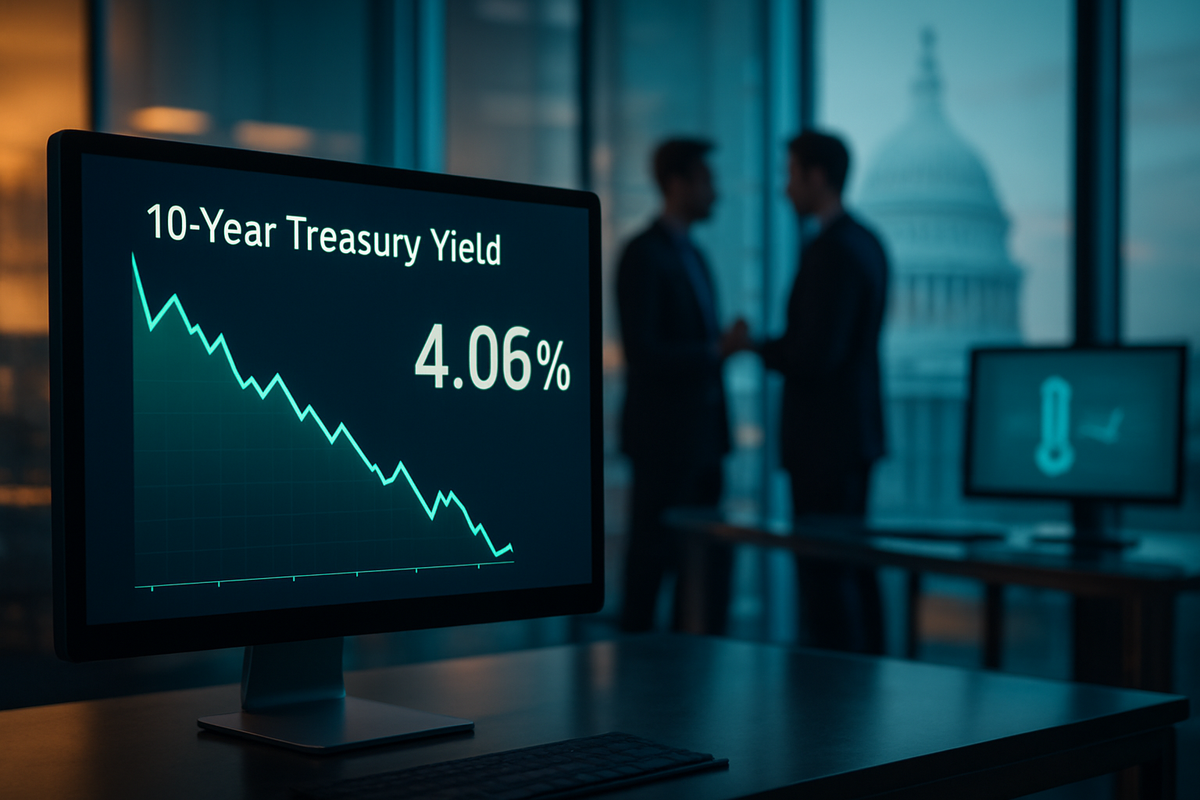
The U.S. bond market experienced a seismic shift on February 13, 2026, as the 10-year Treasury yield plummeted to 4.06% in response to a cooler-than-expected Consumer Price Index (CPI) report. This move marks a significant departure from the volatile interest rate environment that characterized much of 2025, suggesting that the Federal Reserve’s prolonged battle against inflation may finally be entering its final act. Investors reacted with a wave of buying in fixed-income assets, reflecting a growing consensus that the era of "higher-for-longer" rates is giving way to a more accommodative monetary policy.
The immediate implications of this yield drop are far-reaching, signaling a "sweet spot" for the markets where economic growth remains resilient while price pressures subside. With the 10-year yield—a critical benchmark for mortgage rates and corporate borrowing—now hovering just above the psychological 4% floor, the financial landscape is bracing for a potential surge in refinancing activity and a shift in capital allocation toward growth-oriented sectors.
Inflation Thaw Triggers Treasury Surge
The rally began at 8:30 AM ET when the Bureau of Labor Statistics released January’s inflation data. Headline CPI rose at a modest 2.4% year-over-year, coming in below the 2.5% forecast and marking the slowest pace of price growth since mid-2025. Core CPI, which strips out volatile food and energy costs, held steady at 2.5%. This data provided the "glimmer of hope" the market had been seeking after a period of "sticky" inflation in late 2025, which had been exacerbated by a "tariff pass-through" effect on consumer goods.
The path to this moment has been paved by a complex mix of economic signals. Throughout 2025, the U.S. economy displayed a "jobless growth" phenomenon, where high GDP—driven largely by massive AI-related capital expenditures—masked a softening labor market. Significant downward revisions to 2025 payroll numbers, which saw original estimates slashed from 584,000 to just 181,000 jobs, had already begun to soften the Federal Reserve's stance. The January CPI print acted as the final catalyst, convincing traders that the Fed’s current funds rate of 3.50%–3.75% is now restrictive enough to warrant a pivot.
Key stakeholders, including institutional bond desks and pension funds, moved quickly to lock in yields before they fell further. By midday, the probability of a June 2026 rate cut had surged to over 80%. The initial market reaction was a "risk-on" surge, with equity futures jumping and the U.S. dollar weakening against a basket of currencies as the yield differential narrowed.
Sector Shifts: Real Estate and Tech Rise While Banks Face Margin Pressure
The retreat in yields has created a clear divide between market winners and losers. Real Estate Investment Trusts (REITs), which are notoriously sensitive to borrowing costs, saw a massive influx of capital. Realty Income Corp (NYSE: O) and Prologis, Inc. (NYSE: PLD) led the charge, as lower yields make their high-dividend payouts more attractive relative to government bonds. Additionally, data center REITs like Digital Realty Trust (NYSE: DLR) and Equinix, Inc. (NASDAQ: EQIX) found support as the cost of financing their AI-driven infrastructure expansions began to look more manageable.
In the technology sector, the drop in the "risk-free" rate provided a valuation boost to high-growth companies whose future earnings are discounted against Treasury yields. Megacaps like Apple Inc. (NASDAQ: AAPL) and Applied Materials, Inc. (NASDAQ: AMAT) saw shares climb, while the ARK Innovation ETF (NYSEARCA: ARKK), a proxy for high-beta growth, experienced its best trading session in months. Investors are betting that lower rates will reinvigorate consumer spending on big-ticket tech items and lower the cost of capital for speculative ventures.
Conversely, the banking sector faces a potential headwind in the form of Net Interest Margin (NIM) compression. Large institutions such as JPMorgan Chase & Co. (NYSE: JPM) and Bank of America Corp. (NYSE: BAC) traditionally profit from the spread between short-term borrowing costs and long-term lending rates. As the yield curve adjusts to the new inflation reality, the flattening of the curve may squeeze these margins. Regional lenders, including Western Alliance Bancorporation (NYSE: WAL), are being watched closely as they balance the benefits of lower funding costs against the risks of reduced lending profitability.
A New Chapter in the Macroeconomic Narrative
The events of February 13 fit into a broader trend of "normalization" following the post-pandemic and AI-boom volatility. Historically, when the 10-year yield breaks below its 50-day moving average on a cooling inflation print, it often signals a multi-quarter shift in investor sentiment. The 2026 "tariff burn-off" is being compared by some analysts to the mid-1990s "soft landing," where the Federal Reserve successfully managed to lower inflation without triggering a recessionary spiral.
The ripple effects are likely to extend beyond the U.S. borders. A weaker Treasury yield often puts downward pressure on the dollar, providing relief to emerging markets that hold dollar-denominated debt. Furthermore, the focus on AI as a driver of 4.4% GDP growth in late 2025 suggests that the "productivity miracle" may be real, allowing the economy to grow without the traditional inflationary pressures seen in labor-heavy cycles. This fundamental shift is forcing policymakers to rethink traditional Phillips Curve models that link low unemployment directly to high inflation.
From a regulatory perspective, the Fed’s "hawkish hold" strategy of January 2026 appears to have been validated. By maintaining rates long enough to see the "tariff pass-through" effects dissipate, the FOMC has avoided the "stop-go" policy errors of the 1970s. However, the challenge now shifts to ensuring that the transition to lower rates does not over-stimulate the housing market or reignite speculative bubbles in the equity markets.
The Road to June: What Comes Next?
In the short term, all eyes will be on the Federal Reserve’s upcoming communication. While the market has priced in a June cut, Fed officials may remain cautious, waiting for additional labor market data to ensure that the "jobless growth" trend does not turn into a full-scale contraction. Strategic pivots are already underway in the corporate world; many CFOs are likely to accelerate debt issuance to take advantage of the 4.06% benchmark before any potential market volatility returns.
Long-term, the scenario of 2.4% inflation and 4% yields suggests a "new normal" for the terminal rate, likely higher than the zero-bound era but significantly lower than the 2023-2024 peaks. This environment presents a challenge for traditional fixed-income investors who must now decide whether to "extend duration"—buying longer-term bonds—or stay in cash-like instruments that will see their yields vanish as the Fed eventually cuts.
The most likely outcome for the remainder of 2026 is a period of "yield range-trading," where the 10-year oscillates between 3.8% and 4.2% as the market digests the pace of the Fed’s easing cycle. If consumer spending remains robust despite the labor market revisions, the U.S. could see a sustained period of capital investment that benefits both the tech and industrial sectors.
Conclusion and Investor Takeaway
The decline of the 10-year Treasury yield to 4.06% on February 13, 2026, represents more than just a daily market move; it is a signal of a structural shift in the inflation narrative. By undershooting expectations, the CPI report has cleared a path for the Federal Reserve to begin easing its restrictive stance, providing a tailwind for REITs, tech, and the broader housing market. However, the pressure on banking margins and the underlying softness in the labor market serve as reminders that the transition to a lower-rate environment is rarely without friction.
Moving forward, investors should watch for the Fed's March meeting and any further downward revisions to employment data. The key takeaway is that the "inflation monster" appears to be largely tamed, and the focus of the market has officially shifted from "how high will they go" to "how fast will they cut." As we head into the second half of 2026, the ability of companies to maintain margins in a lower-yield, lower-inflation world will be the primary driver of equity performance.
This content is intended for informational purposes only and is not financial advice.