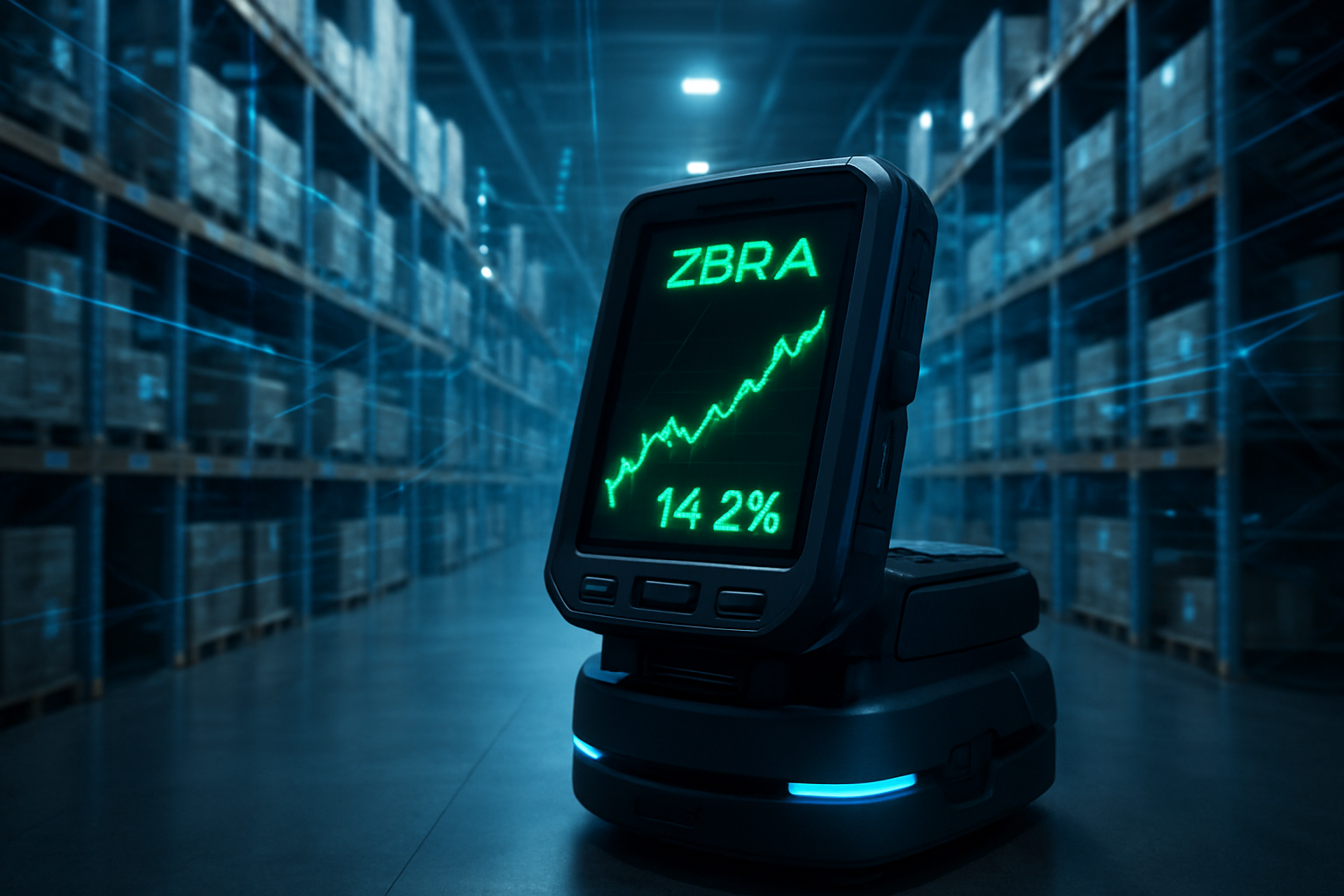
In a trading session characterized by cautious sentiment and macro-inflationary jitters, Zebra Technologies (NASDAQ: ZBRA) emerged as a definitive outlier on February 12, 2026. Shares of the Illinois-based automation leader surged 14.2% following a fourth-quarter earnings report that not only cleared analyst hurdles but fundamentally reset expectations for the industrial technology sector in 2026. The rally added billions to the company’s market capitalization, signaling that the "modernization wave" in global logistics is far from over.
The jump comes at a critical juncture for the broader market. While the major indices struggled to find direction amid fresh consumer price data, Zebra’s performance suggests a decoupling of high-end industrial tech from general economic volatility. For investors, the message was clear: enterprise demand for real-time asset visibility, driven by advanced RFID and AI-integrated scanning, has transitioned from a pandemic-era "nice-to-have" to a non-negotiable component of the 2026 industrial landscape.
A "Triple-Threat" Earnings Performance
Zebra’s meteoric rise was fueled by what analysts are calling a "triple-threat" catalyst: a significant revenue beat, aggressive 2026 guidance, and a massive capital return program. Reporting early on February 12, the company posted Q4 2025 revenue of $1.48 billion, a 10.6% year-over-year increase that comfortably bypassed the consensus estimate of $1.46 billion. Adjusted earnings per share (EPS) landed at $4.33, reflecting robust operational discipline and the successful integration of higher-margin software services into their traditional hardware stacks.
The timeline leading to this breakout began in late 2025, as Zebra finalized its $1.3 billion acquisition of Elo Touch Solutions. Many market observers were initially skeptical of the deal’s timing, fearing a slowdown in retail spending. However, the Q4 results proved those fears premature; Elo’s integration contributed nearly 7 percentage points to Zebra's growth, expanding their footprint into interactive retail and healthcare displays. To cap off the announcement, Zebra’s Board of Directors authorized a new $1 billion share repurchase program, a move that underscored management’s conviction that the stock remained undervalued despite its recent gains.
Initial market reaction was swift. Within the first hour of trading, ZBRA shares gapped up 9% before continuing their climb to close up 14.2%. Institutional traders pointed to the company’s "Asset Visibility & Automation" (AVA) segment as the standout performer, noting that industrial clients are no longer just buying scanners—they are investing in entire ecosystems of machine vision and automated tracking to combat persistent labor shortages.
Winners and Losers in the Automation Arms Race
Zebra’s success sent ripples through the digital data capture and frontline automation sub-sectors. Impinj (NASDAQ: PI), a leader in RAIN RFID silicon, saw its shares rise 5.6% in sympathy. As Zebra—one of Impinj's largest partners—forecasts higher demand for RFID-enabled readers and scanners, the "spillover effect" for component manufacturers in the tracking ecosystem is significant. Similarly, Cognex (NASDAQ: CGNX) maintained its upward momentum, benefiting from the renewed investor appetite for "AI-first" industrial hardware.
Conversely, the day’s winners were contrasted by the stagnation of traditional industrial giants. Honeywell (NASDAQ: HON) shares remained flat, ending the day down 0.3%. While Honeywell remains a formidable competitor, its ongoing restructuring and the planned spin-off of its aerospace business, Solstice, have created a "wait-and-see" approach among investors that stands in stark contrast to the enthusiasm for Zebra’s focused portfolio.
The most notable laggard was Rockwell Automation (NYSE: ROK), which fell 3.65% on the same day. The divergence highlights a growing trend in early 2026: the market is favoring "digital-first" and software-integrated automation providers over traditional, heavy hardware-centric firms. As Zebra pivots toward subscription-based "Robotics-as-a-Service" (RaaS) models, companies tethered to old-guard capital expenditure cycles are finding it increasingly difficult to compete for the same premium valuations.
The Significance of the "Balanced Automation" Era
Zebra’s rally is a bellwether for the transition into what industry experts call the "Pragmatic Phase" of industrial automation. Between 2022 and 2024, the market was defined by "panic-buying" as companies scrambled to solve supply chain crises. In 2026, the demand is more strategic. Zebra’s 9% to 13% sales growth guidance for the full year suggests that the "Connected Frontline"—the digital link between warehouse workers and automated systems—is the new focus of capital investment.
This event also signals a major technological tipping point: the maturity of AI-integrated vision. Zebra is no longer just a barcode company; it is an AI software provider. Their "AI Suite for Frontline Operations" has allowed them to capture higher margins by offering predictive analytics on top of their scanning hardware. This shift mirrors historical precedents, such as the software-led recovery of the networking sector in the mid-2010s, where hardware became the gateway to high-value service contracts.
From a regulatory standpoint, the push for greater traceability in pharmaceutical and food supply chains has provided a tailwind for Zebra. New standards in 2025 and early 2026 have mandated more granular tracking of goods, making Zebra’s RFID and Gen2X readers essential infrastructure. Competitors who failed to invest early in these compliance-ready technologies are now finding themselves locked out of major enterprise contracts.
What Comes Next: A Look at the 2026 Horizon
In the short term, the market will be watching to see if Zebra can maintain this momentum in its Q1 2026 report. Management has already set a high bar, projecting 11% to 15% revenue growth for the first quarter. The key challenge will be managing the supply of high-end silicon components required for their AI-enabled devices. Any hiccup in the semiconductor supply chain could potentially dampen the current euphoria.
Long-term, the strategic pivot to Robotics-as-a-Service (RaaS) will be the most critical metric for investors. By moving toward flexible, subscription-based models for Autonomous Mobile Robots (AMRs), Zebra is attempting to lower the barrier to entry for mid-sized firms. If successful, this could unlock a massive secondary market that was previously priced out of high-end automation, providing a sustainable growth engine well into 2027 and 2028.
We may also see an acceleration of M&A activity. With a $1 billion buyback authorized and a strong cash position, Zebra is well-equipped to swallow smaller AI start-ups that specialize in "Inbound Automation"—the current frontier of warehouse technology focused on autonomous de-palletizing and real-time inventory inspection as goods enter a facility.
Wrap-Up and Investor Outlook
The 14.2% jump in Zebra Technologies' stock is more than just a reaction to a strong earnings report; it is a validation of a multi-year transformation. By successfully integrating the Elo Touch acquisition and leaning into the "AI-first" software pivot, Zebra has decoupled itself from the broader industrial doldrums and positioned itself at the center of the modern supply chain.
For the market moving forward, Zebra represents the gold standard of the "AIDC" (Automatic Identification and Data Capture) space. Its ability to exceed 2026 guidance while peers like Honeywell and Rockwell struggle with macro headwinds suggests that the winners in the industrial sector will be those who can bridge the gap between physical labor and digital intelligence.
Investors should keep a close eye on RFID adoption rates and the progression of the RaaS rollout in the coming months. While the stock may face some near-term consolidation after such a rapid ascent, the fundamental story—of a company that has moved from "scanner maker" to "intelligence provider"—remains the most compelling narrative in the 2026 industrial landscape.
This content is intended for informational purposes only and is not financial advice.