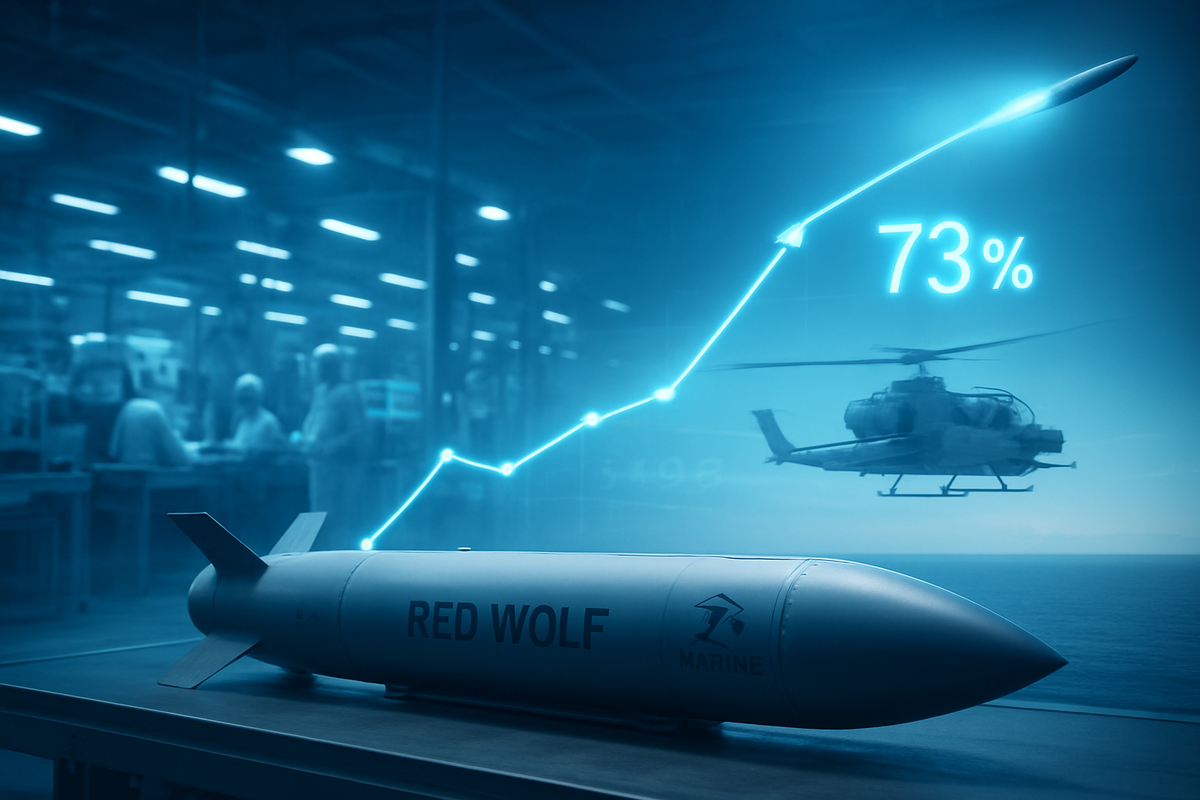
As the defense sector grapples with the escalating complexities of modern warfare, L3Harris Technologies (NYSE: LHX) has emerged as a standout performer, posting a staggering 73% stock surge over the past twelve months. This rally, which has pushed shares into record territory near the $350 mark, is underpinned by a perfect storm of operational excellence, aggressive cost-cutting through its "LHX NeXt" initiative, and the successful integration of strategic acquisitions like Aerojet Rocketdyne. The company's recent performance has turned it from a steady defense contractor into a high-growth momentum play, captivating Wall Street even as valuation premiums begin to rise.
The momentum is fueled by a series of landmark achievements that underscore the company's critical role in the global defense supply chain. From reaching a historic milestone in fuzing deliveries to securing pivotal Navy contracts for advanced missile systems, L3Harris is proving that its pivot toward high-demand munitions and electronic warfare is paying dividends. With 2025 revenue hitting a record $21.9 billion, the company is demonstrating that its "inflection point" strategy is not just talk, but a measurable shift in market dominance.
Precision Performance: Fuzes and 'Red Wolf' Lead the Charge
The primary engine behind this growth is a massive ramp-up in production capacity, particularly within the company’s Fuzing and Ordnance Systems organization. In early February 2026, L3Harris announced a record-shattering delivery milestone, shipping nearly 500,000 fuzes in 2025—an 80% increase over the previous year. These components, which serve as the "brains" of various munitions, are in high demand as U.S. and allied forces look to replenish stockpiles depleted by ongoing global conflicts. This surge in production was facilitated by an $871 million IDIQ contract from the U.S. Army, allowing the company to scale its manufacturing lines at a pace rarely seen in the traditional defense industrial base.
Complementing this high-volume production is a move into high-tech, long-range strike capabilities. In late January 2026, the U.S. Naval Air Systems Command selected L3Harris for an $86.2 million contract to develop the "Red Wolf" missile system for the Marine Corps’ Precision Attack Strike Munition program. Designed as a "mini-cruise missile," the Red Wolf offers a range of up to 200 nautical miles, significantly outperforming traditional short-range helicopter-launched missiles. The system, which can be deployed in autonomous swarms from the AH-1Z Viper, represents a shift toward "affordable mass"—providing high-precision, long-range capabilities at a fraction of the cost of legacy "exquisite" munitions.
Financially, these operational wins translated into a banner 2025. The company reported $21.9 billion in total revenue, bolstered by a 5% organic growth rate and a book-to-bill ratio of 1.3x. This indicates that L3Harris is receiving orders faster than it can fill them, creating a healthy backlog that currently stands at a record $27.5 billion. CEO Christopher Kubasik has attributed much of this success to the "LHX NeXt" program, which successfully realized $1.2 billion in annual cost savings, allowing the firm to expand its operating margins to 15.8% despite the inflationary pressures affecting the broader economy.
Market Dynamics: Identifying the Winners and Losers
L3Harris's meteoric rise has significant implications for its peers in the defense sector. As a primary winner, the company has successfully transitioned from a specialized electronics firm into a diversified prime contractor that rivals the likes of Lockheed Martin (NYSE: LMT) and RTX Corporation (NYSE: RTX). By acquiring Aerojet Rocketdyne, L3Harris effectively captured a critical "bottleneck" in the missile production process—solid rocket motors—giving it a strategic advantage over competitors who must now source these essential components from a company they often bid against for prime contracts.
While L3Harris thrives, traditional aerospace giants like Boeing (NYSE: BA) may find themselves on the losing side of shifting budget priorities. As the Pentagon moves away from expensive, multi-decade platform programs in favor of "affordable mass" and rapidly deployable munitions like the Red Wolf, legacy platform providers may see their share of the defense budget erode. Furthermore, smaller subcontractors who previously provided fuzing or propulsion systems may find themselves squeezed out as L3Harris brings more of its supply chain in-house to maintain the blistering production pace required to meet its 500,000-unit delivery targets.
Investors in Northrop Grumman (NYSE: NOC) are also watching closely. While Northrop remains a leader in high-end stealth and space technology, L3Harris’s aggressive expansion into the "middle tier" of the market—missiles, sensors, and tactical communications—puts direct pressure on Northrop’s tactical systems business. However, the broader defense sector may see a "rising tide" effect; the sheer volume of orders flowing into L3Harris suggests that the entire munitions industrial base is entering a period of prolonged expansion, benefiting specialty chemical providers and metal fabrication firms that feed these massive production lines.
The Paradigm Shift to 'Affordable Mass'
The success of L3Harris and its Red Wolf system marks a broader shift in Western military doctrine. For decades, the U.S. focused on "exquisite" systems—incredibly capable but prohibitively expensive platforms produced in small numbers. The current geopolitical landscape has exposed the vulnerability of this approach, emphasizing the need for high-volume, cost-effective munitions that can saturate enemy defenses. L3Harris has positioned itself at the center of this "affordable mass" trend, pivoting its business model to prioritize high-rate production of smart components and swarmable autonomous systems.
This shift has significant policy implications. Lawmakers are increasingly favoring contractors that can demonstrate rapid scalability. The 80% increase in fuzing deliveries is a case study in how a defense prime can adapt to urgent "emergency" requirements without the typical decade-long procurement cycle. By proving it can scale production while simultaneously innovating with systems like the Red Wolf, L3Harris is setting a new standard for the "Defense Industrial Base 2.0," which prioritizes agility and software-defined capabilities over traditional heavy manufacturing.
Historically, this period mirrors the rapid industrial mobilization seen during the early Cold War, but with a modern twist: the integration of artificial intelligence and autonomous coordination. The Red Wolf’s ability to operate in swarms reflects a move toward decentralized warfare, where the loss of a single unit is negligible compared to the potential damage a coordinated swarm can inflict. As L3Harris continues to lead this charge, it forces competitors to rethink their R&D investments, potentially sparking a new arms race in low-cost, high-impact tactical weaponry.
Valuation Concerns vs. Growth Trajectory
Despite the 73% stock surge, many analysts remain remarkably bullish on LHX, though the debate over valuation is intensifying. Currently trading at a trailing P/E ratio in the 30x to 40x range, the stock is no longer the "value" play it was two years ago. However, proponents argue that the company’s massive $27.5 billion backlog provides a level of earnings visibility that justifies a premium. Discounted Cash Flow (DCF) models from early 2026 suggest an intrinsic value near $380, implying that even at record highs, the stock may still have double-digit upside.
The short-term challenge for L3Harris will be maintaining its margin expansion as it integrates even more of its supply chain. The company is currently undergoing a reorganization into three primary business segments to further streamline operations in 2026. If the "LHX NeXt" savings continue to materialize and the company successfully deleverages its debt from the Aerojet acquisition, it could unlock further shareholder value through increased dividends and share buybacks. However, any hiccups in the high-rate production of fuzes or a delay in the Red Wolf testing phase could provide a reality check for the stock’s premium valuation.
Conclusion: A New Era for Defense Investors
L3Harris Technologies has successfully navigated a complex integration phase to emerge as a dominant force in the modern defense landscape. The 73% surge in its stock price is not merely a product of market exuberance, but a reflection of a company that is meeting the specific demands of 21st-century warfare: speed, scale, and "affordable mass." By delivering half a million fuzes in a single year and winning critical long-range strike contracts, the company has cemented its role as an indispensable partner to the U.S. military.
For investors, the key takeaway is the shift in the company’s profile from a defensive value stock to a growth-oriented technology leader. While the premium valuation requires a higher degree of execution, the massive backlog and favorable industry tailwinds suggest that L3Harris is well-positioned for continued outperformance. In the coming months, the market should watch for updates on the Red Wolf flight tests and the company’s progress in reducing its debt-to-EBITDA ratio. As long as the global demand for munitions remains at historic highs, L3Harris appears to have the wind at its back.
This content is intended for informational purposes only and is not financial advice.