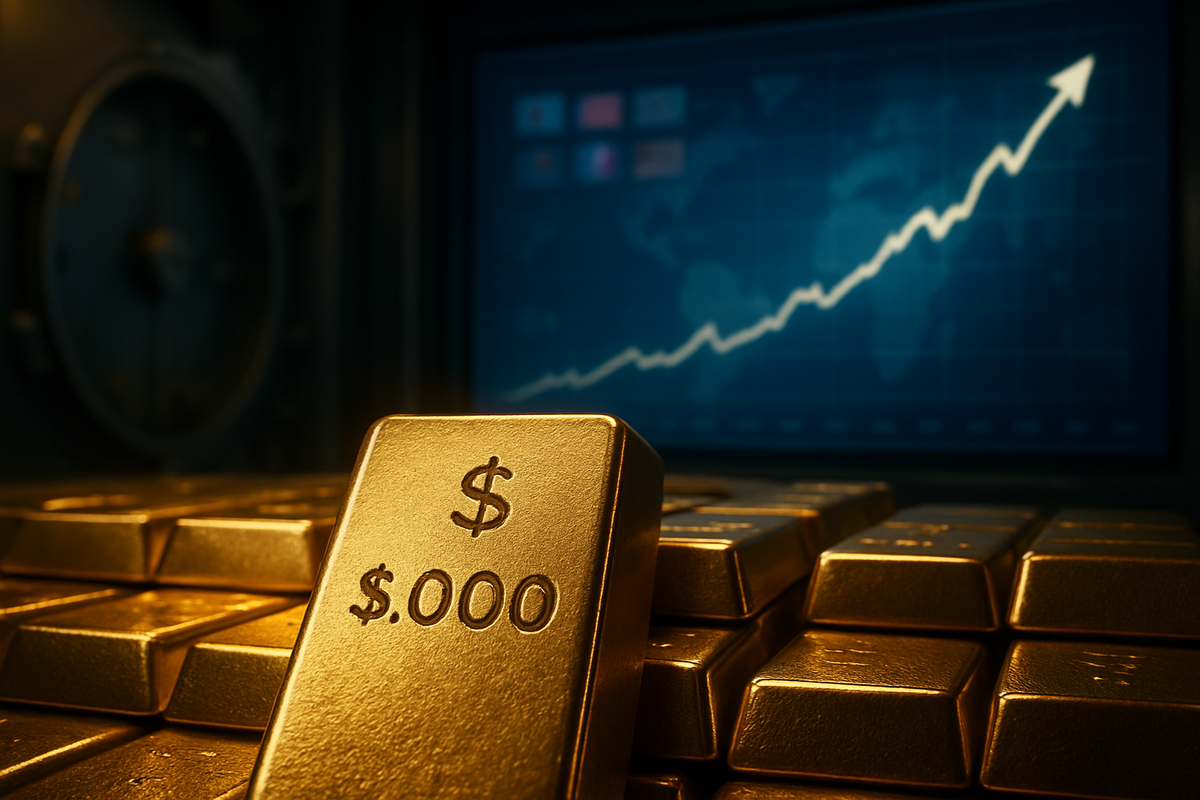
LONDON/NEW YORK – In a historic shift that has redefined the global financial landscape, gold has decisively breached the $5,000 per ounce milestone for the first time in history. As of February 12, 2026, the yellow metal sits at $4,985, having briefly peaked at a staggering $5,608 in late January. This unprecedented surge marks the culmination of a "perfect storm" of macroeconomic triggers, leaving investors and world governments grappling with a reality where gold is no longer just a hedge, but the primary anchor of the international monetary system.
The immediate implications of this milestone are profound. The breach of $5,000 has triggered a massive revaluation of commodity-linked assets and sparked a "Sell America" sentiment across global markets. As the U.S. dollar experiences its most significant weakness in years, the move to gold reflects a systemic loss of confidence in traditional fiat currencies. For the average consumer, the effects are already being felt in the rising costs of everything from high-end electronics to jewelry, while for central banks, the $5,000 mark validates a multi-year strategy of aggressive diversification away from Western-dominated financial reserves.
The Road to $5,000: A Timeline of the 2025 Super-Cycle
The ascent of gold over the past 14 months has been nothing short of spectacular, characterized by a historic 64% gain throughout the calendar year 2025. This rally began in earnest in early 2025 as the Federal Reserve struggled to balance persistent "cost-push" inflation against a slowing economy. However, the true catalyst was a shift in geopolitical strategy. The "Greenland Crisis" of late 2025—where the U.S. administration threatened 10% to 25% tariffs on key European allies—shattered the post-WWII diplomatic consensus. This sparked a flight to safety that saw gold prices jump from roughly $2,800 to over $4,000 in a matter of months.
By January 2026, the momentum had turned into a speculative frenzy. On January 26, 2026, the $5,000 psychological barrier was finally broken on the COMEX exchange, leading to an intraday high of $5,608 just three days later. This "blow-off top" was met with sudden volatility on January 30, when the CME Group aggressively hiked margin requirements and the news broke that Kevin Warsh had been nominated as the next Federal Reserve Chair. Markets perceived Warsh as a figure who might return stability to the dollar, leading to a "flash crash" that brought prices back toward the $5,000 level where they have since consolidated.
The key players in this drama have not been retail traders, but the "Big Three" central banks: China, Russia, and India. The People’s Bank of China (PBOC) has added gold to its reserves for 15 consecutive months, with official holdings now exceeding 2,300 tonnes. Analysts suggest "off-book" holdings may be double that. Meanwhile, the Reserve Bank of India (RBI) has utilized its rising national wealth to add 200 tonnes in the last five years, acting as a structural floor for the market every time prices dipped. This institutional buying has fundamentally altered gold’s market dynamics, making it more resistant to traditional interest-rate pressures.
Corporate Winners and the New Industrial Burden
The mining sector has seen its fortunes transformed by the $5,000 price tag, though not without internal friction. Newmont Corporation (NYSE: NEM) has seen its stock price surge over 170% since early 2025, reaching roughly $124.60. Similarly, Barrick Gold (NYSE: GOLD) has posted gains of 160%. However, the massive profits have led to a "clash of titans" over the Nevada Gold Mines (NGM) joint venture. In early 2026, Newmont challenged Barrick’s plan to IPO its North American assets, asserting a "Right of First Refusal" and claiming that operational standards had slipped under the current management structure. Despite the infighting, both companies are enjoying record gross profit margins exceeding 160%.
On the flip side, industrial users and luxury retailers are reeling. Tech giants like Apple (NASDAQ: AAPL) and Nvidia (NASDAQ: NVDA), which rely on gold for high-end circuitry and semiconductor components, are facing rising input costs that threaten to squeeze hardware margins. In the retail sector, Signet Jewelers (NYSE: SIG) and other high-street jewelers are being forced to pivot toward "investment-grade" jewelry and lab-grown alternatives as the price of a standard 14k gold band moves out of reach for the middle class. Streaming and royalty companies like Franco-Nevada (NYSE: FNV) are the perhaps the cleanest winners, benefiting from the price surge without the direct operational headache of rising energy and labor costs in the mining pits.
Geopolitics and the "Crisis Currency" Status
The wider significance of gold at $5,000 cannot be overstated. We are witnessing the most aggressive "de-dollarization" trend since the 1970s. The U.S. Dollar Index (DXY) weakened by nearly 10% in 2025, falling to its lowest level in four years. This weakness is not merely cyclical; it is a structural response to the "weaponization" of the dollar in trade disputes and the ballooning U.S. fiscal deficit. In this environment, gold has transitioned from a passive asset into an active "liquidity anchor" for the BRICS nations and even some European allies looking to shield themselves from transatlantic trade wars.
This event mirrors the 1971 "Nixon Shock," but in reverse. While 1971 marked the end of the gold-backed dollar, 2026 may be remembered as the year gold returned as the "de facto" reserve asset of a multi-polar world. The regulatory implications are also mounting; there is growing talk in Washington about new "windfall taxes" on mining companies, while the G7 is discussing a "Gold Transparency Act" to monitor the movement of physical bullion across borders to prevent sanctions-evasion by Russia and its partners.
What Comes Next: Stability or Speculative Bubble?
In the short term, the market is looking toward the confirmation of Kevin Warsh as Fed Chair. If Warsh signals a return to "sound money" principles and manages to stabilize the dollar, gold may enter a prolonged period of consolidation between $4,500 and $5,000. However, if the tariff threats against Europe and Mexico escalate into a full-scale trade war, $6,000 could be within reach by the end of 2026. The strategic pivot for investors is now moving toward "junior miners" and explorers, as the major producers struggle to find enough new deposits to satisfy the voracious appetite of central banks.
The long-term challenge will be the "physical vs. paper" divide. As gold prices stay high, we expect a surge in demand for physical delivery, which could stress the vaults of the London Bullion Market Association (LBMA). If the "paper" market—where gold is traded via ETFs like SPDR Gold Shares (NYSE: GLD)—becomes disconnected from the physical price of bullion, we could see a systemic breakdown in how gold is valued globally, leading to a fragmented market with different prices in Shanghai, Dubai, and London.
Closing Thoughts for the Modern Investor
The breach of $5,000 per ounce is a watershed moment that signals the end of the post-2008 era of dollar hegemony and the beginning of a new, commodity-centric financial order. The historic 64% gain in 2025 was not a fluke, but a warning shot. For investors, the takeaway is clear: gold is no longer a "niche" insurance policy. It has become a central pillar of portfolio construction in an age of geopolitical instability and currency debasement.
Moving forward, the market will be defined by the tension between central bank accumulation and Federal Reserve policy. While the volatility of early 2026 has been jarring, the underlying drivers—debt, tariffs, and de-dollarization—remain firmly in place. Investors should watch the Nevada joint venture dispute between Newmont and Barrick as a bellwether for the health of the mining industry, and keep a close eye on the DXY for any signs of a dollar recovery. In the "Golden Age" of 2026, the only certainty is that the old rules of the market no longer apply.
This content is intended for informational purposes only and is not financial advice.