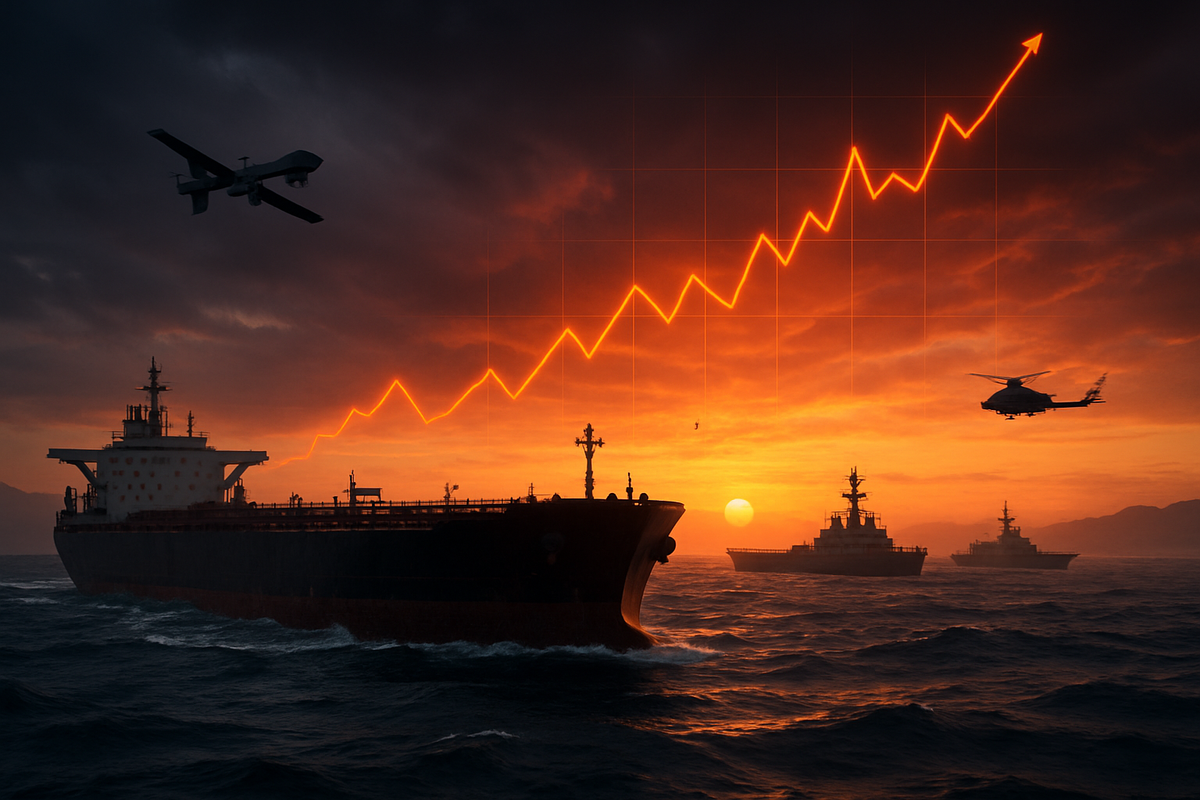
As of February 11, 2026, the global energy landscape is teetering on the edge of a significant supply disruption following a series of aggressive maritime interdictions by the United States. On February 9, US naval forces successfully boarded and seized the Aquila II, a crude oil tanker allegedly part of Iran’s "shadow fleet," in the Indian Ocean. This move, the latest in a string of similar operations since December 2025, has sent Brent crude prices surging toward $70 per barrel as traders brace for a direct military or economic response from Tehran.
The immediate implications are stark: the "geopolitical war premium," which had largely subsided during the mid-2025 period of oversupply, has returned with a vengeance. Analysts warn that if the Strait of Hormuz—the world’s most critical oil chokepoint—becomes a theater of active conflict, the current price volatility could be merely a prelude to a triple-digit oil shock. With US inflation already proving stickier than expected in early 2026, this escalation threatens to derail the Federal Reserve's hopes for a "soft landing" and a series of rate cuts.
The Path to Escalation: Maximum Pressure in the High Seas
The seizure of the Aquila II was not an isolated incident but the culmination of a "Maximum Pressure 2.0" campaign launched by the returning Trump administration in early 2026. Since late 2025, the US Treasury has identified over 20 tankers linked to the Iranian-Venezuelan oil trade and the Quds Force. The timeline of escalation began in December 2025 with the seizure of the M/T Skipper and Bella I, followed by the deployment of the USS Abraham Lincoln (CVN-72) aircraft carrier strike group to the Arabian Sea to oversee maritime enforcement.
Iran has not remained passive during this buildup. On December 24, 2025, the Islamic Revolutionary Guard Corps (IRGC) retaliated by seizing a foreign-flagged vessel near Gheshm Island, and more recently, on February 5, 2026, a US F-35 fighter jet was forced to down an Iranian Shahed-139 drone that approached the US carrier group. These skirmishes have effectively turned the Persian Gulf into a high-risk zone, with the US Maritime Administration (MARAD) issuing emergency advisories for all US-flagged tankers, such as the Stena Imperative, to avoid Iranian territorial waters and refuse all boarding requests.
Key stakeholders, including the International Maritime Organization and major OPEC+ producers, are monitoring the situation with growing alarm. While the US argues these seizures are necessary to cut off funding for regional proxies and force a new nuclear diplomatic framework, the immediate result has been a 5% jump in crude prices in just 48 hours. Market sentiment is now dominated by the fear that Iran may resort to its "nuclear option": mining the Strait of Hormuz or launching missile strikes against regional oil infrastructure in Saudi Arabia or the UAE.
Corporate Fallout: Winners and Losers in a Volatile Market
The companies positioned to "win" from this volatility are primarily upstream oil producers that benefit from higher commodity prices without significant exposure to the Persian Gulf's shipping risks. ExxonMobil (NYSE: XOM) and Chevron (NYSE: CVX) have seen their stock prices buoyed by the rising price of Brent crude, as their massive portfolios in the Permian Basin and Guyana provide a "safe" alternative to Middle Eastern supply. However, these gains are tempered by the potential for domestic political pressure in the US to limit exports if domestic gasoline prices spike too high.
Conversely, the global shipping industry is facing a dual crisis of rising costs and physical danger. A.P. Moller-Maersk (CPH: MAERSK-B) and Hapag-Lloyd (ETR: HLAG) are already grappling with the long-term diversions around the Cape of Good Hope, which have added 10–14 days to transit times since 2024. In early February 2026, Maersk warned that its earnings for the year could be halved if the "normalization" of the Red Sea is further delayed by these new US-Iran tensions. The cost of "war risk" insurance has spiked for all vessels entering the Gulf, a cost that is being passed directly to consumers.
European energy majors like BP (NYSE: BP) and Shell (NYSE: SHEL) are in a precarious middle ground. While they benefit from higher oil prices, they are also under immense pressure to maintain shareholder returns through buybacks. If volatility becomes too extreme, or if assets in the Middle East are directly threatened by Iranian retaliation, these companies may be forced to pause capital return programs, as they did during previous periods of geopolitical instability.
Broader Significance: The Return of Weaponized Trade
This event fits into a broader trend of "weaponized trade" that has come to define the mid-2020s. The US's shift from financial sanctions to physical seizure of assets marks a significant escalation in how superpowers manage regional adversaries. It echoes the historical precedents of the "Tanker War" in the 1980s, but with the added complexity of modern drone warfare and a global economy that is far more interconnected through "just-in-time" logistics.
The regulatory implications are profound. The US Department of Justice and the Treasury are essentially acting as a global maritime police force, a role that challenges international maritime law and could provoke a backlash from major oil importers like China. If China, the primary destination for "shadow fleet" oil, decides to provide naval escorts for its tankers, the risk of a superpower confrontation in the South China Sea or the Indian Ocean would increase exponentially.
Furthermore, the impact on US inflation cannot be overstated. With headline inflation reported at 2.5% for early 2026, any sustained increase in energy costs—which rose 2.8% year-over-year in January—could force the Federal Reserve to maintain high interest rates. This "higher-for-longer" environment would continue to pressure the US manufacturing sector, where the Global Manufacturing PMI is already hovering near the stagnation mark of 50.9.
Future Outlook: Strategic Pivots and Worst-Case Scenarios
In the short term, the market will likely see a period of "headline-driven" trading. Any rumor of a diplomatic backchannel or, conversely, a new IRGC seizure, will send prices swinging by $2–$3 a day. A potential "strategic pivot" for oil companies will involve accelerating production in "low-risk" geographies. We are likely to see a surge in investment in the offshore fields of Brazil and the African Atlantic coast as buyers seek to bypass the Strait of Hormuz entirely.
A long-term scenario involves the potential for a "structural" oil price floor. Even if a full-scale war is avoided, the increased insurance premiums and the necessity of naval escorts for commercial shipping will permanently raise the floor for oil prices. Investors should watch for the "Gemini Network" collaboration between Maersk and Hapag-Lloyd as a litmus test for how the shipping industry will adapt; if these giants can maintain schedule reliability despite the chaos, it may mitigate some of the inflationary pressure on retail goods.
The worst-case scenario remains a total closure of the Strait of Hormuz. While Iran relies on the waterway for its own remaining trade, a "cornered" regime might view closure as its only leverage. In such a scenario, analysts at BloombergNEF suggest Brent could reach $100/bbl by late 2026, regardless of the current global supply surplus from non-OPEC producers.
Conclusion: A Tense Horizon for Global Energy
The seizure of the Aquila II has signaled that the era of "shadow fleet" immunity is over, but it has done so at the cost of significant global stability. The key takeaway for the market is that the geopolitical "war premium" is no longer a temporary spike but a permanent fixture of 2026 energy pricing. As the US continues its maritime enforcement, the risk of a miscalculation—leading to a direct military engagement—remains the single largest "tail risk" for the global economy.
Moving forward, the market is likely to remain bifurcated. Upstream oil producers in the Americas will thrive on the volatility, while global shipping and consumer-facing sectors like retail will continue to struggle with the "inflationary tax" of geopolitical instability. The Federal Reserve's "hawkish pause" in January 2026 suggests that policymakers are aware of this trap, but they have few tools to combat supply-side inflation driven by naval warfare.
Investors should closely watch the US Maritime Administration’s advisories and the weekly inventory reports from the Energy Information Administration (EIA). If US inventories begin to draw down while Middle Eastern tensions rise, the path to $90 or $100 oil will be cleared. The lasting impact of this event will be an accelerated shift toward energy independence in the West and a more fractured, expensive, and dangerous global trade map.
This content is intended for informational purposes only and is not financial advice.