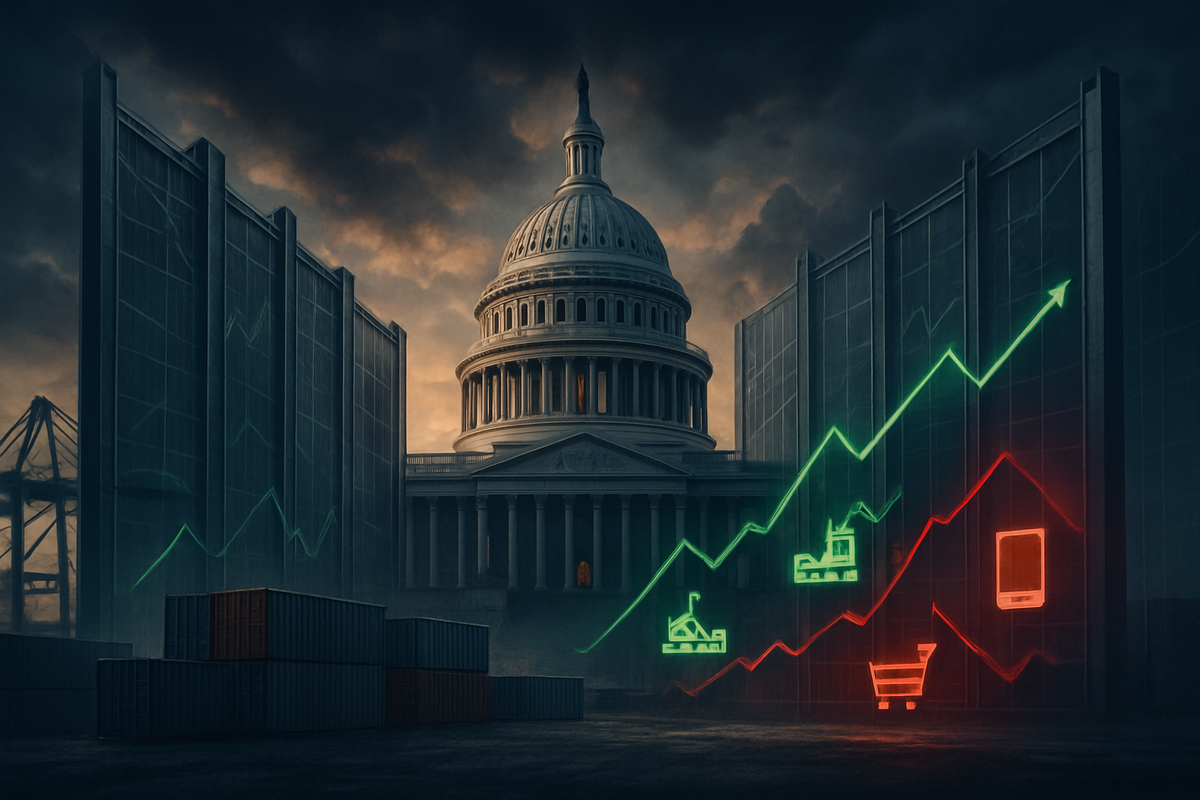
In a landmark procedural victory for the second Trump administration, the U.S. House of Representatives has decisively rejected a multi-pronged effort to block or stall the President’s aggressive new tariff regime. The vote, which took place in early February 2026, effectively clears the legislative path for the "Trade Fairness and Reciprocity Act of 2026," a controversial bill that codifies the Executive Branch's authority to impose sweeping duties without the traditional case-by-case approval from Congress.
This development marks a definitive turning point in U.S. economic history, as the "America First" agenda moves from a series of executive orders to a permanent legislative reality. For the markets, the news has catalyzed a sharp divergence between domestic industrial sectors and globalized consumer giants. While the administration argues these measures are essential to protecting American jobs and reducing the trade deficit, investors are bracing for a sustained period of "cost-push inflation" and potential retaliation from major trading partners.
The Procedural Showdown: How the Wall Was Built
The defeat of the anti-tariff coalition followed weeks of intense legislative maneuvering in the House. In late January 2026, a bipartisan group—consisting of the Democratic minority and a small contingent of "free-trade" Republicans—attempted to leverage a "Motion on the Previous Question" to amend House rules. Their goal was to force a vote on a "Resolution of Approval" mechanism, which would have required any new tariff exceeding 5% to be subject to a Congressional vote before implementation. However, the House majority held firm, defeating the motion in a 222–212 vote that fell largely along party lines.
The final blow to the opposition came in early February when a "Motion to Recommit" the trade bill to the House Ways and Means Committee was defeated. This motion, led by those wary of executive overreach, sought to attach "sunset clauses" to the Universal Baseline Tariff (UBT), which would have mandated that the tariffs expire after two years unless renewed by Congress. By rejecting these procedural blocks, the House has effectively signaled its support for a unified trade front, granting the President broad discretion to use tariffs as a primary tool for both economic and diplomatic leverage.
The core of this legislative victory is the enablement of the administration’s two-tier strategy: a 10% to 20% Universal Baseline Tariff on nearly all imports and a specific 60% levy on Chinese-manufactured goods. This "Reciprocal Trade Act" power allows the administration to match the tariff levels of any country that imposes higher duties on U.S. goods than the U.S. does on theirs—a policy often described by supporters as "eye-for-an-eye" trade.
Market Bifurcation: The Winners and Losers of the New Order
The immediate reaction on Wall Street has been a dramatic "re-rating" of several key sectors. The primary beneficiaries are domestic materials and industrial companies, which are now shielded from foreign competition by the new tariff floor. Nucor Corporation (NYSE: NUE) and United States Steel Corporation (NYSE: X) have emerged as market favorites, with Nucor’s stock surging as domestic steel prices stabilize at higher levels. These companies are viewed by analysts as a "hedge" against trade volatility, as their business models are inherently tied to protected domestic demand.
Conversely, the retail and consumer technology sectors are facing significant headwinds. Walmart Inc. (NYSE: WMT) and Target Corporation (NYSE: TGT) have both reported increased cost pressures, as roughly 70% to 80% of their product assortments are imported. Walmart has already begun implementing "rolling price increases" to offset the 10% universal tariff, leading to concerns about consumer "sticker shock." Target, with its higher exposure to discretionary categories like home decor and apparel, has seen its margins squeezed even tighter as consumers prioritize higher-priced essentials.
The tech sector is also reeling from the 60% China tariff. Apple Inc. (NASDAQ: AAPL) remains particularly vulnerable; despite efforts to move assembly to India and Vietnam, its reliance on Chinese components and final assembly remains substantial. Analysts estimate that the "iPhone Tax" could add $150 to $250 to the cost of high-end devices by late 2026, forcing the company to choose between absorbing the costs or risking a decline in unit sales. Meanwhile, the agricultural sector is bracing for the "collateral damage" of retaliation. Archer-Daniels-Midland Company (NYSE: ADM) has seen its export volumes to Asia collapse by nearly 30% as China retaliates with its own 50% duties on U.S. soybeans and corn.
A Paradigm Shift in Global Trade and Policy
The significance of this House vote extends far beyond the immediate fiscal impact; it represents a fundamental shift in the American approach to the "power of the purse." By abdicating its traditional role in overseeing trade duties, Congress has effectively handed the reins of the national economy to the Executive Branch. This move fits into a broader global trend of economic nationalism, where trade is no longer viewed solely as a means of efficiency, but as a strategic weapon.
This event mirrors the protectionist era of the 1930s, though it is adapted for a hyper-integrated modern world. The potential ripple effects are vast: as the U.S. raises its walls, allies in the European Union and the BRICS nations are already discussing "counter-tariffs" and alternative trade blocs that exclude American goods. This "decoupling" from the global supply chain, while intended to bolster the domestic industrial base, risks creating a more fragmented and volatile global economy where inflation is structural rather than transitory.
From a regulatory standpoint, the "Trade Fairness and Reciprocity Act" creates a permanent state of negotiation. Every foreign tariff on a U.S. widget now becomes an automatic trigger for a reciprocal U.S. duty. This "automated trade war" mechanism limits the ability of future administrations to return to a free-trade status quo without significant legislative reversals, making the 2026 tariff regime a deeply entrenched feature of the American economy.
The Road Ahead: Inflation, Earnings, and Retaliation
In the short term, market participants should expect heightened volatility as the Q1 2026 earnings season approaches. Many companies that relied on "just-in-time" global supply chains are now scrambling to find "just-in-case" domestic alternatives, a pivot that requires massive capital expenditure and time. We are likely to see a "Strategic Pivot" period where multinational corporations divest from high-tariff regions and invest heavily in automation and domestic manufacturing, a trend that should benefit companies specialized in factory robotics and industrial software.
Long-term possibilities include a permanent "reshoring" of the American manufacturing sector, though this comes with the caveat of a permanently higher cost of living. The Federal Reserve, currently in a "higher for longer" stance as of February 2026, will be forced to balance the inflationary impact of these tariffs against the slowing growth in consumer-facing sectors. A "stagflationary" scenario—where growth stalls while prices rise—remains the primary risk factor that could derail the administration’s economic goals.
Conclusion: Navigating the "America First" Reality
The House of Representatives’ rejection of the effort to block tariff votes is a definitive win for the second Trump administration and a clear signal that the era of globalized free trade is, for the foreseeable future, at an end. The consolidation of trade authority within the Executive Branch ensures that tariffs will remain the primary instrument of U.S. economic policy through the remainder of the decade.
Moving forward, the market will continue to bifurcate. Investors should watch for "onshoring" success stories and domestic material producers who can capitalize on protected markets. However, the "inflation tax" on the American consumer and the risk of a protracted "Cold Trade War" with China and the EU cannot be ignored. In the coming months, the focus will shift from legislative battles in Washington to retaliatory strikes in Beijing and Brussels, and the ability of corporate America to pass these rising costs on to a wary public.
This content is intended for informational purposes only and is not financial advice.