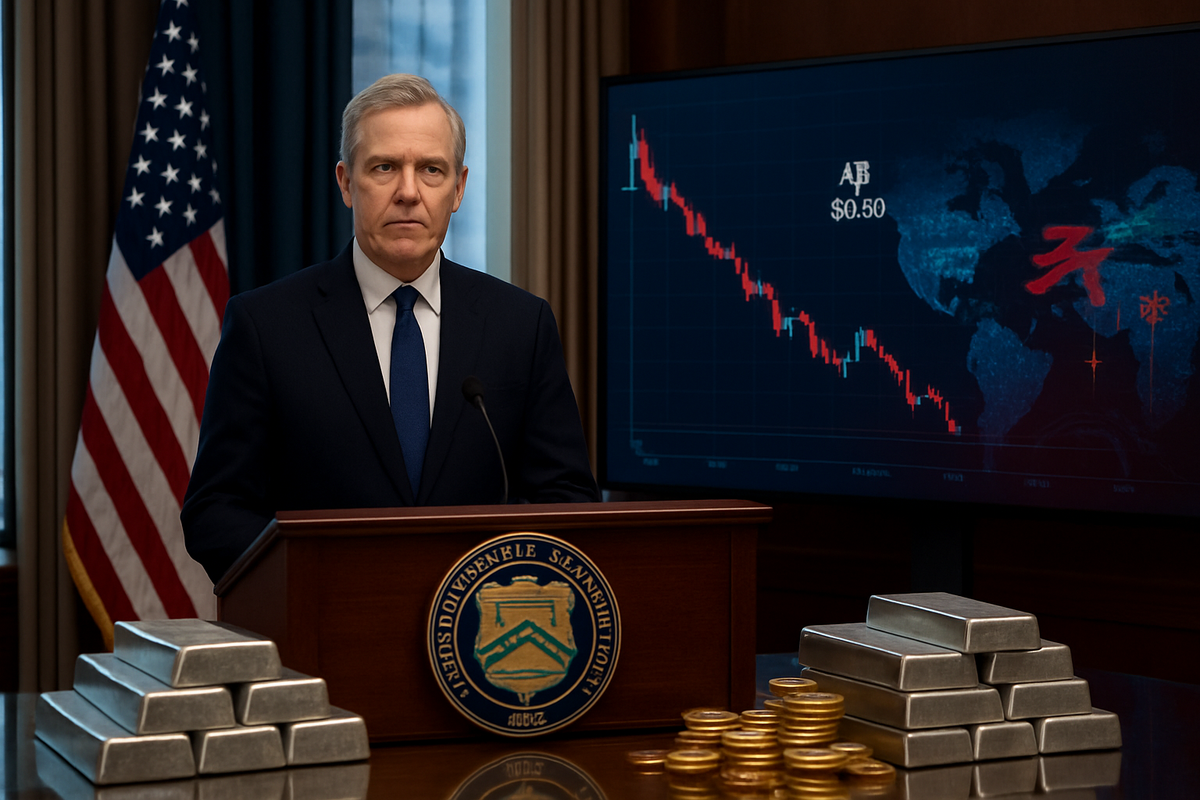
In a series of pointed remarks on February 10, 2026, U.S. Treasury Secretary Scott Bessent characterized the recent extreme volatility in the precious metals markets as a "speculative blowoff." Bessent explicitly attributed the dramatic swings in gold and silver prices to "unruly" trading activities originating from China, where retail and institutional leverage reached a breaking point earlier this month. As silver prices corrected sharply to the $82 level—a staggering drop from the historic highs seen just weeks ago—the Treasury Secretary’s comments have ignited a debate over market stability and the growing influence of Asian trading volumes on global benchmarks.
The Secretary's assessment comes at a critical juncture for the metals market. After silver hit an all-time high of nearly $122 an ounce in late January 2026, the subsequent crash wiped out billions in paper wealth in a matter of days. Bessent’s rhetoric suggests that the U.S. Treasury is closely monitoring what it views as a "leveraged mania" that has decoupled from traditional economic fundamentals. For investors, the $82 mark now serves as a psychological and technical battleground, reflecting a market caught between structural supply deficits and a massive speculative washout.
The Anatomy of a Market Correction: From $121 to $82
The volatility that prompted Secretary Bessent’s intervention began in early January 2026, driven by a confluence of geopolitical instability in the Middle East and a surge in demand for silver in the renewable energy and AI data center sectors. By January 29, silver had skyrocketed to $121.64 per ounce, fueled by a retail-driven "short squeeze" atmosphere. However, the momentum shifted abruptly as Chinese authorities began to tighten margin requirements on domestic exchanges to curb what they perceived as excessive speculation.
In a televised interview on February 8, 2026, which set the stage for today's market reaction, Bessent noted that the Chinese government’s decision to "yank the brakes" on domestic leverage was the primary catalyst for the global price collapse. He specifically highlighted the UBS SDIC Silver Futures Fund in China, which had been trading at a staggering 36% premium over its net asset value before emergency suspensions were enacted. This "speculative blowoff," as Bessent termed it, saw silver plummet nearly 50% from its peak to its current stabilization point near $82.00.
The $82 level is significant not only as a technical support zone but as a symbol of the "speculative washout" described by the Treasury. Market analysts report that the drop was exacerbated by automated liquidation orders as silver breached key moving averages. The CME Group responded to the chaos by raising silver margin requirements to 20% in late January, a move Bessent defended as a necessary stabilizing measure for a market he described as "dangerously overheated."
Winners and Losers in a Volatile Metals Landscape
The sudden price correction has sent shockwaves through the mining and streaming sector. Major gold producers like Newmont Corporation (NYSE: NEM) and Barrick Gold Corporation (NYSE: GOLD) have seen their valuations pressured as the "metals mania" cooled. While these companies remain profitable due to the historically high price floor, the volatility has introduced significant uncertainty into their short-term earnings guidance. Agnico Eagle Mines (NYSE: AEM), known for its lower-risk geographic profile, has outperformed its peers slightly, though it remains tethered to the broader sector's sentiment.
On the silver side, "pure-play" miners like First Majestic Silver Corp. (NYSE: AG) and Hecla Mining Company (NYSE: HL) have faced the brunt of the "blowoff." After enjoying a massive run-up in January, these stocks have seen significant pullbacks as investors reassess the sustainability of three-digit silver prices. Coeur Mining, Inc. (NYSE: CDE) and Pan American Silver Corp. (NYSE: PAAS) have also seen increased trading volume as they navigate the transition from a speculative rally to a more fundamental-driven price discovery phase.
Conversely, royalty and streaming companies have shown greater resilience. Wheaton Precious Metals (NYSE: WPM) and Franco-Nevada Corporation (NYSE: FNV), which benefit from fixed-cost structures, are viewed by some analysts as safer havens during such extreme price swings. These firms, along with Royal Gold, Inc. (NASDAQ: RGLD), provide exposure to the upside of silver and gold without the direct operational risks and margin compression that traditional miners face when energy and labor costs remain high while metal prices fluctuate wildly.
Geopolitical Tensions and the "Warsh Pivot"
Secretary Bessent’s comments also underscore a deepening geopolitical divide. By blaming Chinese speculators for the "unruly" market, the U.S. Treasury is signaling its discomfort with China’s dominance over precious metals refining and trading. Bessent has repeatedly pointed out that China refines a vast majority of the world’s silver and rare earth elements, calling this concentration a "single point of failure" for the global economy. This rhetoric aligns with a broader U.S. policy of "prudent derisking" rather than a total decoupling from Chinese supply chains.
The broader market significance of this event is further complicated by the "Warsh Pivot." The recent nomination of Kevin Warsh to lead the Federal Reserve has led to a strengthening U.S. Dollar, as markets anticipate a more hawkish stance on monetary policy. A stronger dollar typically exerts downward pressure on gold and silver, which are priced in greenbacks. The intersection of Bessent’s warnings about Chinese speculation and the potential for higher U.S. interest rates has created a "perfect storm" for the $82 silver price floor.
Historically, "speculative blowoffs" are followed by long periods of consolidation. The 2026 silver crash bears striking similarities to the 1980 Hunt Brothers silver bubble and the 2011 peak, both of which saw rapid ascents followed by painful corrections. However, unlike those historical precedents, the current market is supported by a structural physical deficit, as industrial demand for silver in solar panels and AI hardware continues to grow, potentially limiting the downside compared to previous eras.
What Comes Next: Consolidation or Further Collapse?
In the short term, the market will likely test the $82 level repeatedly. If this support holds, it could provide a foundation for a more sustainable rally based on industrial demand rather than speculative fervor. However, some bearish forecasts from institutions like Oxford Economics suggest that if the "speculative washout" continues, silver could drift toward $64 by the end of the year. Conversely, Citigroup analysts argue that once the "Warsh Shock" is fully priced in, a return to $100+ is inevitable given the persistent supply-demand gap.
Strategic pivots will be required for both miners and investors. Mining companies may need to reconsider their capital expenditure plans if price volatility persists, potentially slowing down new projects and further tightening the future supply of silver. For investors, the focus will shift from chasing momentum to identifying value in the "speculative wreckage." The ability of the market to decouple from the high-leverage trading environment in China will be a key indicator of long-term stability.
Market Outlook and Final Thoughts
The comments from Secretary Scott Bessent on February 10, 2026, serve as a stark reminder of how quickly global markets can turn when speculation outpaces fundamentals. The "speculative blowoff" in gold and silver has not only recalibrated price expectations but has also highlighted the profound impact of Chinese trading volumes on Western benchmarks. The drop to $82 marks the end of a frenzied chapter and the beginning of a more sober assessment of the metals' true value.
Moving forward, investors should watch for any further regulatory interventions from both the U.S. and China, as well as shifts in the U.S. Dollar index following the official transition at the Federal Reserve. While the immediate "blowoff" may be over, the underlying geopolitical tensions and supply chain vulnerabilities mentioned by Bessent remain unresolved. As the dust settles at $82, the market’s focus will return to the enduring question: can silver’s industrial necessity eventually overcome its speculative volatility?
This content is intended for informational purposes only and is not financial advice.