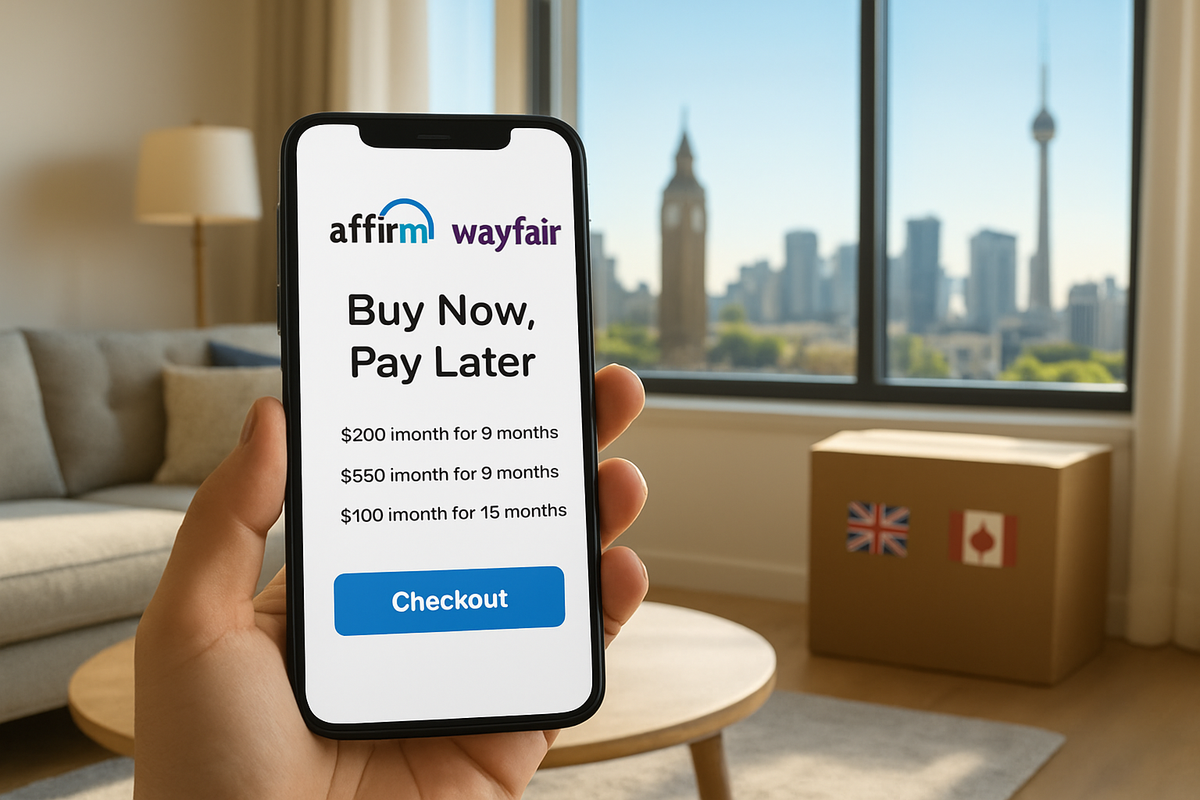
In a move that signals a bold new chapter for the cross-border e-commerce and fintech sectors, Affirm (NASDAQ: AFRM) and Wayfair (NYSE: W) announced on February 5, 2026, the official expansion of their long-standing partnership into the United Kingdom and Canada. This strategic rollout enables shoppers in these regions to utilize Affirm’s transparent "Buy Now, Pay Later" (BNPL) services at checkout, bringing flexible, interest-free, and installment-based payment options to one of the most capital-intensive retail sectors: home furnishings and décor.
The expansion comes at a critical juncture for both companies. As Wayfair looks to revitalize its international revenue following a retreat from certain European markets, and Affirm seeks to solidify its dominance in high-ticket verticals, this collaboration is more than just a technical integration. It represents a targeted effort to capture the shifting consumer preferences in the UK and Canada, where shoppers are increasingly demanding the same financial flexibility they have enjoyed in the United States, but with the added security of regulated, honest finance.
The Road to International Integration
The journey to this international expansion was paved by a successful integration of Affirm into Wayfair’s physical and digital storefronts in the U.S. in October 2025. Following that milestone, the two companies moved quickly to synchronize their systems for a dual-market launch in early February 2026. The timing is notable; Affirm’s entry into the UK was preceded by a meticulous pre-authorization phase with the Financial Conduct Authority (FCA), positioning the company as a "compliant-first" player in a market that has historically been wary of unregulated credit products.
Wayfair’s decision to launch in the UK and Canada simultaneously is a byproduct of its refined international strategy. After reporting a 10.9% dip in international revenue in early 2025 and subsequently exiting the German market, the furniture giant narrowed its focus to regions with high e-commerce maturity and similar consumer profiles to its American base. By leveraging Affirm's "no late fees and no compounding interest" model, Wayfair aims to lower the barrier to entry for high-ticket items like sectional sofas and dining room sets, which often require significant upfront capital.
Market reaction has been cautiously optimistic. Following the announcement and Affirm’s concurrent Q2 2026 earnings beat—where it reported $1.12 billion in revenue—investors have viewed the partnership as a vital engine for Gross Merchandise Volume (GMV) growth. While traditional retailers struggle with fluctuating consumer sentiment, the ability to offer transparent monthly payments is seen as a key differentiator that could help Wayfair maintain its market share against both low-cost competitors and premium design houses.
Winners, Losers, and the Battle for the Checkout
The clear winner in this expansion appears to be Wayfair. By integrating Affirm, the retailer is expected to see a significant lift in its Average Order Value (AOV) and conversion rates. In the home goods category, the psychological gap between a $2,000 purchase and a $165-a-month commitment is vast. Furthermore, by linking Affirm’s financing with the "Wayfair Rewards" program, the company is building a self-reinforcing ecosystem of loyalty and credit that is difficult for smaller furniture retailers to replicate.
Affirm also stands to gain significantly, particularly in its quest for volume diversification. By dominating the "Home" vertical—a sector with much higher ticket sizes than the fashion and beauty categories dominated by competitors—Affirm can maintain its high GMV growth rates even if general consumer spending slows. This expansion allows Affirm to directly challenge established European players like Klarna and global giants like PayPal (NASDAQ: PYPL), positioning itself as the "adult in the room" of the BNPL world through its commitment to simple, transparent terms.
On the losing end of this deal are smaller, regional BNPL providers and traditional high-street banks in the UK and Canada. These institutions have been slower to innovate their digital checkout experiences, often relying on clunky credit card applications or high-interest store cards. As Affirm and Wayfair streamline the financing process to a matter of seconds, these traditional lenders risk being cut out of the point-of-sale entirely. Additionally, competitors who have built their models on late fees may find themselves at a disadvantage as UK regulators move toward a more consumer-centric framework.
A New Era of Regulated Fintech
The expansion of the Affirm-Wayfair partnership is a microcosm of a broader trend: the institutionalization of BNPL. We are moving away from the "Wild West" era of unregulated fintech and into a phase where scale and regulatory compliance are the primary barriers to entry. In the UK, the upcoming "Regulation Day" on July 15, 2026, will bring BNPL under the full purview of the FCA. Affirm’s proactive entry into this environment suggests a strategy that welcomes regulation as a way to weed out less-stable competitors.
Historically, BNPL was seen as a tool for "Generation Z" to buy fast fashion. However, the 2026 data shows a significant shift toward older, more affluent demographics using installments for "life stage" purchases like home renovations and furniture. This shift is particularly evident in Canada, where the BNPL market is projected to reach $9.53 billion USD by the end of 2026. The entry of a major pair like Affirm and Wayfair validates BNPL as a mainstream financial tool rather than a niche subprime product.
Furthermore, this move reflects a ripple effect across the e-commerce infrastructure. Platforms like Shopify (NYSE: SHOP), which already have deep ties with Affirm, are watching these international expansions closely. The success of this rollout could serve as a blueprint for other major retailers to take their domestic financing partnerships global, potentially leading to a consolidated global network of "preferred" checkout lenders that mirror the dominance of Visa or Mastercard.
Looking Ahead: The July 2026 Deadline
The short-term focus for both companies will be the seamless execution of the UK and Canada launches. Investors will be looking for early data on credit performance and customer acquisition costs in these new regions. The most critical milestone on the horizon is the July 15, 2026, regulatory shift in the UK. How Affirm navigates the mandatory affordability checks and the oversight of the Financial Ombudsman Service will be a litmus test for its long-term viability in the European market.
In the long run, this expansion may force a strategic pivot from traditional banks in Canada and the UK. We may see an increase in mergers and acquisitions, as legacy banks look to acquire nimble fintechs to regain their footing at the checkout. For Affirm and Wayfair, the challenge will be maintaining the balance between aggressive growth and responsible lending, especially if the global economy faces a downturn that tests the resilience of installment-based credit models.
The Bottom Line for Investors
The expansion of the Affirm and Wayfair partnership into the UK and Canada marks a significant milestone in the globalization of flexible finance. For Wayfair, it is a calculated bet on the recovery of its international segment; for Affirm, it is a strategic land grab in a high-value vertical. As the companies integrate their services across three of the world's largest e-commerce markets, they are setting a new standard for how retailers and fintechs can collaborate to drive consumer spending.
Moving forward, the market will be watching Affirm’s delinquency rates and Wayfair’s international revenue margins with a hawk’s eye. The success of this venture hinges on the ability of "honest finance" to resonate with British and Canadian consumers who are increasingly wary of traditional debt. Investors should keep a close watch on the July regulatory changes in the UK, as any friction introduced by the FCA could impact the momentum of this high-profile expansion. For now, the Affirm-Wayfair alliance remains a powerful example of how strategic partnerships can redefine the global retail landscape.
This content is intended for informational purposes only and is not financial advice.