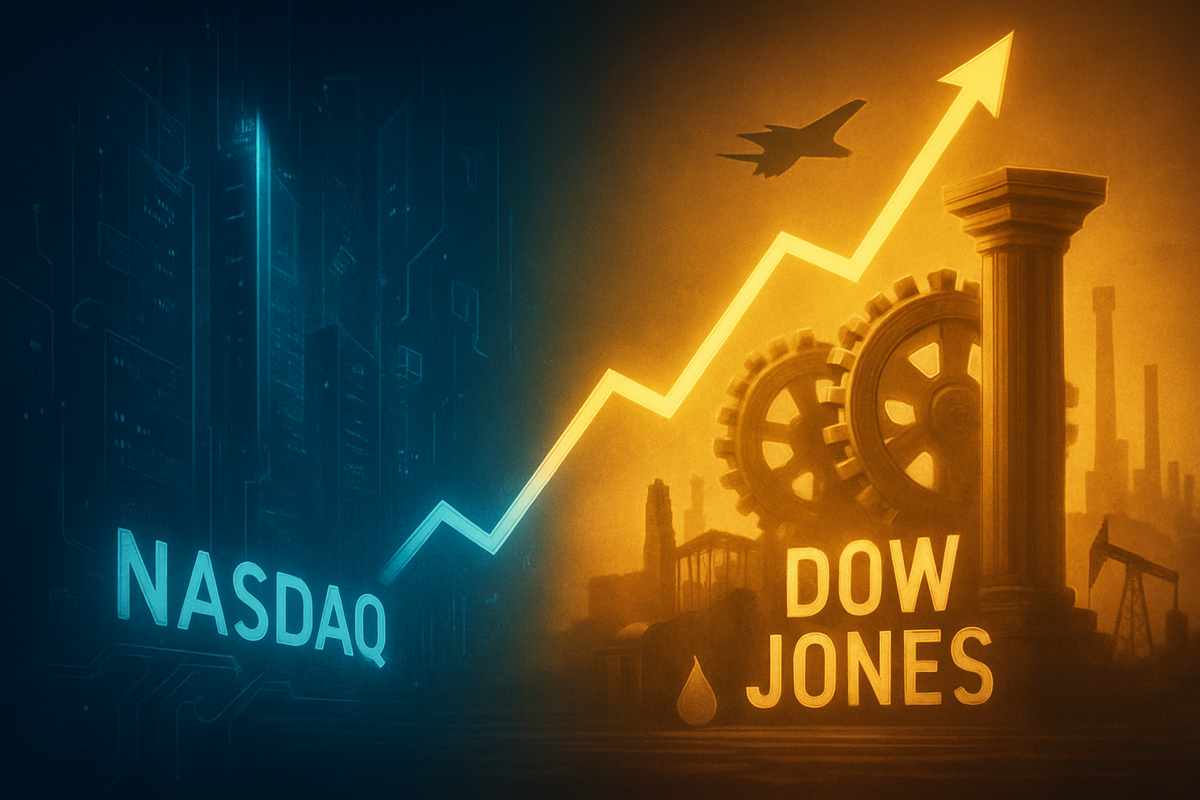
As the first full trading week of 2026 unfolds, a profound transformation is reshaping the landscape of the U.S. equities market. The relentless dominance of high-growth technology stocks, which propelled the Nasdaq Composite to record heights throughout 2024 and 2025, appears to be hitting a wall of skepticism. In its place, a massive rotation is underway, funneling capital into the blue-chip stalwarts of the Dow Jones Industrial Average (DJIA) and defensive sectors that offer a haven from geopolitical volatility and a "sticky" inflationary environment.
This "Great Decompression" represents more than just a temporary dip for tech; it signals a fundamental shift in investor psychology. While the Dow Jones has surged past the historic 49,000 mark in the opening days of January, the Nasdaq has struggled to maintain its footing, underperforming small-cap indices and value-oriented sectors by margins not seen in years. For the "Magnificent Seven" and the broader AI-industrial complex, the honeymoon phase of speculative valuation is giving way to a rigorous "reality check" regarding long-term profitability and capital expenditure.
The Anatomy of the January Rotation
The divergence between the tech-heavy Nasdaq and the industrially-weighted Dow became starkly apparent on January 2, 2026, the first trading day of the year. While the Nasdaq Composite faced immediate selling pressure, the Dow Jones Industrial Average (DJIA) trended upward, fueled by its heavy exposure to energy, financials, and defense. By the end of the first week, the Nasdaq 100 was trailing the small-cap Russell 2000 by approximately 4 percentage points—marking one of the most significant rotations into small and mid-cap value stocks in market history.
Several converging catalysts triggered this sudden migration. First, the Federal Reserve’s decision to pause its rate-cutting cycle in late December 2025 caught many growth investors off guard. With inflation hovering stubbornly near 3%, the "higher-for-longer" narrative has returned, weighing heavily on the discounted cash flow models that justify the sky-high valuations of tech giants. Simultaneously, a geopolitical shock in South America—specifically a U.S. military operation in Venezuela resulting in the capture of President Nicolás Maduro—sent oil prices into a tailspin of volatility, driving a "flight to quality" toward domestic energy producers and defense contractors.
The shift was further accelerated by the domestic policy agenda. President Trump’s proposal for a $1.5 trillion defense budget for 2027—a massive increase from previous levels—acted as a lightning rod for capital. Investors, sensing a shift toward a more militarized and industrially-focused fiscal policy, began liquidating over-extended tech positions to fund entries into "old economy" sectors. This movement was not a market crash, but a broadening of leadership, as the extreme concentration that defined the previous two years finally began to decompress.
Winners and Losers: A Tale of Two Tapes
The casualty list of this rotation is topped by the former darlings of the AI era. Apple Inc. (NASDAQ: AAPL) has seen its shares drop nearly 7% from its December 2025 highs, as rising component costs and a perceived saturation of the AI-integrated hardware market dampened investor enthusiasm. Similarly, Tesla, Inc. (NASDAQ: TSLA) entered 2026 on a record seven-day losing streak, as competition in the EV space and shifting federal subsidies weighed on its growth narrative. Even the software giant Microsoft Corp. (NASDAQ: MSFT) felt the pinch, declining 2.1% in the first week as analysts began demanding more concrete evidence of AI service profitability.
Conversely, the defense and energy sectors have emerged as the clear beneficiaries of the new year. Northrop Grumman Corp. (NYSE: NOC) saw its shares rally over 10% following the defense budget announcement, while Lockheed Martin Corp. (NYSE: LMT) and General Dynamics Corp. (NYSE: GD) posted gains of 8% and 5% respectively. In the energy space, Valero Energy Corp. (NYSE: VLO) hit all-time highs, alongside gains for Exxon Mobil Corp. (NYSE: XOM) and Chevron Corp. (NYSE: CVX), as the Venezuelan crisis heightened the value of domestic refining and production.
Interestingly, the AI sector itself is seeing a divergence. While hardware and infrastructure plays are being questioned, Alphabet Inc. (NASDAQ: GOOGL) managed to hit new all-time highs, viewed by many as a more resilient leader in AI-integrated search and advertising. Meanwhile, Nvidia Corp. (NASDAQ: NVDA) remained relatively flat, bolstered by persistent chip shortages but no longer immune to the broader sector's cooling sentiment. On the losing end of policy shifts, Blackstone Inc. (NYSE: BX) and homebuilder D.R. Horton, Inc. (NYSE: DHI) saw declines after presidential rhetoric targeted institutional ownership of single-family homes.
Broader Implications and Historical Precedents
This rotation fits into a broader historical pattern of "market normalization." After periods of extreme concentration—such as the Nifty Fifty in the 1970s or the Dot-com boom of the late 90s—the market often undergoes a painful but necessary rebalancing. The current trend suggests that the "AI premium" is being re-evaluated. Investors are no longer willing to pay any price for growth; they are now looking for "growth at a reasonable price" (GARP), which is leading them toward the more attractively valued components of the Dow.
The ripple effects extend beyond just stock prices. The shift toward defense and energy suggests a market that is pricing in a more fragmented and volatile global order. This has regulatory implications as well; as capital flows into defense and domestic manufacturing, we may see a further pivot in government policy toward protectionism and industrial subsidies. The struggle of the Nasdaq also reflects a potential "AI fatigue," where the initial awe of generative technologies is being replaced by the mundane reality of implementation costs and regulatory scrutiny.
Historically, such rotations have often preceded a more sustainable, albeit slower, bull market. By spreading capital across a wider range of sectors, the market reduces its dependency on a handful of mega-cap tech stocks. This "breadth expansion" is generally viewed as a sign of a healthy, maturing economic cycle, even if it causes short-term pain for those heavily concentrated in the Nasdaq 100.
The Road Ahead: Scenarios for 2026
In the short term, the market's direction will likely be dictated by the upcoming Q4 2025 earnings season. If tech giants can demonstrate that their massive AI investments are translating into bottom-line growth, we may see a "buy the dip" opportunity for the Nasdaq. However, if earnings reports confirm the market's fears of slowing margins, the rotation into the Dow and defensive sectors could accelerate, potentially pushing the DJIA toward the 50,000 milestone before the end of the first quarter.
Strategic pivots will be required for both companies and investors. Tech firms may need to shift their narrative from "innovation at all costs" to "operational efficiency and shareholder returns." For investors, the challenge will be identifying which "old economy" stocks still have room to run. The energy and defense sectors are currently riding a wave of geopolitical momentum, but they remain sensitive to policy shifts and global commodity prices.
A potential scenario is a "sideways" market for tech throughout much of 2026, while the broader market catches up. This would allow valuations to normalize without a catastrophic crash. However, if the Federal Reserve is forced to hike rates again to combat "sticky" inflation, the rotation could turn into a more aggressive sell-off for growth stocks, creating a challenging environment for the Nasdaq for the foreseeable future.
Summary and Investor Outlook
The early days of 2026 have delivered a clear message: the era of tech exceptionalism is facing its sternest test yet. The rotation from the Nasdaq to the Dow Jones is a reflection of a world grappling with geopolitical instability, persistent inflation, and a demand for tangible corporate earnings. Key takeaways include the resurgence of the energy and defense sectors as primary market drivers and the cooling of the AI-driven growth narrative.
Moving forward, the market appears to be transitioning into a "show me" phase. Investors should watch for the sustainability of the rally in industrials and whether the Nasdaq can find a floor near its 200-day moving average. The "Magnificent Seven" are no longer a monolithic block; individual performance will vary based on actual AI monetization.
As we move deeper into 2026, the focus will remain on the Federal Reserve's next moves and the evolving geopolitical situation in South America. For the disciplined investor, this rotation offers an opportunity to diversify away from over-concentrated tech positions and into sectors that are better positioned for the current macroeconomic reality. The "Great Decompression" may be uncomfortable for some, but it is a necessary evolution for a market seeking its next sustainable leg up.
This content is intended for informational purposes only and is not financial advice.