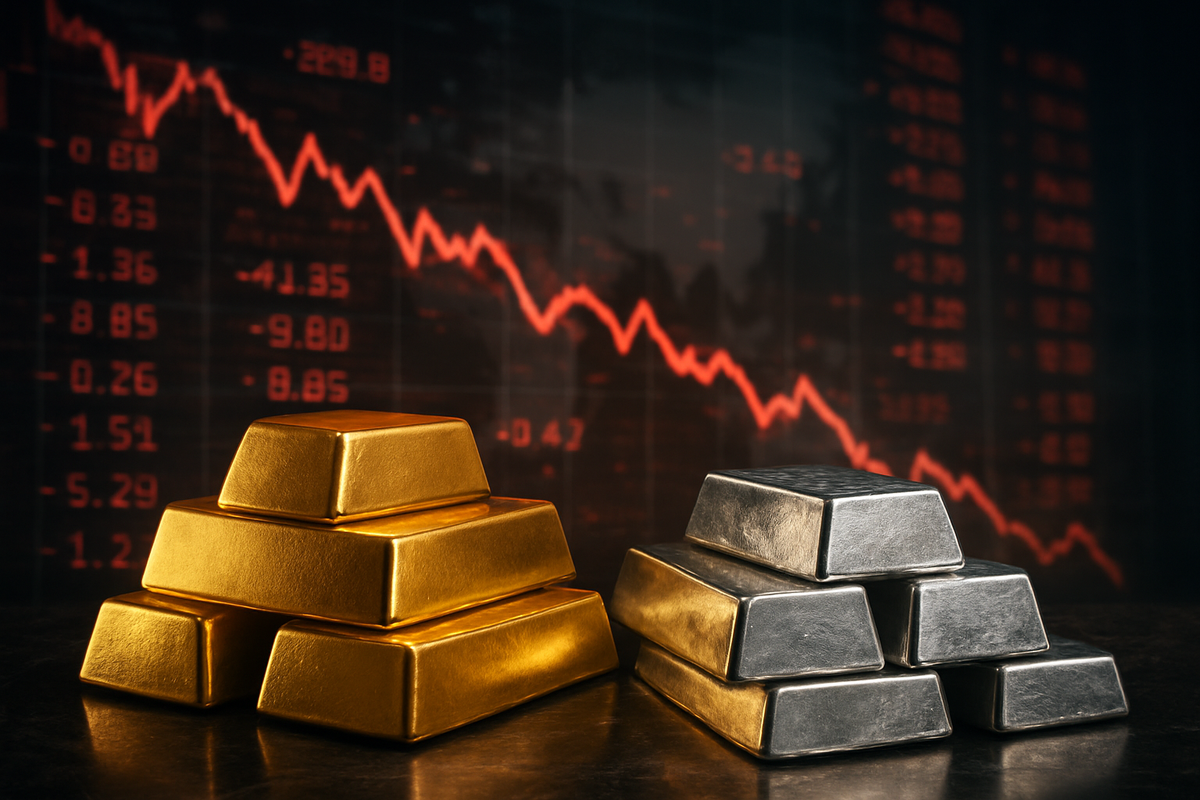
NEW YORK – In a week that will likely be remembered as one of the most volatile in the history of commodities trading, precious metals have undergone a violent "flash correction" that has left investors reeling. After a parabolic ascent that saw Gold shatter the $5,500 per ounce ceiling and Silver surge to unprecedented record highs, the market experienced a brutal reversal today, January 30, 2026. Within hours of the market opening, Gold prices tumbled 5%, while Silver, often the more volatile sibling in the precious metals family, collapsed by a staggering 13%.
This sudden evaporation of gains comes on the heels of a year-long rally that many analysts had termed "the trade of the decade." The move has sent shockwaves through the financial sector, sparking massive margin calls and forcing a rapid re-evaluation of the "safe-haven" narrative that has dominated global markets since early 2025. While the correction was sharp, the underlying drivers—geopolitical fragmentation and a fundamental shift in the global monetary order—suggest that the era of "cheap" precious metals may be a thing of the past, even as the market pauses to catch its breath.
From Euphoria to Exhaustion: The Timeline of a Mania
The journey to $5,500 gold was not an overnight phenomenon but the culmination of eighteen months of escalating global tensions. The rally began in earnest in April 2025, following the implementation of the "Liberation Day" tariffs, which saw the U.S. impose sweeping 100% duties on major trading partners, including Canada. As trade wars escalated into a broader "currency war," the U.S. dollar faced unprecedented pressure, further exacerbated by a domestic political crisis involving a high-profile criminal investigation into the leadership of the Federal Reserve. By late 2025, the "de-dollarization" trend had shifted from a fringe economic theory to a central bank reality, with foreign institutions dumping U.S. Treasuries in favor of physical bullion.
The mania reached its fever pitch in the first three weeks of January 2026. Gold, which had started the year near $3,200, accelerated vertically as reports surfaced that BRICS nations were preparing a gold-backed settlement unit. Silver followed suit, driven by a chronic physical shortage and a surge in demand for high-capacity AI server cooling systems. By yesterday afternoon, Gold touched an intraday high of $5,595 per ounce, while Silver hit a record $121.64. However, the atmosphere turned sour overnight following rumors that the White House would appoint a "hard-money" hawk to the Federal Reserve, signaling an end to the era of fiscal dominance. The ensuing dollar rebound acted as a pin to the commodities bubble, triggering a cascade of automated sell orders that wiped out billions in paper wealth in a single session.
Winners and Losers in the Mining Sector
The extreme price action has created a divergent landscape for the world’s largest mining companies. Newmont (NYSE: NEM), the world’s largest gold producer, had seen its stock price double over the last six months as it integrated its massive Newcrest acquisition. Despite today’s 5% drop in the metal, Newmont’s shares have shown relative resilience, supported by the company’s "Tier 1" asset base and record-breaking cash flow projections for the 2026 fiscal year. Similarly, Barrick Gold (NYSE: GOLD) has emerged as a powerhouse, leveraging high copper prices alongside the gold surge. Barrick recently announced a massive $1 billion share buyback program, funded by the windfall profits of the $5,000 gold era, though its stock remains sensitive to the immediate technical damage caused by today's silver-led rout.
On the losing end of the ledger are the high-leverage junior miners and silver-focused entities like Pan American Silver (NASDAQ: PAAS). With Silver dropping 13% in a single day, companies with high operational costs are suddenly facing a squeezed margin environment that they hadn't anticipated just 48 hours ago. Streaming and royalty giant Wheaton Precious Metals (NYSE: WPM) also saw a sharp pullback today; however, many analysts argue that the streaming model—which limits capital expenditure exposure—remains the safest way to play the sector's long-term upside. For investors who entered at the peak of the "Silver Squeeze" earlier this month, the losses are significant, particularly in the ETF space where the iShares Silver Trust (NYSE: SLV) saw record-breaking outflows as the North American session opened.
A Geopolitical Pivot: The Broader Significance
The current volatility is more than just a "technical correction" in a bull market; it is a reflection of a world in the midst of a historic transition. For the first time in nearly thirty years, central bank gold holdings have surpassed the value of U.S. Treasury holdings on a global scale. This "crossover" marks a fundamental loss of confidence in the traditional reserve asset and a return to "neutral" assets that lack counterparty risk. The 1,100 tonnes of gold purchased by central banks in 2025 served as a floor for the market, but the parabolic move to $5,500 was driven by retail and institutional FOMO (fear of missing out), which has now been purged.
Historically, moves of this magnitude are often followed by periods of painful consolidation. Critics of the gold rally compare the current environment to the 1980 peak or the 2011 "double top," suggesting that the metals may have entered a multi-year cooling period. However, proponents argue that unlike previous cycles, the current surge is backed by a $3 trillion U.S. deficit and a "permanent rupture" in global trade relations. The 13% drop in Silver, while dramatic, must be viewed in the context of a metal that had doubled in price in less than ninety days. The "ripple effect" of this volatility is likely to be felt in the renewable energy sector and AI manufacturing, where the cost of raw materials has suddenly become the primary bottleneck for industrial production.
The Road Ahead: What Comes Next?
In the short term, the market will look for a "support floor" where the initial buyers might return. Analysts are eyeing the $4,800 level for Gold and the $85 level for Silver as critical technical zones that must hold to keep the long-term bull thesis intact. The immediate focus for the market will be the official announcement regarding the next Federal Reserve Chair. If a "hawk" is indeed appointed, the U.S. dollar could see a multi-month rally, which would keep a lid on precious metals prices and potentially force a deeper correction toward the 200-day moving average.
Strategic pivots are already underway at the corporate level. Large-scale miners are expected to use this price dip to accelerate merger and acquisition activity, hunting for "distressed" junior explorers who may be struggling with the sudden volatility. For the public, the "Gold Mania" of 2025/2026 has served as a wake-up call regarding the fragility of fiat currency. Even with a 13% correction, Silver remains at levels that were unthinkable two years ago, and the narrative of "hard assets in an era of uncertainty" is unlikely to disappear.
Summary and Investor Outlook
The "Great Metal Meltdown" of January 30, 2026, serves as a sobering reminder that even the most robust bull markets do not move in a straight line. The key takeaway for investors is that the "parabolic phase" of the rally is over, and a more mature, volatile phase has begun. While the 5% drop in Gold and 13% drop in Silver are painful for those who bought the top, they represent a necessary "clearing of the decks" for a market that had become dangerously over-leveraged.
Moving forward, the market's trajectory will be determined by three factors: the stability of the U.S. dollar, the continuation of central bank buying, and the resolution of the "Liberation Day" trade disputes. Investors should keep a close eye on the performance of Newmont (NYSE: NEM) and Barrick Gold (NYSE: GOLD) as bellwethers for the health of the broader mining sector. While the headlines today scream "crash," the long-term charts suggest that the foundations of the precious metals market have been permanently altered. The coming months will tell us if this was the end of the rally, or simply the pause that refreshes.
This content is intended for informational purposes only and is not financial advice.