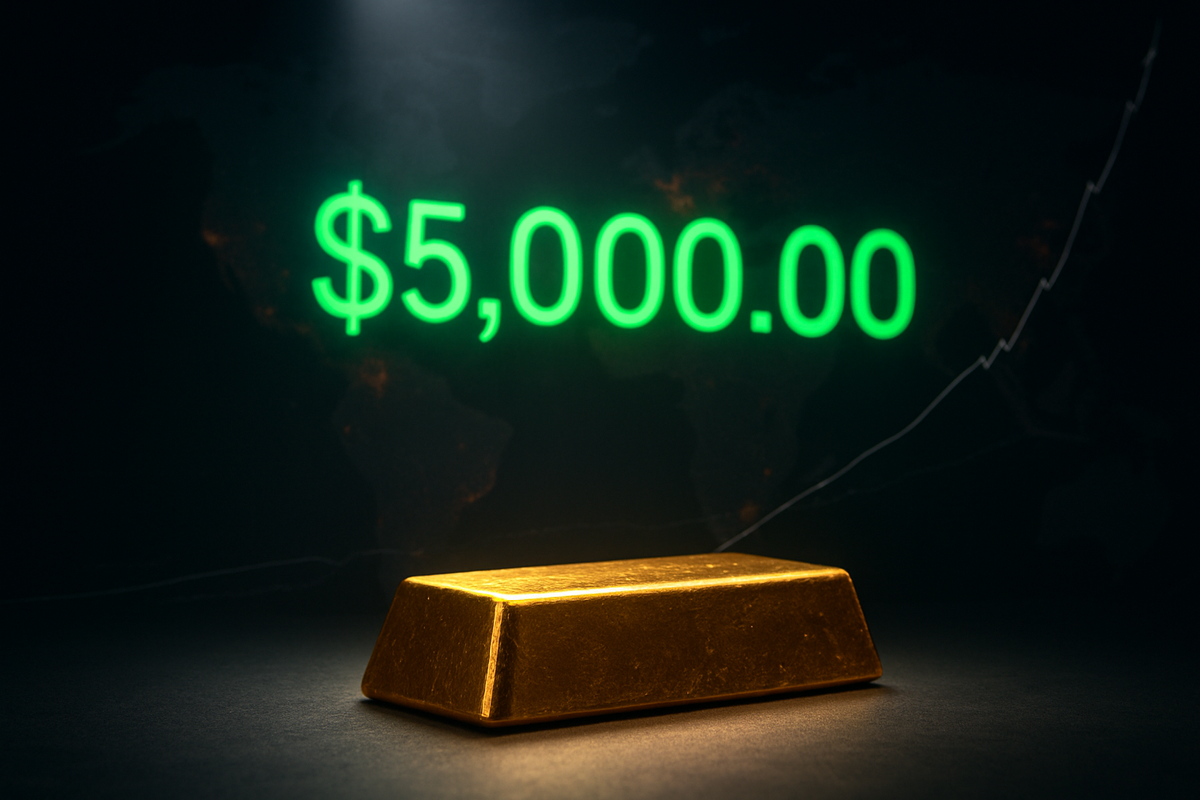
In a move that has sent shockwaves through the global financial system, the price of gold officially breached the historic $5,000 per ounce milestone on Monday, January 26, 2026. The yellow metal, long considered the ultimate store of value, reached an intraday peak of $5,111, capping a parabolic run that saw prices rise by more than 60% over the last calendar year. The immediate implications are profound, signaling a massive loss of confidence in traditional fiat currencies and a desperate scramble for safety among both institutional and retail investors.
The psychological breakthrough has triggered a domino effect across the commodities complex. Silver has simultaneously surged past $100 per ounce, while the broader U.S. dollar index faces renewed pressure as the "debasement trade" accelerates. For market participants, the $5,000 mark is more than just a number; it represents a fundamental shift in the perception of global economic stability, as persistent inflation and crumbling geopolitical norms force a total re-evaluation of risk.
A Perfect Storm: The Path to $5,000
The journey to $5,000 per ounce was paved by a series of "geopolitical bombshells" that began in late 2025 and reached a fever pitch in the opening weeks of 2026. A primary catalyst was the recent escalation of tensions in South America. On January 3, 2026, the U.S. military’s "Operation Absolute Resolve"—which resulted in the capture of Venezuelan President Nicolás Maduro—led to the rerouting of 161 metric tons of Venezuelan gold to the U.S. COMEX vaults. This move, while celebrated by some, sent a tremor of fear through global central banks, who now view their gold reserves as potentially vulnerable to international seizure, further fueling the drive for physical possession over paper assets.
Simultaneously, the Middle East remains a tinderbox. Following the fallout of the mid-2025 kinetic conflict between Israel and Iran, the region has been plagued by internal instability and proxy wars in Yemen and Sudan. This persistent volatility, combined with the U.S. administration’s aggressive tariff threats against traditional allies like Canada and Europe over "Greenland friction," has created an environment where uncertainty is the only constant. Investors, sensing a vacuum in global leadership, have turned to gold as the "stateless" currency of last resort.
Market reaction was instantaneous as the London and New York exchanges opened. Trading volumes hit record highs, with major bullion dealers reporting shortages of physical bars and coins. Central banks, particularly in the BRICS+ bloc, are reportedly accelerating their diversification efforts away from the U.S. dollar, treating gold not just as a reserve asset, but as a strategic shield against sovereign debt risks that have reached unsustainable levels in the West.
Winners and Losers: The Corporate Gold Rush
The most direct beneficiaries of this historic surge are the major mining conglomerates, whose profit margins have expanded exponentially. Barrick Gold (NYSE: GOLD) has seen its stock price soar by over 200% in the last 12 months, reporting a staggering free cash flow of $1.6 billion in its most recent quarterly filing. The company is currently embroiled in a high-stakes corporate standoff, attempting a $42 billion spin-off of its North American assets—a move that requires the blessing of Newmont (NYSE: NEM).
Newmont, the world’s largest gold miner, has also seen its valuation nearly double, currently trading near all-time highs as it integrates assets from its Newcrest acquisition. Other major players like Agnico Eagle Mines (NYSE: AEM) are reaping the rewards of their high-grade, low-cost operations, which are now generating "super-profits" at $5,000 gold. However, these companies face rising operational challenges, including increased royalty demands from host governments and surging costs for diesel and machinery—inflationary pressures that affect the miners just as much as the public.
Conversely, the "losers" in this environment are industries heavily reliant on gold as an industrial input. High-end electronics manufacturers and jewelry retailers like Signet Jewelers (NYSE: SIG) are facing a collapse in consumer demand as retail prices for gold jewelry become prohibitive for the average consumer. Additionally, tech firms that utilize gold in high-performance semiconductors are seeing margin compression as raw material costs spike, forcing many to accelerate the search for cheaper alternatives in conductive plating.
The Death of the Dollar? Analyzing the Shift
This milestone fits into a broader trend of "de-dollarization" that has moved from the fringes of economic theory to the center of global trade. The weaponization of the financial system, combined with a decade of aggressive monetary expansion, has led to a structural shift in how nations value their wealth. Unlike the gold spikes of the 1970s, which were primarily driven by oil shocks and domestic inflation, the 2026 surge is fueled by a "vaporizing of trust" in the international rules-based order.
The ripple effects are being felt in the sovereign debt markets. As gold climbs, the relative value of government bonds—traditionally the safe-haven competitor to gold—is being called into question. If gold is the "ultimate insurance policy," the high premiums being paid today suggest that the market views the risk of a "sovereign default event" or a major currency reset as a distinct possibility rather than a remote tail risk.
Historically, gold milestones have often preceded periods of significant regulatory change. Market analysts are already whispering about the possibility of an international conference to discuss a return to some form of commodity-backed monetary system—a "Bretton Woods 2.0." While such a move seems distant, the $5,000 price tag makes it difficult for policymakers to ignore the message the market is sending about the health of fiat currency.
The Road to $6,000: What Comes Next
While $5,000 is a monumental achievement, many on Wall Street believe the rally is far from over. Bank of America (NYSE: BAC) has issued a bold price target of $6,000 per ounce by Spring 2026, citing a "parabolic phase" that typically marks the end-stage of a multi-year bull market. Goldman Sachs (NYSE: GS) has similarly revised its outlook, raising its target to $5,400, noting that private sector investment is only now beginning to catch up with the heavy buying seen by central banks over the last three years.
In the short term, the market may face a "healthy correction" as early buyers take profits. However, any pullback is likely to be met with aggressive buying from those who missed the initial surge. The long-term challenge for the market will be liquidity; if gold continues to be hoarded as a survival asset, the price could become increasingly detached from any fundamental economic reality, leading to a "liquidity trap" where the metal is too valuable to be traded but too essential to be ignored.
Strategic pivots are already underway. Wealth management firms are advising clients to increase their precious metals allocation from the traditional 5% to as high as 20% or 30%. Meanwhile, the emergence of gold-backed digital currencies (CBDCs) is gaining traction as nations look for ways to facilitate trade without relying on the U.S. dollar-denominated SWIFT system.
Summary and Final Thoughts
The breach of $5,000 gold marks a watershed moment for the 21st-century economy. It is a stark reminder that in times of extreme geopolitical friction and fiscal instability, the world returns to the "oldest money." The key takeaways for investors are clear: inflation is not just persistent but structural, and geopolitical risk is no longer a background noise—it is the primary driver of market value.
Moving forward, the market will remain highly sensitive to every headline from the Middle East and the escalating "resource wars" in South America and the Arctic. While the prospect of $6,000 gold offers an attractive upside, the volatility associated with these prices suggests a bumpy ride ahead.
Investors should keep a close eye on central bank gold-buying reports and any signs of a "truce" in the global trade wars. For now, the "Gold Rush of 2026" shows no signs of slowing down, as the world searches for a safe harbor in an increasingly turbulent sea of debt and diplomacy.
This content is intended for informational purposes only and is not financial advice.