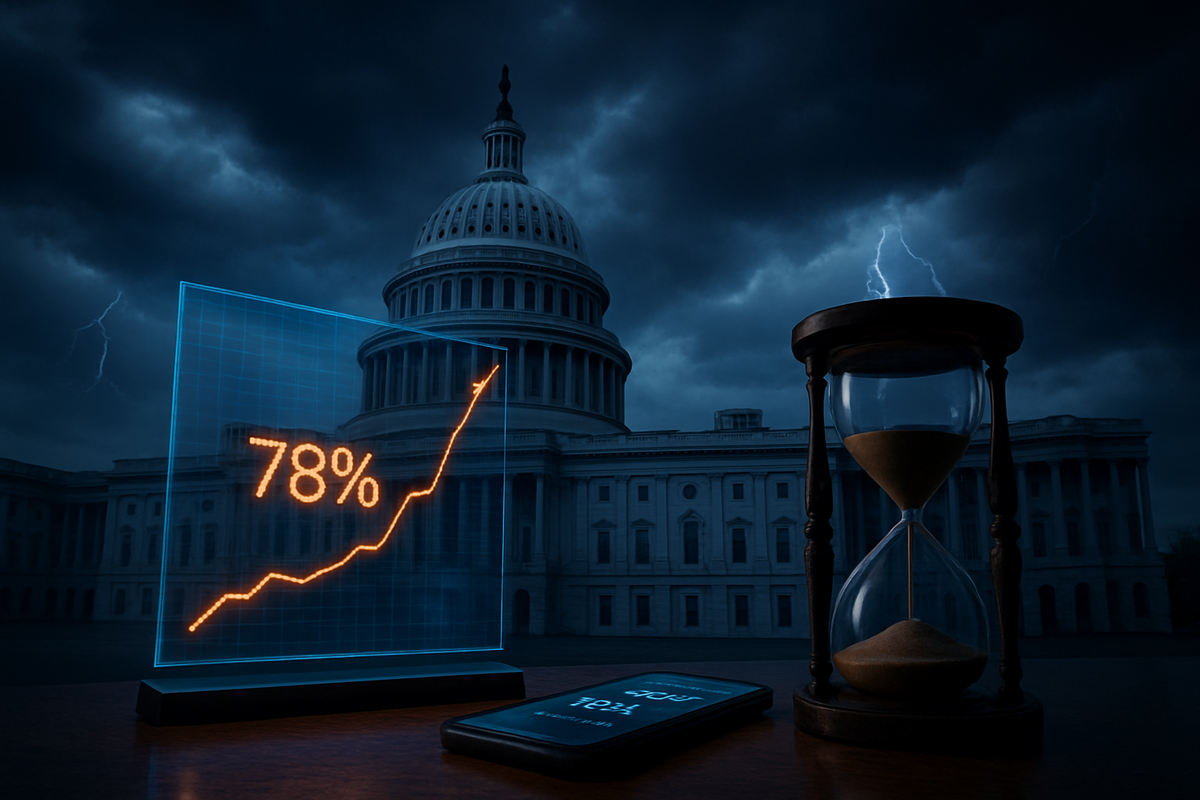
With only four days remaining until federal funding expires, the United States is staring down the barrel of its second government shutdown in less than six months. As of January 26, 2026, prediction markets have seen a violent spike in volatility, with Polymarket data now reflecting a staggering 78% probability that a funding lapse will occur by the January 30 deadline. This surge in betting activity marks a dramatic shift in sentiment from just a week ago, when a deal seemed within reach, reflecting growing alarm over a deep-seated legislative impasse in Washington D.C.
The immediate implications of a shutdown would be severe, threatening to freeze approximately 90% of annual discretionary spending across essential departments, including Defense, Homeland Security, and Labor. Investors are increasingly concerned that this "second wave" of political instability will derail a fragile economic recovery following the record-breaking 43-day shutdown that paralyzed the nation in late 2025. With the Senate currently deadlocked and the White House taking a hardline stance on departmental funding, the financial markets are bracing for a protracted period of "flying blind" as critical economic data releases face an indefinite pause.
A Nation on the Brink: The Path to the January 30 Cliff
The current crisis is a direct consequence of the temporary "band-aid" measure passed in November 2025, which ended the previous shutdown but failed to resolve fundamental disagreements over the fiscal year 2026 budget. While the House of Representatives, led by Speaker Mike Johnson, successfully passed several appropriations bills earlier this month, the process hit a wall in the Senate. The fragile peace was shattered on January 24, 2026, following a controversial incident in Minneapolis involving federal agents from "Operation Metro Surge." The resulting political fallout has galvanized Senate Democrats, led by Minority Leader Chuck Schumer, who has vowed to block any funding package that includes current levels of Department of Homeland Security (DHS) funding without significant oversight reforms.
The timeline leading to this moment has been characterized by high-stakes brinkmanship. Following the Minneapolis incident, negotiations transitioned from standard fiscal debate to a heated referendum on federal law enforcement power. Senate Majority Leader John Thune (R-SD) has struggled to secure the 60 votes necessary to overcome a Democratic filibuster, currently lacking the support of at least seven crossover votes. Meanwhile, President Donald Trump has signaled he will not sign any "minibus" bill that separates DHS funding from broader military and labor spending, effectively creating a "nuclear" legislative standoff.
Initial market reactions have been swift and defensive. The Cboe Volatility Index (VIX) has trended sharply upward as traders price in the risk of a long-term lapse. On the prediction platforms, Kalshi has mirrored the Polymarket trend, with odds for a shutdown jumping from 11% to 79% over the past weekend. This reflects a growing consensus among "super-forecasters" that the current political divide is too wide to be bridged by the midnight deadline on Friday.
Corporate Fallout: Winners and Losers in the Funding Vacuum
The primary victims of this legislative paralysis are the nation’s major defense and government services contractors. Lockheed Martin Corp (NYSE: LMT), RTX Corp (NYSE: RTX), and Northrop Grumman Corp (NYSE: NOC) are facing a double-edged sword of operational freezes and aggressive executive oversight. Under a new Executive Order titled "Prioritizing the Warfighter," the administration has threatened to bar "underperforming" contractors from conducting stock buybacks or issuing dividends—a move that has already pressured the stock prices of these defense giants. A shutdown would halt all new contract solicitations and non-excepted modifications, starving these firms of high-margin new business.
Government services providers like Booz Allen Hamilton Holding Corp (NYSE: BAH) and Leidos Holdings Inc (NYSE: LDOS) are also in the crosshairs. Booz Allen Hamilton has already reported a $50 million revenue hit from the late 2025 shutdown; a second lapse within the same fiscal year could be catastrophic for their quarterly guidance, as "billable expenses" for thousands of consultants would evaporate overnight. Conversely, small-to-medium-sized contractors, which lack the massive cash reserves of General Dynamics Corp (NYSE: GD), face a genuine threat of insolvency if federal payments are delayed beyond a 14-day window.
On the other side of the ledger, "safe-haven" assets are seeing a significant bid. Gold has recently breached the $5,000 per ounce mark for the first time in history, as investors flee the uncertainty of U.S. sovereign debt. Additionally, Bitcoin has seen a surge in volume as a hedge against domestic political instability. For traditional equity investors, the few "winners" might include volatility-focused products like the ProShares VIX Short-Term Futures ETF (NYSEArca: VIXY), which benefits from the market's mounting anxiety.
The Broader Market and Historical Parallels
This event is not occurring in a vacuum; it fits into a broader trend of extreme fiscal polarization that has come to define the 2020s. Economically, a shutdown would freeze the release of data from the Bureau of Labor Statistics (BLS) and the Census Bureau. This would leave the Federal Reserve "flying blind" ahead of its critical February interest rate decision, likely forcing the central bank to maintain a cautious, hawkish stance that could further dampen market enthusiasm. The ripple effects would extend to international partners, as delays in U.S. foreign military sales and diplomatic funding create a vacuum in global security.
Historically, the market often recovers from shutdowns once a resolution is reached, as seen in the 2018-2019 and 2025 events. However, the current scenario is unique due to its proximity to the previous record-breaking lapse. Analysts warn that credit rating agencies, such as Moody’s and S&P, may view a second shutdown in four months as evidence of "institutional erosion," potentially leading to a formal downgrade of the U.S. sovereign credit outlook. This would raise borrowing costs across the entire economy, from mortgages to corporate bonds.
Future Scenarios: Continuing Resolution or Long-Term Collapse?
In the short term, the most likely "escape hatch" is a short-duration Continuing Resolution (CR) that would push the deadline into February or March. However, given the current animosity between the Senate Minority and the White House, even a one-week extension is no longer a guarantee. If a shutdown occurs on January 30, companies will be forced into rapid strategic pivots. Many contractors will likely implement immediate furloughs or reassign personnel to commercial projects to preserve cash.
Longer-term, this standoff may necessitate a fundamental shift in how government-dependent companies operate. We may see a "flight to quality" where investors favor firms with diversified commercial revenue streams over those purely dependent on federal appropriations. The market opportunity may lie in "shutdown-resistant" sectors like healthcare or consumer staples, while the primary challenge remains the unpredictability of a legislative body that appears increasingly comfortable using the entire federal budget as a negotiating lever.
Final Assessment for Investors
The takeaway for the coming week is one of extreme caution. The 78% probability on Polymarket suggests that the "smart money" is no longer betting on a last-minute miracle. The combination of a 2025 fiscal hangover and the 2026 "Minneapolis Trigger" has created a political perfect storm that is difficult to navigate via traditional lobbying or compromise.
As we move forward, investors should watch for any signs of a "minibus" compromise in the Senate or a softening of the White House’s executive stance on defense dividends. However, the more likely scenario is a period of heightened volatility and a significant slowdown in government-adjacent economic activity. The coming months will test the resilience of the U.S. financial system and its ability to withstand a prolonged period of self-inflicted political paralysis.
This content is intended for informational purposes only and is not financial advice