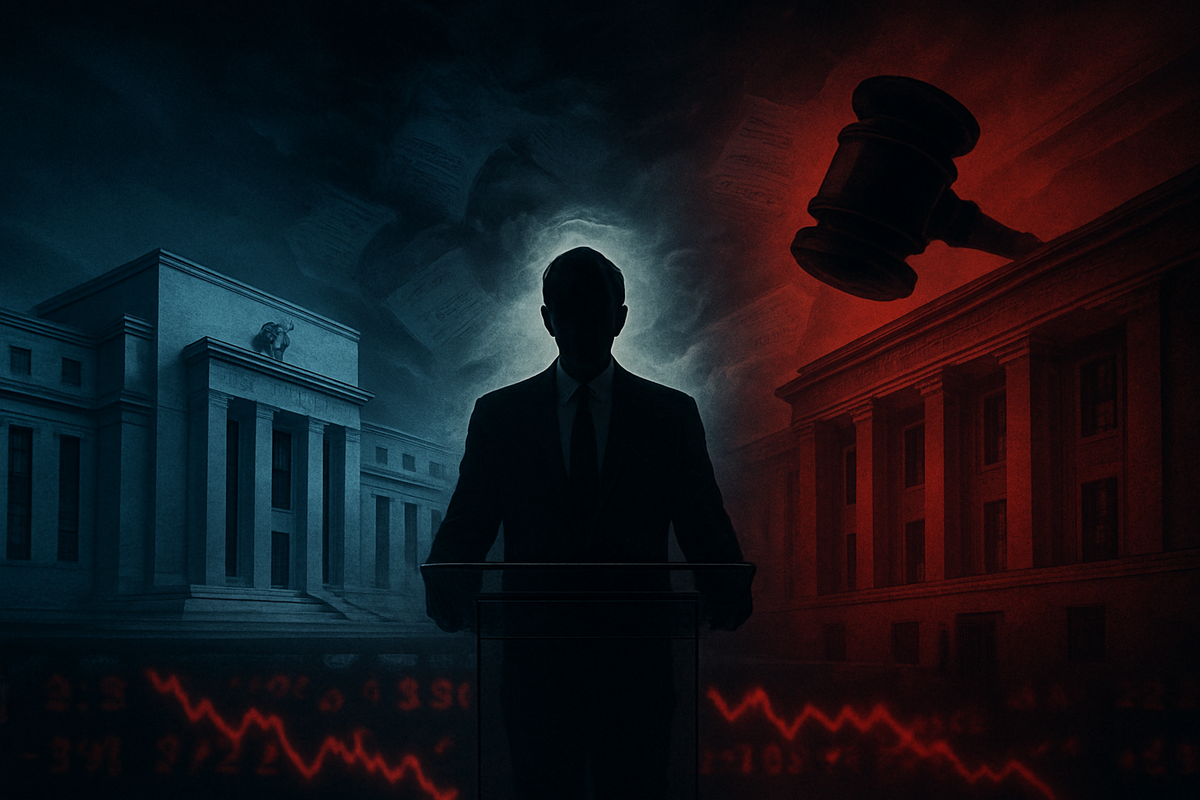
The long-standing wall between the White House and the Federal Reserve has been breached as of January 20, 2026, following an unprecedented criminal investigation launched by the Department of Justice (DOJ) into Federal Reserve Chairman Jerome Powell. The investigation, which centers on alleged misinformation regarding a $2.5 billion renovation of the central bank’s headquarters, has been widely interpreted by economists and market participants as a "pretextual" attempt to force Powell out of his role before his term ends in May. The immediate fallout has sent shockwaves through the global financial system, introducing a "political risk premium" into U.S. assets that has not been seen in decades.
The conflict has escalated into a full-blown constitutional standoff on this Inauguration Day, as Powell has signaled his intent to remain at the helm despite escalating pressure from Attorney General Pam Bondi and the administration. For the markets, the stakes could not be higher. While the administration demands aggressive interest rate cuts to stimulate a flagging economy, Powell and the Federal Open Market Committee (FOMC) have stood their ground, citing persistent inflation. This "open war" has led to a historic divergence between fiscal expectations and monetary policy, leaving investors to grapple with a US dollar that is plummeting against major currencies and Treasury yields that are spiking due to fears of institutional instability.
A Timeline of Intimidation: The Road to the Grand Jury
The current crisis traces its roots to mid-2025, when the relationship between the executive branch and the Eccles Building fractured over the Fed’s refusal to lower interest rates to the 1% target demanded by the President. The tension reached a boiling point on January 11, 2026, when the DOJ served the Federal Reserve with grand jury subpoenas. The official focus of the probe is Powell’s June 2025 testimony before the Senate Banking Committee regarding the renovation of the Marriner S. Eccles headquarters. Prosecutors are investigating whether Powell intentionally misled Congress about cost overruns that saw the project’s budget balloon from an initial $1.9 billion to $2.5 billion.
Powell has not been silent in the face of these allegations. In a defiant video statement released shortly after the subpoenas were served, he labeled the investigation "political intimidation" and a direct assault on the independence of the Federal Reserve. He argued that the DOJ’s focus on a construction project is a thinly veiled attempt to create a "for cause" legal justification to remove him, as the law protects a Fed Chair from being fired over policy disagreements alone. The drama is further compounded by the administration's parallel efforts to remove Fed Governor Lisa Cook over unrelated mortgage fraud allegations—a case that has also reached the Supreme Court.
Initial market reactions have been swift and severe. As of today, January 20, 2026, the 10-year Treasury yield has surged past 4.2%, reflecting a "sell America" sentiment among international bondholders who fear the end of a non-partisan central bank. Meanwhile, gold has reached a record high of $4,700 per ounce, and Bitcoin has neared the $92,000 mark as investors flee toward decentralized or hard-asset havens. The upcoming FOMC meeting on January 28 is now viewed as a pivotal moment, with markets pricing in a 95% probability that the Fed will hold rates steady simply to demonstrate its refusal to be bullied by the DOJ.
The Market Toll: Winners and Losers in a Volatile Landscape
The institutional instability has created a clear divide between winners and losers across the S&P 500. Major financial institutions like JPMorgan Chase & Co. (NYSE: JPM) and Goldman Sachs Group Inc. (NYSE: GS) have found themselves in a precarious position. JPMorgan CEO Jamie Dimon has publicly supported Fed autonomy, warning that political interference could destabilize the global economy. However, both JPM and Goldman Sachs are bracing for near-term underperformance in U.S. equities as the "political risk premium" makes American stocks less attractive compared to European and Asian counterparts.
On the other hand, BlackRock, Inc. (NYSE: BLK) has seen its influence grow as a central player in the narrative. Rick Rieder, BlackRock’s CIO of Global Fixed Income, has emerged as a top contender to succeed Powell if he is removed or once his term expires in May. Rieder’s recent meeting with the President has fueled speculation that BlackRock could help bridge the gap between the administration’s desire for lower rates and the market’s need for predictability. While BlackRock’s institutional stance remains cautious, the firm’s fixed-income strategies have become the primary focus for investors looking to navigate the bond market's wild fluctuations.
In the real estate sector, homebuilders like D.R. Horton, Inc. (NYSE: DHI) are bearing the brunt of the chaos. Despite the President's vocal demands for lower rates, the spike in Treasury yields caused by the DOJ-Fed friction has pushed mortgage rates higher. D.R. Horton’s stock has experienced extreme volatility; while some traders bet on an eventual administration win (and subsequent rate cuts), the immediate reality of higher borrowing costs and potential earnings declines of 25% has dampened sentiment. Conversely, exchange operators like CME Group Inc. (NASDAQ: CME) are thriving on the volatility. CME reported record-breaking volumes in interest rate futures and prediction markets as traders desperately hedge against the legal and constitutional risks unfolding in Washington.
The Death of Independence? Wider Significance and Precedents
The DOJ’s criminal investigation into Powell is more than just a legal battle; it represents a fundamental shift in the American economic order. Historically, the Federal Reserve’s independence has been a cornerstone of global confidence in the U.S. dollar. By weaponizing the DOJ to investigate policy leaders over administrative matters like building renovations, the current administration is challenging a precedent that has stood since the Fed-Treasury Accord of 1951. Experts argue that if the Fed becomes an arm of the executive branch, the U.S. could see a permanent increase in inflation expectations and a steady erosion of the dollar’s status as the world’s reserve currency.
This event fits into a broader global trend of "populist monetary policy," where governments in both emerging and developed markets have sought to seize control of central banks to fund fiscal spending or stimulate short-term growth. The ripple effects are already being felt among partners and competitors; the European Central Bank and the Bank of England have expressed solidarity with Powell, fearing that a compromised Fed will force them into unwanted policy shifts to protect their own currencies. The regulatory implications are also significant, as any move to weaken the "for cause" removal protection for Fed governors would likely require a Supreme Court ruling, potentially redefining the "unitary executive" theory for decades to come.
Comparisons have been drawn to the Nixon era, when the President famously pressured Arthur Burns to keep rates low ahead of the 1972 election. However, the use of a criminal probe marks a much more aggressive and dangerous escalation. Unlike the 1970s, where pressure was applied behind closed doors, the 2026 crisis is being fought in the public eye through subpoenas, social media, and prediction markets. This transparency has amplified the market impact, as every DOJ leak or Fed counter-statement is instantly priced into the value of the dollar and the yield curve.
Looking Ahead: The Looming May Deadline
In the short term, the market remains fixated on the January 28 FOMC meeting. The Fed is expected to hold a "fortress" position, maintaining current interest rates to signal that its policy is determined by data, not the DOJ. However, this strategy carries the risk of deepening the economic slowdown, potentially handing more ammunition to the administration’s "pro-growth" narrative. Strategic pivots are already occurring within the private sector, as large corporations move to lock in long-term financing now, fearing that even if rates eventually drop, the underlying market instability will make credit spreads prohibitively expensive.
Long-term, the focus remains on May 2026, when Powell’s term as Chair officially ends. Powell has suggested he may remain on the Board of Governors until 2028—a move allowed by law—specifically to act as a "firewall" against the politicization of the bank. This sets the stage for a prolonged "shadow chairmanship" where the outgoing leader continues to influence policy from a junior seat. Potential scenarios range from a Supreme Court-mandated truce to a full-scale firing of the Board, which would likely trigger a massive sell-off in U.S. Treasuries and a potential downgrade of U.S. sovereign debt by major rating agencies.
Conclusion: A Turning Point for the Global Financial Order
The 2026 standoff between the DOJ and Jerome Powell marks a watershed moment for the United States. The weaponization of legal investigations to influence monetary policy has introduced a level of institutional risk that was once thought impossible in a developed economy. For investors, the takeaway is clear: the "Fed Put"—the idea that the central bank will always step in to support markets—is being replaced by "Fed Friction," where policy decisions are increasingly dictated by a need to defend the institution’s very existence.
As the market moves forward, the primary focus will be on the resilience of U.S. institutions. If Powell manages to survive the DOJ probe and finish his term, it may bolster the Fed's independence in the long run. However, the damage to the dollar’s reputation for stability may already be done. Investors should watch for the Supreme Court's upcoming rulings on executive power and the results of the January 28 FOMC meeting. In this new era, the most important economic indicator may no longer be the CPI or the unemployment rate, but the legal filings emerging from the Department of Justice.
This content is intended for informational purposes only and is not financial advice