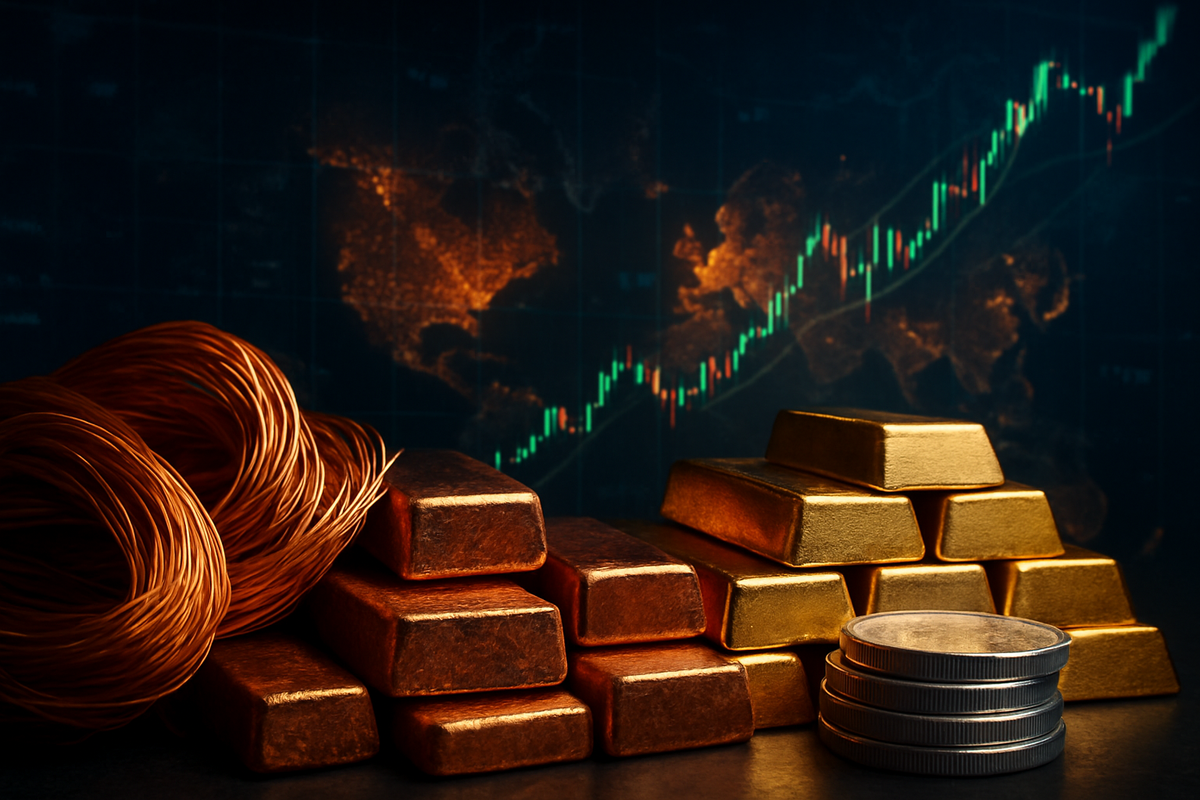
In a week that financial historians may long remember as the "Great Commodities Re-Rating," the prices of gold, silver, and copper surged to unprecedented highs on January 14, 2026. Driven by a volatile cocktail of institutional crises in the United States, escalating military tensions in the Middle East, and a structural supply deficit in industrial metals, the commodities market witnessed what analysts are calling a "violent recalibration of risk." Spot gold breached the $4,600 mark, while silver neared $100 per ounce, signaling a desperate flight to safety by global investors.
The immediate implications of this surge are profound, affecting everything from the cost of high-end electronics and electric vehicles to the very foundation of the U.S. dollar's hegemony. As the Federal Reserve faces an unprecedented legal challenge to its autonomy and China tightens its grip on strategic metal exports, the "hard asset" trade has transitioned from a niche hedge to the dominant market theme of 2026. For consumers and corporations alike, the "super-squeeze" in metals represents a new era of inflationary pressure that threatens to derail the fragile post-recession recovery.
A Perfect Storm: The Events of January 14
The market reached a breaking point on the morning of January 14, 2026, following a series of geopolitical and domestic shocks that crippled investor confidence. The primary catalyst was the escalating "Independence Crisis" at the Federal Reserve. On January 11, the Department of Justice served grand jury subpoenas to Fed Chair Jerome Powell and the Board of Governors regarding a probe into headquarters renovation costs—a move widely viewed by Wall Street as political intimidation. By the time markets opened on the 14th, a "Sell-America" sentiment had taken hold, driving investors out of Treasuries and into the safe haven of gold, which hit a staggering peak of $4,650.50 per ounce.
Simultaneously, the geopolitical landscape fractured. In the Middle East, civil unrest in Iran coupled with public threats of U.S. military intervention created a "war premium" on all commodities. This was exacerbated by the U.S. military’s capture of Venezuelan leader Nicolás Maduro earlier in the month and a bizarre but intensifying diplomatic rift with Denmark over the status of Greenland. As traditional alliances wavered, silver prices exploded by 5% in a single session to $93.57 per ounce. This move was accelerated by China’s January 1st decision to reclassify silver as a "strategic dual-use material," effectively cutting off Western supply chains from Chinese refined silver.
Industrial metals were not spared from the frenzy. Copper, often referred to as "Dr. Copper" for its ability to gauge economic health, shattered records on the London Metal Exchange (LME) to trade at $13,407 per metric ton. Unlike the fear-driven spikes in precious metals, copper’s rise was the result of a physical shortage. The permanent closure of the Cobre Panamá mine and operational hurdles at major sites in Indonesia and the Democratic Republic of Congo have left the market in a 400,000-metric-ton deficit. When the news hit on the 14th that AI-optimized data centers were consuming three times more copper than initially projected, the "red metal" entered a vertical price discovery phase.
Winners and Losers: The Corporate Divide
The primary beneficiaries of this price explosion have been the global mining majors, whose profit margins have expanded to historic levels. Newmont Corp. (NYSE: NEM) and Barrick Gold (NYSE: GOLD) have seen their stock prices double over the past year as their all-in sustaining costs (AISC) remain anchored near $1,600/oz, allowing them to capture nearly $3,000 in pure profit for every ounce of gold unearthed. Similarly, Freeport-McMoRan (NYSE: FCX) has become a darling of the S&P 500, leveraging its massive copper assets in Indonesia and the U.S. to generate record-breaking free cash flow. Silver producers like First Majestic Silver Corp. (NYSE: AG) and Hecla Mining (NYSE: HL) are also seeing a "re-rating," as silver is increasingly treated as both a monetary asset and a critical industrial component for the energy transition.
However, the "metals mania" has created a severe margin squeeze for downstream consumers, particularly in the tech and automotive sectors. Tesla (NASDAQ: TSLA) is facing an estimated $900 increase in raw material costs per vehicle due to the copper-intensive nature of its battery packs and motor windings. This has forced the company to pause its aggressive price-cutting strategy, potentially dampening consumer demand. Electronics giants like Apple (NASDAQ: AAPL) and Samsung (OTC: SSNLF) are also feeling the heat; silver is essential for high-end printed circuit boards, and analysts suggest that the bill of materials for the upcoming 2026 flagship smartphones could rise by as much as 15%, leading to inevitable price hikes for the end-user.
In the renewable energy sector, the impact is even more dire. Solar panel manufacturers such as Jinko Solar (NYSE: JKS) and LONGi Green Energy are reporting that silver paste has surpassed silicon as their single largest cost component. The "silver squeeze" has pushed some manufacturers into net losses, sparking a desperate technological race to substitute silver with copper or aluminum—a transition that could take years to perfect. For these companies, the record-high metal prices are not a cause for celebration but a threat to their very survival.
Broader Significance and Historical Precedents
The current surge represents more than just a temporary spike; it is a signal of a broader structural shift in the global economy. For decades, the world relied on a "just-in-time" supply chain and a stable U.S. dollar. The events of mid-January 2026 suggest that both pillars are crumbling. The weaponization of silver exports by China and the domestic pressure on the Federal Reserve have created a "debasement trade" reminiscent of the 1970s stagflation era, yet amplified by the modern demand for "green" and "AI" infrastructure.
This event also highlights the decoupling of copper from traditional industrial cycles. Historically, copper prices would fall during periods of high interest rates or geopolitical uncertainty due to expected slowdowns in construction. Today, however, the "Triple Threat" of AI data center growth, global power grid modernization, and the electric vehicle transition has created a floor for copper demand that ignores traditional macro headwinds. We are witnessing the birth of a "Commodity Super-Cycle" that is being driven as much by national security and technological necessity as it is by investment speculation.
From a regulatory standpoint, the record highs are likely to trigger increased government intervention. We are already seeing "resource nationalism" rise in South America and Africa, where governments are demanding a larger share of mining profits through windfall taxes. In the U.S. and Europe, the strategic importance of these metals may lead to new "onshoring" subsidies, similar to the CHIPS Act, as Western nations realize they cannot meet their climate or AI goals while being beholden to volatile global markets or adversarial export controls.
The Road Ahead: What to Expect Next
In the short term, the market is likely to remain in a state of "extreme overbought" territory, making it susceptible to sharp, volatile corrections as profit-taking occurs. However, the underlying supply-demand imbalances suggest that any dip will be aggressively bought by institutional players. For the mining sector, the challenge will be managing escalating labor and energy costs, which threaten to eat into their newfound margins. Companies that can successfully navigate the geopolitical risks of operating in jurisdictions like Peru or the DRC will be the long-term winners.
Looking further ahead, we may see a strategic pivot in how corporations manage their metal needs. "Direct-to-mine" partnerships, where companies like Tesla (NASDAQ: TSLA) or NVIDIA (NASDAQ: NVDA) take equity stakes in mining projects to secure future supply, are expected to become the industry standard. Additionally, the recycling of electronics and solar panels will transition from an environmental goal to a financial necessity, as the "urban mine" becomes a more attractive source of silver and copper than traditional geological deposits.
The possibility of a "two-tier" market is also emerging. If China continues to restrict silver exports, we could see a permanent price discrepancy between Western and Eastern exchanges. This fragmentation would complicate global trade and lead to increased smuggling and "gray market" activity in commodities. For investors, the focus must shift from pure price appreciation to supply chain resilience and the ability of companies to pass on these historic costs to a consumer base already weary of inflation.
Final Assessment: A New Commodity Standard
The record highs of January 14, 2026, mark the definitive end of the era of "cheap atoms." As the digital world expands via AI and the physical world electrifies, the raw materials required to power these transitions have become the most valuable currency on earth. The simultaneous surge in gold and silver reflects a profound lack of trust in traditional institutions, while the rise of copper underscores the physical limits of our technological ambitions.
Moving forward, the market is likely to remain in a "high-floor" environment. Even if geopolitical tensions ease, the structural deficit in copper and the reclassification of silver will prevent a return to 2024 price levels. Investors should closely watch for any signs of a resolution to the Federal Reserve’s legal battles, as a restoration of central bank independence could cool the gold rally. However, for silver and copper, the industrial narrative is now the primary driver.
In conclusion, the "Metals Mania" of 2026 is a wake-up call for a global economy that has long taken its physical inputs for granted. The coming months will be a period of intense adaptation, as industries either find ways to innovate around these costs or face a permanent reduction in profitability. For the savvy investor, the focus remains on quality miners with high-grade reserves and downstream companies with the pricing power to weather the storm.
This content is intended for informational purposes only and is not financial advice.