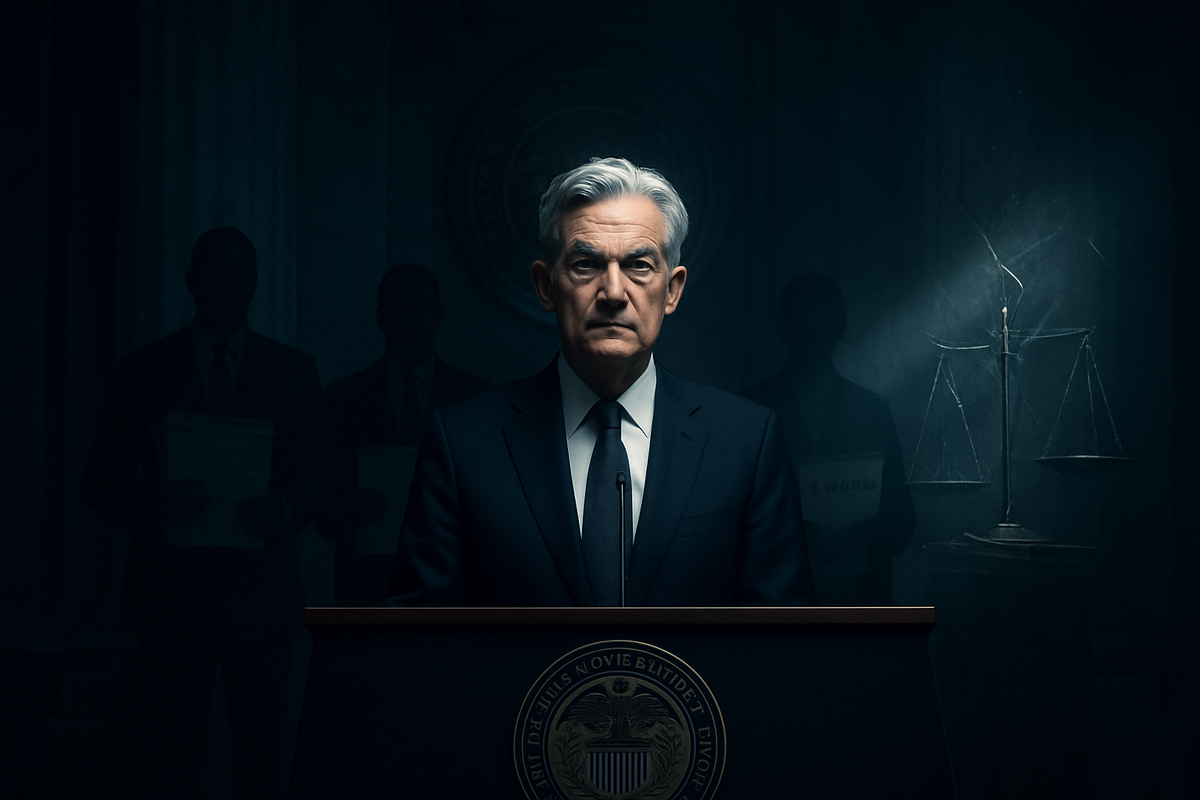
In an unprecedented escalation of the conflict between the executive branch and the nation’s central bank, the Department of Justice (DOJ) has launched a criminal investigation into Federal Reserve Chair Jerome Powell. The probe, which centers on alleged perjury regarding the $2.5 billion renovation of the Federal Reserve’s headquarters, has sent shockwaves through global financial markets as of January 12, 2026. Powell has broken his characteristic silence to denounce the investigation as a "pretext" designed to intimidate the Fed into aggressive interest rate cuts, marking the most significant threat to the Federal Reserve’s independence in its 113-year history.
The immediate implications of this probe have been felt across all asset classes, triggering a "sell-America" trade that has seen the U.S. dollar and Treasury bonds retreat while safe-haven assets like gold and silver surge to record highs. Investors are grappling with a new reality where the "Fed Put"—the long-standing belief that the central bank will act as a backstop for the economy—is now entangled in a high-stakes legal war. As Powell vows to serve out his term ending in May 2026, the standoff raises a fundamental question: Can a central bank remain data-driven when its leader is under the shadow of a criminal subpoena?
The Renovation Probe: Fact or Fiction?
The current crisis traces its roots to June 2025, when Chair Powell testified before the Senate Banking Committee regarding the ballooning costs of the Eccles Building renovation. Originally budgeted at $1.9 billion, the project’s cost rose to $2.5 billion, a figure the Trump administration has repeatedly inflated in public statements to over $3 billion. High-ranking officials, including Office of Management and Budget (OMB) Director Russ Vought and Federal Housing Finance Agency (FHFA) Director Bill Pulte, accused Powell of misleading Congress about "luxury" features, including VIP elevators and roof terrace gardens—claims Powell has categorically denied.
The timeline accelerated rapidly in late 2025 when U.S. Attorney for the District of Columbia, Jeanine Pirro, approved a formal criminal inquiry. On January 9, 2026, the DOJ served the Federal Reserve with grand jury subpoenas, effectively turning a policy dispute into a criminal matter. Powell’s response on January 11 was a watershed moment; in a public video statement, he argued that the renovation costs were merely a convenient excuse for an administration that has spent the last year demanding 200 basis points in rate cuts to fuel its economic agenda.
Key stakeholders, including Attorney General Pam Bondi, have framed the investigation as a necessary check on "taxpayer waste," but the timing suggests a deeper motive. Throughout 2025, the Fed resisted the White House's demands for drastic easing, opting instead for a cautious 75-basis-point reduction to combat persistent inflation fueled by new tariff regimes. This resistance appears to have been the catalyst for the DOJ's intervention, setting the stage for a constitutional showdown between the President’s power to oversee the executive and the Fed’s statutory independence.
Market Winners and Losers in the "Pretext" Era
The banking sector has been the most visible casualty of this institutional instability. Major institutions like JPMorgan Chase (NYSE: JPM), Bank of America (NYSE: BAC), and Citigroup (NYSE: C) saw their shares tumble as the probe was announced. The uncertainty surrounding future monetary policy, combined with administration proposals to cap credit card interest rates at 10%, has left bank analysts scrambling to adjust earnings forecasts. Lenders with high exposure to consumer credit, such as Capital One (NYSE: COF) and American Express (NYSE: AXP), have faced even steeper declines as the prospect of a politically managed Fed threatens to destabilize the credit markets.
In the technology sector, the reaction has been bifurcated. While "Magnificent Seven" giants like NVIDIA (NASDAQ: NVDA) and Microsoft (NASDAQ: MSFT) have shown some resilience due to their dominant positions in the AI supercycle, Apple (NASDAQ: AAPL) has faced significant pressure. The high cost of capital, which remains floor-priced at 3.5%, has stripped away the valuation premiums previously enjoyed by growth stocks. Smaller, speculative tech firms that rely on "easy money" have been the clear losers, as the "inflation risk premium" on long-term debt has spiked in response to the DOJ's actions.
Conversely, the housing sector has seen a volatile "policy-driven" rally. Homebuilders such as Lennar (NYSE: LEN), D.R. Horton (NYSE: DHI), and PulteGroup (NYSE: PHM) initially gained ground on rumors that the administration would bypass the Fed to lower mortgage rates through direct government bond purchases. However, these gains are fragile; if the DOJ probe leads to a loss of global confidence in the U.S. dollar, the resulting rise in Treasury yields could push mortgage rates higher regardless of government intervention, creating a "policy whiplash" for the entire real estate industry.
Historical Precedents and the Death of Independence
The 2026 standoff echoes some of the most contentious moments in Federal Reserve history, yet it introduces a more aggressive tactical playbook. In 1965, President Lyndon B. Johnson famously summoned Chair William McChesney Martin to his Texas ranch to physically intimidate him over interest rate hikes. Similarly, the "Nixon Tapes" revealed President Richard Nixon’s successful pressuring of Arthur Burns to ease policy ahead of the 1972 election—a move widely credited with fueling the "Great Inflation" of the 1970s.
However, the current situation is distinct because it weaponizes the legal system. Where past presidents used the "bully pulpit" or personal relationships, the 2026 administration is using criminal subpoenas. This shift from political pressure to legal jeopardy represents a fundamental change in the relationship between the White House and the Fed. It suggests that the "independence" of the central bank is no longer protected by institutional norms, but is subject to the same partisan legal battles that define modern American politics.
The broader significance of this event lies in the "Sell-America" trade. Historically, Fed-bashing was viewed as a domestic political theater. In 2026, the globalized nature of the U.S. dollar means that any perceived loss of Fed independence is treated as a systemic risk. Foreign central banks and sovereign wealth funds are now demanding a "political risk premium" for holding U.S. debt, a development that could have long-term consequences for the dollar’s status as the world’s primary reserve currency.
The Path Forward: Defensive Hawkishness or Capitulation?
In the short term, the Federal Reserve faces a strategic dilemma often referred to as "defensive hawkishness." To prove that it has not been intimidated by the DOJ probe, the Federal Open Market Committee (FOMC) may feel compelled to keep interest rates higher for longer, even if economic data suggests a cut is warranted. This "policy error" risks pushing the U.S. economy into a deeper recession simply to maintain the appearance of institutional integrity.
As we look toward the expiration of Powell’s term in May 2026, several scenarios emerge. The administration may attempt to install a "Shadow Fed Chair"—a loyalist appointee who could provide alternative guidance and undermine Powell’s authority before his term officially ends. Alternatively, if Powell is indicted, it could trigger a protracted legal battle over the President’s authority to remove a Fed Chair "for cause," a case that would almost certainly end up before the Supreme Court.
Investors should prepare for a period of heightened volatility where "Fed-speak" is replaced by "DOJ-speak." The traditional metrics of employment and inflation (CPI) may take a backseat to court filings and grand jury leaks. The primary challenge for the market will be price discovery in an environment where the discount rate is determined not by economic theory, but by political survival.
Wrap-Up: A New Regime for Investors
The DOJ probe into Jerome Powell marks the end of an era for the Federal Reserve. The central bank's transition from an independent, data-driven technocracy to a political lightning rod is now complete. For investors, the key takeaway is that the "institutional guardrails" of the past decade have been significantly weakened. The market must now price in a permanent "political risk premium" for U.S. assets, reflecting the reality that the Fed's decisions are no longer insulated from the whims of the executive branch.
Moving forward, the market will likely remain in a state of flux until the leadership transition in May 2026 is resolved. Watch for signs of "defensive hawkishness" in the upcoming FOMC minutes and pay close attention to the 10-year Treasury yield as a barometer of global confidence. If the Fed loses its credibility as an inflation fighter, the resulting shift in the global financial order could be the most lasting impact of this probe.
In the coming months, the focus will remain on the U.S. Attorney’s Office in D.C. and the Fed’s headquarters. Whether Powell stays or goes, the precedent has been set: the Federal Reserve is no longer an island of stability, but a battlefield in the ongoing struggle for control over the American economy.
This content is intended for informational purposes only and is not financial advice.