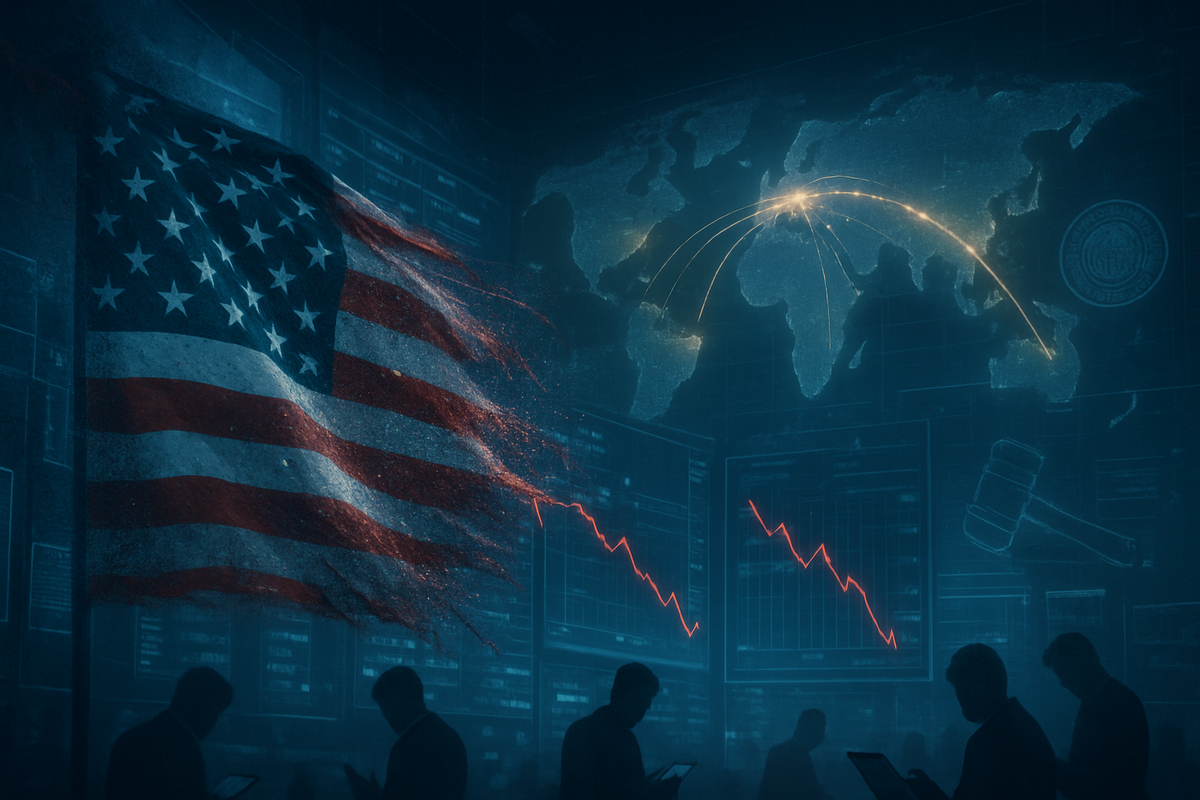
For over a decade, the mantra of global finance was "TINA"—There Is No Alternative to U.S. equities. But as of January 12, 2026, that era has come to a jarring halt. A powerful "Sell America" sentiment has gripped international markets, triggered by a volatile cocktail of aggressive trade protectionism, unprecedented attacks on the Federal Reserve’s independence, and a radical restructuring of the U.S. tax and regulatory code. What began as a localized reaction to shifting political rhetoric has evolved into a structural exodus, with institutional investors increasingly viewing the United States as a "developed market with emerging market risks."
The immediate implications are stark. For the first time in twenty years, the S&P 500 finished 2025 as the worst-performing major equity index, while the U.S. Dollar and Treasuries have suffered a rare synchronized sell-off. This capital flight is not merely a "dip" but a fundamental reconsideration of "American Exceptionalism." As the "risk premium" for holding U.S. assets rises, the global financial map is being redrawn, favoring European value plays and a revitalized Asian tech sector that has found a way to bypass the Silicon Valley hardware monopoly.
The Timeline of the 'Sell America' Shift
The erosion of investor confidence can be traced back to the "April Tariff Storm" of 2025. On April 2, a day now known in trading circles as "Liberation Day," the administration announced a 10% flat tariff on all imports and "reciprocal" duties reaching as high as 34% for China and 20% for the European Union. The move, championed by Commerce Secretary Howard Lutnick, triggered a $6.6 trillion evaporation of market value in 48 hours. While the administration framed the move as a way to protect domestic industry, the market saw it as a declaration of a multi-front trade war that would inevitably squeeze corporate margins and stoke inflation.
The situation worsened on July 4, 2025, with the signing of the One Big Beautiful Act (OBBA). While the legislation made the 2017 tax cuts permanent, it contained a "poison pill" for international investors: Section 899. This clause introduced withholding taxes on non-resident earnings within the U.S., effectively taxing foreign capital for the privilege of being in American markets. This "tax on the world" prompted a massive liquidation by sovereign wealth funds and European pension funds. Simultaneously, the institutional independence of the Federal Reserve came under fire. Following the attempted removal of Governor Lisa Cook and the January 2026 issuance of grand jury subpoenas to Fed Chair Jerome Powell over a headquarters renovation project—widely seen as a pretext for political pressure—the Fed’s credibility as an inflation-fighter has been deeply compromised.
The Winners and Losers of the New World Order
The "Sell America" rotation has created a clear divide between the "Old Guard" of U.S. mega-caps and the international "Value" stars. Apple Inc. (NASDAQ: AAPL), Tesla, Inc. (NASDAQ: TSLA), and Starbucks Corp. (NASDAQ: SBUX) were among the hardest hit during the 2025 rout, with shares tumbling as China launched retaliatory countermeasures and supply chains buckled under the tariff weight. Even the AI darling Nvidia Corp. (NASDAQ: NVDA) was not immune; it lost $600 billion in market cap in early 2025 after the Chinese AI model DeepSeek R1 proved that advanced intelligence could be achieved without the most expensive U.S. GPUs, shattering the "hardware moat" narrative.
Conversely, the "unloved" sectors of Europe and Asia have seen a renaissance. The EURO STOXX Banks Index surged 76% in 2025 as capital fled U.S. tech for European value. Société Générale (OTC:SCGLY) and Barclays PLC (NYSE: BCS) emerged as top performers, benefiting from stable interest rates and a lack of regulatory "blackmail" seen in the U.S. In the healthcare space, Fresenius SE & Co. KGaA (OTC:FSNUY) became a defensive haven as U.S. giants like UnitedHealth Group Inc. (NYSE: UNH) struggled with massive cuts to Medicaid funding mandated by the OBBA. In Asia, Tencent Holdings Ltd. (OTC:TCEHY) and Alibaba Group Holding Ltd. (NYSE: BABA) have rallied, reclaiming their status as AI leaders by integrating more efficient, cost-effective domestic models.
A Structural Shift in Global Governance
This event marks a significant departure from historical precedents. Unlike the 2008 financial crisis, where the U.S. was the "cleanest shirt in the dirty laundry," the current crisis is perceived as self-inflicted and structural. The decision to bring independent agencies like the Fed under "Presidential supervision" via executive order has signaled to the world that the U.S. may no longer adhere to the rules-based order it helped create. This "De-Americanization" of portfolios is a direct response to what Goldman Sachs Group Inc. (NYSE: GS) analysts call a "multipolar world" where U.S. exceptionalism is no longer a given.
The regulatory shift has also been profound. The January 2026 remedies order against Alphabet Inc. (NASDAQ: GOOGL), which forced the company to share its search index with competitors, signaled the end of the "Big Tech" era of untouchable monopolies. When combined with the withdrawal of standard merger guidelines by the DOJ, the environment for U.S. business has shifted from "predictable" to "peak ambiguity." This has forced a ripple effect among competitors; while European regulators like the EU's Digital Markets Act were once seen as the primary threat to tech, the U.S. is now viewed as equally, if not more, interventionist, albeit for different political reasons.
What Lies Ahead: The 2026 Outlook
In the short term, the market is bracing for a potential U.S. recession. J.P. Morgan Chase & Co. (NYSE: JPM) has flagged a 35% probability of a downturn in 2026, citing the "K-shaped" impact of the OBBA, where tax cuts for the wealthy are offset by the "tariff toll" on the average consumer. Strategic pivots are already underway; BlackRock, Inc. (NYSE: BLK) has moved to a "selective" stance, favoring international financials and healthcare over broad U.S. indices. Investors should expect continued volatility as the "April Tariff Storm" matures and the Fed leadership transition in May 2026 approaches.
The long-term challenge for the U.S. will be reclaiming its status as a safe haven. If the administration continues to use the dollar and the Fed as geopolitical weapons, the "Sell America" sentiment could become a permanent fixture of the 2020s. However, this also creates opportunities for nimble investors. The 40% valuation discount of Emerging Markets relative to the U.S. remains a "pillar of opportunity" for those willing to brave the geopolitical headwinds.
Final Assessment: The End of the TINA Trade
The key takeaway from the events of late 2025 and early 2026 is that the U.S. market can no longer rely on its reputation to attract capital. The "Sell America" movement is a rational response to a shift in the fundamental "social contract" between the U.S. government and global investors. When political rhetoric threatens the independence of the central bank and regulatory shifts become tools of trade negotiation, capital will naturally seek more stable ground.
Moving forward, the market will be hyper-focused on two things: the survival of Fed independence and the actual implementation of the "reciprocal" tariffs. For the first time in a generation, the "Buy the Dip" mentality in U.S. equities is being replaced by a "Sell the Rip" strategy. Investors should watch the upcoming Supreme Court rulings on the removal of Fed governors and the Q1 2026 earnings reports of consumer giants like Procter & Gamble Co. (NYSE: PG) and Nike, Inc. (NYSE: NKE) to see if the "tariff toll" is as destructive as feared. The "American Dream" is not dead, but for the global investor, it has certainly become much more expensive to own.
This content is intended for informational purposes only and is not financial advice.