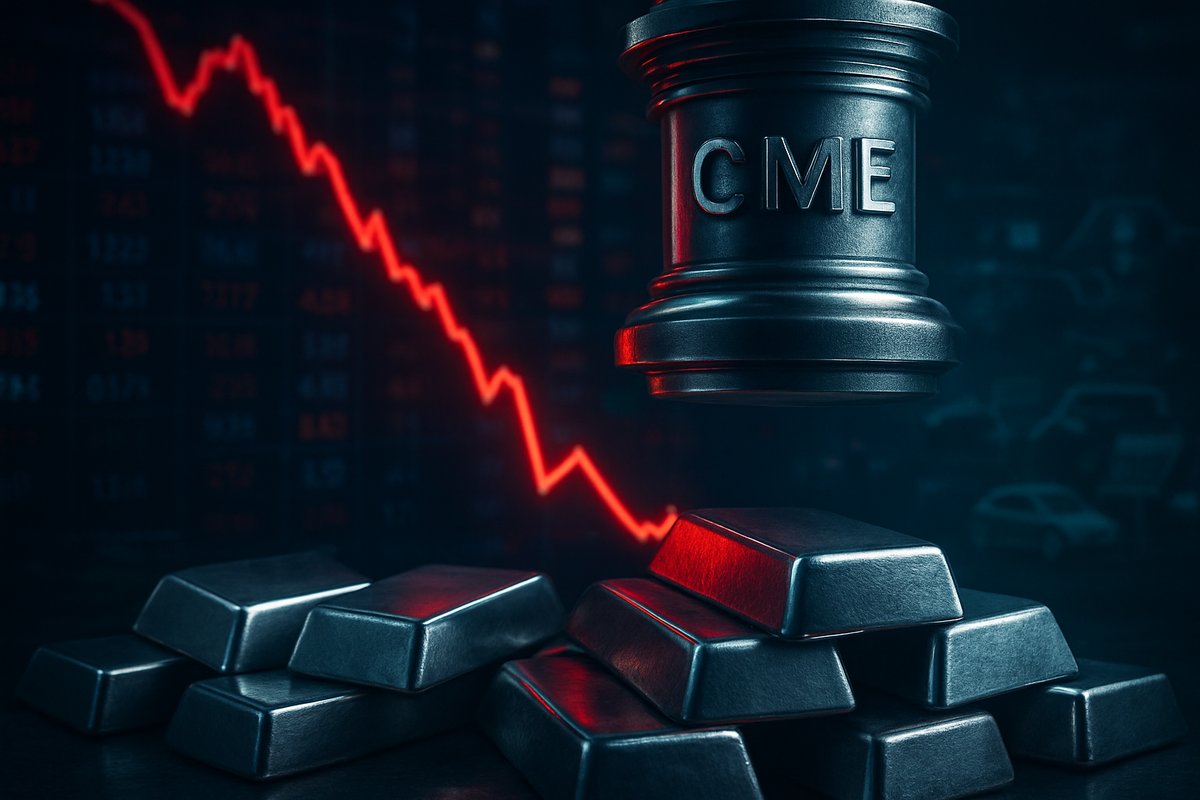
The silver market is ending 2025 in a state of high-velocity retreat, as a series of aggressive regulatory interventions by the CME Group (NASDAQ: CME) successfully punctured a speculative bubble that had briefly driven the precious metal to historic nominal highs. After a parabolic rally that saw silver touch an intraday peak of $84.01 per ounce on December 29, the market has undergone a violent correction, shedding more than 15% of its value in just 48 hours. As of today, December 31, 2025, silver is trading in the $71.00 range, leaving leveraged traders scrambling to cover positions in what is being described as the "New Year’s Eve Liquidation."
The catalyst for this sudden reversal was a rare "one-two punch" from the CME Group, which hiked margin requirements on silver futures twice within a single week. By significantly increasing the amount of collateral required to hold a silver contract, the exchange effectively forced over-leveraged "long" speculators out of the market. This move has not only cooled the immediate price action but has also sparked a broader debate about the role of exchange operators in managing commodity volatility during a period of unprecedented industrial demand for silver in the green energy and artificial intelligence sectors.
The Timeline of the "New Year's Eve Liquidation"
The turmoil began in earnest during the holiday-thinned trading week of late December. On December 26, 2025, the CME Group issued Advisory No. 25-393, raising the initial margin for March 2026 silver contracts from $22,000 to $25,000. While the market initially absorbed this 13.6% increase, speculative momentum continued to build, driven by reports of a massive physical silver deficit in the Shanghai markets. This "Great Divergence" between Eastern physical demand and Western paper leverage led to a final, frantic push that saw silver prices scream toward the $85 level by the morning of December 29.
Recognizing a potential systemic risk as volatility metrics spiked to levels not seen in over a decade, the CME Group acted again. On December 30, 2025, the exchange announced a second, more punitive hike, raising margins by an additional 30% to $32,500 per contract. The impact was instantaneous. By the time the New York floor opened on the final day of the year, a wave of forced liquidations had hit the tape. Investors who had entered the market at the $80 level found themselves facing margin calls they could not meet, leading to a cascading sell-off that erased billions in paper wealth in a matter of hours.
Winners and Losers in the Silver Rout
The primary casualties of this volatility have been the major silver mining stocks, which are often viewed as leveraged plays on the underlying metal. First Majestic Silver Corp. (NYSE: AG) and Pan American Silver Corp. (NYSE: PAAS) both saw their share prices crater by double digits following the second margin hike. These companies, which had enjoyed a stellar 2025 as silver prices doubled, are now facing a period of intense valuation reassessment. Similarly, the iShares Silver Trust (NYSEARCA: SLV), the world’s largest silver ETF, saw its largest single-day outflow of the year on December 30, as retail and institutional investors alike fled the volatility.
Conversely, the CME Group (NASDAQ: CME) stands as a complex winner in this scenario. While the margin hikes may temporarily dampen trading volumes, the exchange’s primary mandate is to maintain orderly markets and mitigate counterparty risk. By pricking the bubble before a more catastrophic collapse could occur, the CME has reinforced its role as the global arbiter of price discovery. Additionally, industrial consumers of silver, such as solar panel manufacturer First Solar, Inc. (NASDAQ: FSLR) and EV giant Tesla, Inc. (NASDAQ: TSLA), may find relief in the price drop. These companies have been struggling with soaring input costs throughout 2025, and a stabilization of silver prices in the $70 range could improve their manufacturing margins heading into 2026.
Broader Significance and Historical Precedents
The events of late 2025 mirror the infamous silver crash of May 2011, when the CME hiked margins five times in nine days to break a similar speculative fever that had pushed the metal toward $50 per ounce. However, the 2025 context is fundamentally different due to the structural shift in silver’s utility. Unlike 2011, where the rally was largely driven by inflation hedging and retail "stacking," the 2025 surge was underpinned by a genuine physical shortage. Silver’s critical role in AI data center cooling systems and high-efficiency photovoltaic cells has created a floor for demand that did not exist fifteen years ago.
This event also highlights a growing tension between global exchanges. Throughout December, the price of silver in Shanghai remained significantly higher than the COMEX price in New York, suggesting that the "paper" market in the West is increasingly decoupled from the "physical" reality in the East. Regulatory bodies like the Commodity Futures Trading Commission (CFTC) are now under pressure to investigate whether the CME’s margin hikes disproportionately favored large institutional short-sellers at the expense of smaller participants who were betting on the physical deficit.
What Lies Ahead for the Silver Market
In the short term, the silver market is likely to undergo a period of painful consolidation. Analysts expect the metal to find support between $65 and $68, as the forced liquidations conclude and long-term value seekers re-enter the fray. The primary challenge for the market in early 2026 will be rebuilding trust among retail investors who felt "burned" by the suddenness of the CME’s intervention. Strategic pivots are already underway at major mining firms; many are expected to hold back physical supply from the market in protest of the lower prices, which could ironically set the stage for the next supply-driven rally.
Longer-term, the fundamental bull case for silver remains intact. The structural deficit predicted by the Silver Institute at the start of 2025 has only widened, and the technological demand from the "AI Revolution" shows no signs of slowing. Investors should watch for a potential shift in how silver is traded, with a possible move toward more physical-backed instruments and away from the high-leverage futures contracts that proved so volatile this December.
Final Wrap-Up and Investor Outlook
The silver market’s wild ride in late 2025 serves as a stark reminder of the power of exchange-mandated margin requirements. While the $84 peak may have been a bridge too far for the CME Group’s risk models, the underlying industrial demand ensures that silver will remain a central fixture of the global economy in 2026. The key takeaway for investors is that while the "paper" price can be manipulated or suppressed by regulatory levers, the "physical" reality of supply and demand eventually dictates the long-term trend.
Moving forward, the market will be closely watching the $70 support level. If silver can hold this ground in the first weeks of January, it will signal that the 2025 rally was not just a speculative fluke, but a fundamental repricing of a critical industrial metal. Investors should keep a close eye on CME margin announcements and the ongoing price premium in Eastern markets, as these will be the primary indicators of the next major move in the silver space.
This content is intended for informational purposes only and is not financial advice.