The S&P 500 index climbed to a fresh all-time high on Friday, December 26, 2025, as Wall Street extended its post-holiday momentum into what is traditionally known as the "Santa Claus Rally." Buoyed by a combination of resilient economic data and cooling inflation figures, the benchmark index reached a new intraday peak, putting it on track to finish the year with its third consecutive year of double-digit gains—a feat not seen since the technology boom of the late 1990s.
The record-breaking performance comes as investors digest a "Goldilocks" economic environment: growth remains robust while price pressures continue to ease. With the Federal Reserve signaling a supportive stance and the artificial intelligence "supercycle" providing a structural tailwind for corporate earnings, market sentiment remains "electrically positive" despite the thin trading volumes typically seen during the final week of the year.
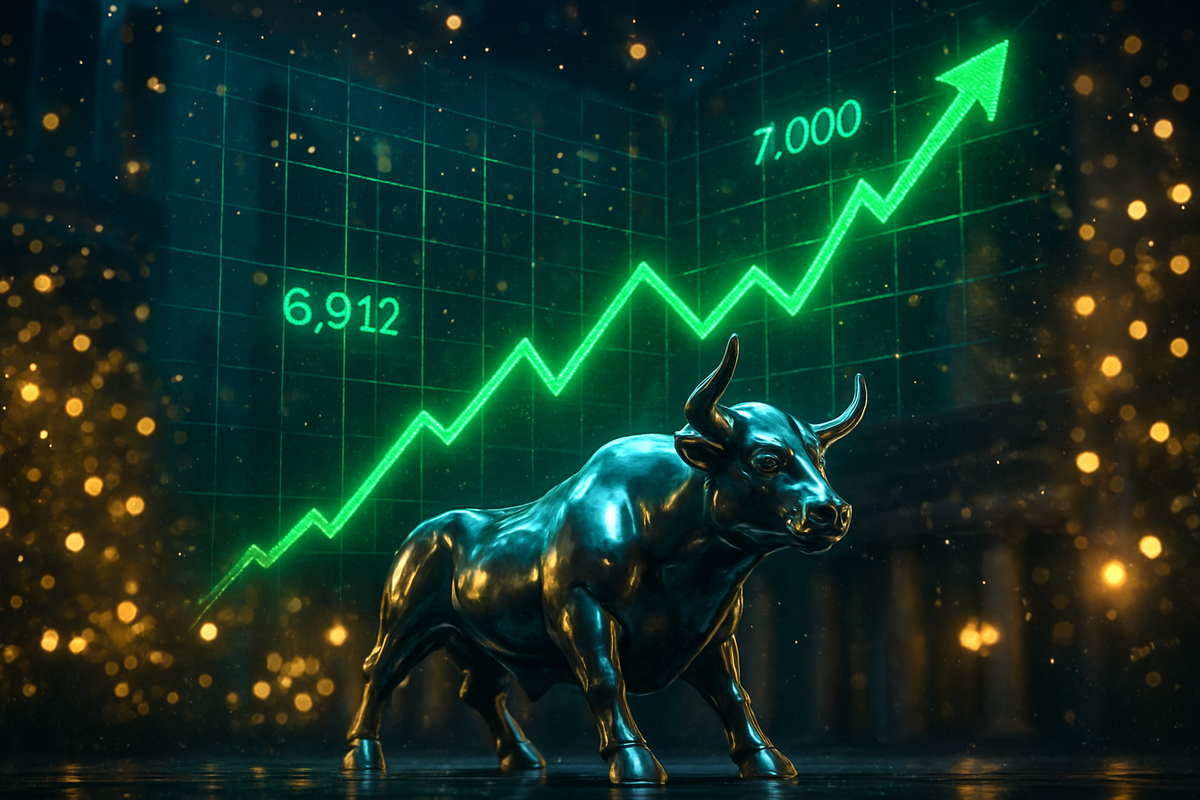
The S&P 500 successfully breached multiple psychological and technical barriers this week, setting a fresh closing record of 6,912 on December 24, followed by an intraday touch of 6,937.42 as the market reopened after the Christmas holiday. This surge represents a year-to-date gain of approximately 18%, capping off a remarkably resilient 2025. The timeline for this rally was solidified earlier in the month when the Federal Open Market Committee (FOMC) delivered a 25-basis-point interest rate cut on December 10, bringing the federal funds rate to a range of 3.5%–3.75%.
While trading volume was roughly 50% below the monthly average due to the holiday season, the move higher was decisive. The rally has been characterized by a notable broadening of participation; while technology remains the primary engine, cyclical sectors like financials and materials have surged to the forefront. Key stakeholders, including institutional asset managers closing out a banner year, have fueled the demand, betting that the "soft landing" for the U.S. economy has transitioned into a period of sustained, non-inflationary growth.
The primary beneficiaries of this record-breaking run continue to be the titans of the "AI Supercycle." Nvidia (NASDAQ: NVDA) solidified its position as the market’s most valuable player, with its market capitalization reaching a staggering $4.5 trillion after a late-December licensing deal with AI startup Groq boosted investor confidence. Similarly, Microsoft (NASDAQ: MSFT) saw steady gains as its massive capital expenditures in AI infrastructure began to translate into record-setting productivity gains across its software suite.
However, the rally was not limited to Silicon Valley. Goldman Sachs (NYSE: GS) emerged as a massive winner in the financial sector, with its stock up 61% year-to-date as deal-making and IPO activity returned to pre-pandemic levels. In the industrial space, Caterpillar (NYSE: CAT) reached new heights, driven by the massive demand for data center power segments. On the losing side, companies that failed to adapt to the high-rate, high-tech environment—particularly legacy retailers and regional banks with heavy commercial real estate exposure—have struggled to keep pace with the broader index, highlighting a growing divergence between "new economy" leaders and "old economy" laggards.
The current market performance is more than just a seasonal rally; it represents a significant shift in the broader economic narrative. The passage of the "One Big Beautiful Bill Act" (OBBBA) earlier in 2025, which permanently extended corporate tax cuts and introduced significant manufacturing deductions, has provided a fundamental floor for earnings. This fiscal support, combined with a 4.3% GDP growth rate in the third quarter, suggests that the U.S. economy is navigating a unique path of high growth paired with moderating inflation.
Historically, a "three-peat" of double-digit annual gains is rare and often precedes a period of increased volatility as valuations become stretched. Critics point to the S&P 500’s price-to-earnings ratios, which are now approaching levels last seen during the 1999 dot-com era. However, proponents argue that unlike the late 90s, today’s leaders are generating massive cash flows and real-world utility through AI integration. The ripple effects are being felt globally, as international markets struggle to keep pace with the U.S. "exceptionalism" fueled by domestic energy independence and technological dominance.
As the market looks toward 2026, the primary question is whether the S&P 500 can sustain its momentum and breach the 7,000-point milestone. Analysts suggest that the first quarter of 2026 will be a critical testing ground, as the "hawkish cuts" from the Federal Reserve—rate reductions accompanied by cautious rhetoric—will require corporate earnings to do the heavy lifting. Strategic pivots may be necessary for companies in the consumer discretionary sector, such as Amazon (NASDAQ: AMZN), which must balance record infrastructure spending with shifting consumer habits in a post-inflationary world.
Potential challenges include a "data-dependent" Fed that could pause rate cuts if PCE inflation (currently at 2.9%) stalls in its descent toward the 2% target. Furthermore, geopolitical tensions and the implementation of new trade policies under the OBBBA framework could introduce fresh volatility. Investors should prepare for a transition from a "momentum-driven" market to a "quality-driven" one, where balance sheet strength and margin expansion become the primary drivers of stock performance.
The S&P 500’s record-breaking week is a testament to the resilience of the American economy and the transformative power of the current technological revolution. With the index hovering near 7,000, the "Santa Claus Rally" of 2025 has provided a celebratory end to a year that many feared would be marred by recession. Instead, the combination of proactive monetary policy, supportive fiscal measures, and a historic surge in AI investment has created a formidable bull market.
Moving forward, investors should keep a close watch on the labor market and upcoming inflation prints in early 2026. While the current sentiment is overwhelmingly bullish, the "three-peat" of double-digit gains suggests that the easy money has been made, and the next phase of the cycle will require more selective positioning. For now, Wall Street is content to ride the holiday wave, closing out 2025 on a high note that few would have predicted at the start of the year.
This content is intended for informational purposes only and is not financial advice.