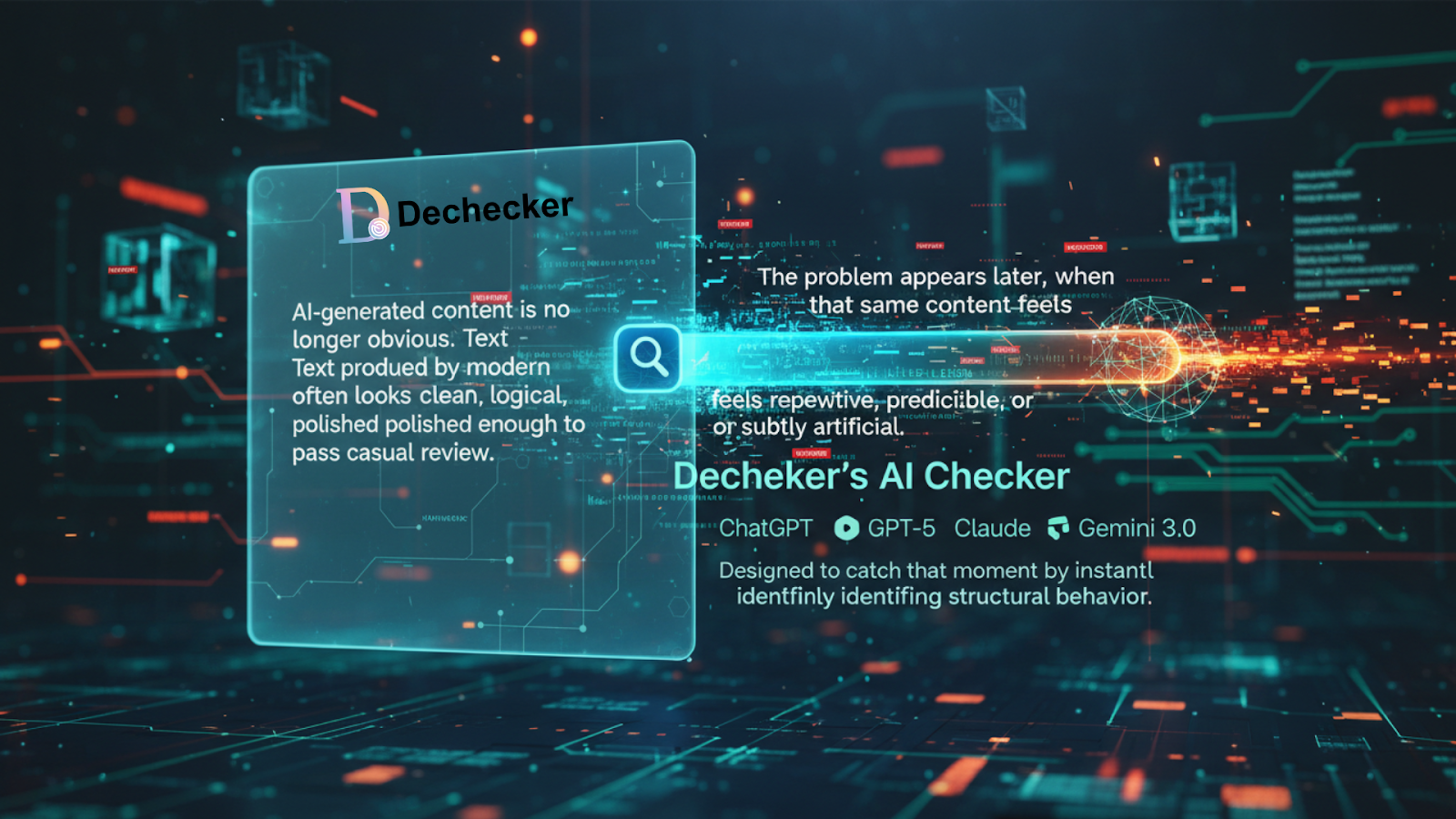
AI-generated content is no longer obvious. Text produced by modern models often looks clean, logical, and polished enough to pass casual review. The problem appears later, when that same content feels repetitive, predictable, or subtly artificial. Dechecker’s AI Checker is designed to catch that moment by instantly identifying whether a text still carries the structural behavior of ChatGPT, GPT-5, Claude, or Gemini 3.0.
Why Instant AI Detection Matters Today
AI Writing Is Fast, but Review Is Slower
AI tools can generate thousands of words in minutes. Human review, however, takes time. When writers or editors cannot quickly tell whether a draft still behaves like AI-generated content, decisions slow down.
Dechecker shortens that gap. By providing immediate detection results, it allows users to decide early whether revision is necessary.
Modern AI Content Rarely Looks “Wrong”
Most AI-generated text is grammatically correct and logically complete. That is exactly why it becomes risky. The absence of errors does not equal originality or credibility.
The AI Checker focuses on deeper behavioral patterns rather than surface quality.
How Dechecker Identifies AI-Generated Behavior
Detection Aligned With Major AI Models
Dechecker is built around the models that dominate real-world usage. ChatGPT, GPT-5, Claude, and Gemini 3.0 each generate language using different internal strategies, but they share identifiable patterns in structure and consistency.
The AI Checker evaluates how sentences expand ideas, how paragraphs resolve, and how evenly information is distributed across the text.
Why Model Awareness Improves Accuracy
Many AI detectors fail because they treat all AI writing as the same. Dechecker does not. By accounting for model-specific behavior, it remains effective even when content has been lightly edited or paraphrased.
This is why detection remains stable across longer documents.
What Users See After Running a Check
Clear, Immediate Feedback
Users paste their text and receive results almost instantly. There are no configuration steps and no technical explanations to decode. The outcome shows whether the text aligns strongly with AI-generated behavior or reads closer to human writing.
This simplicity is intentional. Detection should support decisions, not delay them.
Insight That Leads to Action
Instead of stopping at a label, Dechecker highlights patterns that make the content feel artificial. Writers can immediately see whether the issue lies in over-explained sections, uniform pacing, or overly complete reasoning.
Editing becomes purposeful rather than experimental.
How Detection Leads to Higher Originality
Originality Comes From Breaking AI Symmetry
AI-generated content often distributes attention evenly across ideas. Nothing feels emphasized. Nothing feels skipped. This symmetry is efficient, but unnatural.
Once Dechecker exposes this pattern, writers can reshape the text. Some ideas are condensed. Others are expanded. The structure becomes uneven in a human way.
Practical Impact on Perceived Uniqueness
After revising with detection feedback, users frequently see a significant reduction in AI likelihood. More importantly, the content feels authored rather than assembled.
In practice, this is why many users experience a dramatic increase in perceived originality without changing the core message.
Why Readability Improves at the Same Time
AI Explains Too Much, Too Evenly
AI writing tends to over-clarify. Every transition is explicit. Every conclusion is stated. Over time, this slows the reader down.
The AI Checker identifies this consistency across the full document, not just individual sentences.
Human Writing Leaves Space
When writers remove unnecessary explanations and allow ideas to connect implicitly, the text becomes easier to read. Flow improves because the reader is not being guided at every step.
Many users describe the revised version as feeling roughly twice as readable as the original draft.
Supporting Real Content Workflows
Mixed AI and Human Drafts Are Normal
Most modern content is created with some level of AI assistance. Dechecker does not treat this as a problem. It evaluates the final output as a reader would experience it.
This makes the AI Checker suitable for professional and editorial environments.
Spoken Input and Converted Text
Some writers begin with spoken drafts created using an audio to text converter. These drafts often start with strong human variation. Dechecker helps ensure that later edits do not smooth that variation into AI-like uniformity.
Detection becomes a safeguard rather than a restriction.
Credibility Without Absolute Claims
Likelihood Over Certainty
Dechecker does not claim to prove authorship. It reports how closely a text aligns with known AI-generated behavior from ChatGPT, GPT-5, Claude, and Gemini 3.0.
This approach respects real-world complexity and avoids false certainty.
Control Stays With the Writer
Users decide how much a detection result matters for their context. Dechecker provides clarity, not judgment.
That balance is essential for trust.
Writing That Feels Human Again
AI tools are part of modern writing. The challenge is not avoiding them, but ensuring the final content feels intentional, readable, and credible. By instantly detecting AI-generated patterns and revealing where structure becomes too predictable, Dechecker helps writers regain that balance.
The AI Checker turns detection into a practical advantage—one that improves originality, readability, and trust without slowing the writing process.