Today, March 16, 2026, the tech world converges on San Jose for NVIDIA’s (NASDAQ: NVDA) annual GPU Technology Conference (GTC). What was once a niche gathering for graphics enthusiasts has transformed into the "Woodstock of AI," a global summit determining the direction of the fourth industrial revolution. With a market capitalization now hovering near $4.5 trillion, NVIDIA has surpassed the status of a mere semiconductor firm; it is the fundamental architect of the global intelligence economy. This article explores NVIDIA’s current dominance, its ambitious new hardware roadmap, and the shifting risks as the company enters the era of "Agentic AI."
Historical Background
Founded in 1993 by Jensen Huang, Chris Malachowsky, and Curtis Priem, NVIDIA’s journey began with a focus on PC graphics and gaming. The company’s invention of the GPU in 1999 revolutionized the industry, but the pivotal moment came in 2006 with the launch of CUDA (Compute Unified Device Architecture). By allowing researchers to use GPUs for general-purpose computing, NVIDIA unwittingly planted the seeds for the modern AI era. Over the next two decades, the company survived the "dot-com" bubble and the mobile phone era (where its Tegra chips struggled) to emerge as the undisputed king of the data center following the "AlexNet" breakthrough in deep learning.
Business Model
NVIDIA’s business model has undergone a radical transformation from selling discrete hardware components to delivering "full-stack" AI factories. Its revenue is primarily segmented into:
- Data Center (85%+ of revenue): Selling integrated systems like the GB300 NVL72, InfiniBand networking, and the software layers required to run massive Large Language Models (LLMs).
- Gaming and Pro Visualization: Still a multi-billion dollar business, now increasingly used for high-end workstations and synthetic data generation for AI.
- Automotive and Robotics: A growing segment focused on autonomous driving (DRIVE platform) and the "Omniverse" for digital twins.
- Software and Services: The newest pillar, featuring NVIDIA AI Enterprise and "NemoClaw," providing the operating system for enterprise-grade AI agents.
Stock Performance Overview
As of March 16, 2026, NVDA trades at a split-adjusted price of approximately $180.
- 1-Year Performance: Up 45%, driven by the flawless ramp-up of the Blackwell architecture.
- 5-Year Performance: An astounding 1,200% increase, reflecting the company’s capture of nearly the entire initial AI infrastructure spend.
- 10-Year Performance: One of the greatest runs in market history, with the stock up over 25,000% since early 2016, a testament to the compounding power of the AI revolution.
Financial Performance
In its recently concluded Fiscal Year 2026, NVIDIA posted financial results that shattered all previous records for the semiconductor industry:
- Revenue: $215.9 billion (a 65% YoY increase).
- Gross Margins: Held steady at a remarkable 75%, defying critics who predicted that competition would compress pricing.
- Net Income: $120.1 billion, representing more profit in a single year than most S&P 500 companies have generated in their entire history.
- Cash Flow: Free cash flow remains a primary driver for the company's aggressive share buyback programs and R&D spending, which now exceeds $15 billion annually.
Leadership and Management
Founder-CEO Jensen Huang remains the face of the company, often described as a "Chef-CEO" for his hands-on approach to both technical design and corporate culture. His leadership is characterized by "flat" organizational structures and a culture of "intellectual honesty" regarding failures. Under his guidance, the management team has successfully navigated supply chain crises and geopolitical tensions, maintaining a reputation for being two steps ahead of the hardware cycle.
Products, Services, and Innovations
At GTC 2026, NVIDIA unveiled the successor to its Blackwell architecture: Vera Rubin (R100).
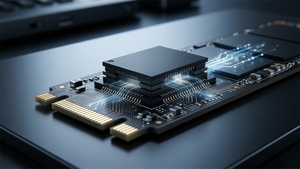
- The Rubin Architecture: Named after astronomer Vera Rubin, these chips utilize HBM4 (High Bandwidth Memory) and 3D silicon stacking to provide 4x the inference performance of the B200.
- The Vera CPU: A new ARM-based processor designed to replace the Grace CPU, optimized specifically for "Agentic AI"—software that can reason and take actions independently.
- Spectrum-X800: A networking platform that brings InfiniBand-like performance to standard Ethernet, broadening NVIDIA’s reach in mid-market data centers.
Competitive Landscape
While NVIDIA holds an estimated 85% market share in AI compute, the competition is intensifying:
- AMD (NASDAQ: AMD): The Instinct MI400 has emerged as a formidable rival, particularly for hyperscalers seeking a lower "total cost of ownership." AMD’s market share in AI accelerators has grown to nearly 10% by early 2026.
- Hyperscaler Silicon: Amazon (AWS), Google (GCP), and Microsoft (Azure) have significantly increased deployments of their own custom chips (Trainium, TPU, Maia). These chips act as a "ceiling" on NVIDIA’s growth within the largest cloud providers.
- Intel (NASDAQ: INTC): Having largely pivoted to foundry services, Intel is now a strategic manufacturing partner for NVIDIA’s lower-tier chips while still competing via its Gaudi 4 accelerator.
Industry and Market Trends
The "Phase 1" of AI—training massive models—is maturing. The industry is now entering "Phase 2," centered on Inference and Agentic AI. This shift favors NVIDIA’s software stack (CUDA and NemoClaw), as enterprises prioritize the reliability and ecosystem of NVIDIA over raw hardware specs. Furthermore, "Sovereign AI" has become a dominant trend, with nations investing in domestic data centers to ensure "data dignity" and national security.
Risks and Challenges
- Power Constraints: Data centers are reaching the limits of global power grids. The 1,000W+ power draw of Rubin-class GPUs requires multi-billion dollar investments in liquid cooling and nuclear power.
- Valuation: At $4.5 trillion, the market has "priced in" perfection. Any slight deceleration in growth could lead to a significant price correction.
- Anti-Trust: Regulators in the EU and US are increasingly scrutinizing NVIDIA’s dominance in the AI software layer, investigating whether CUDA creates an unfair "moat."
Opportunities and Catalysts
- Physical AI: The "Project GR00T" initiative for humanoid robotics is moving from research to reality, with NVIDIA’s Jetson Thor chips powering the first generation of commercially viable industrial robots.
- Sovereign AI Revenue: Analysts project that national government contracts could represent a $50 billion annual opportunity by 2028.
- The Inference Explosion: As billions of AI agents start running 24/7, the demand for inference-optimized hardware is expected to dwarf the initial training market.
Investor Sentiment and Analyst Coverage
Wall Street remains overwhelmingly bullish. Of the 65 analysts covering the stock, 58 maintain a "Buy" or "Strong Buy" rating. Institutional ownership remains at record highs, though some hedge funds have begun trimming positions to lock in decade-long gains. Retail sentiment remains fervently positive, often viewing NVDA as a "generational hold" similar to Apple or Microsoft in previous decades.
Regulatory, Policy, and Geopolitical Factors
Geopolitics remain the "X-factor." In early 2026, the US government introduced a "Revenue-Sharing" model for certain AI exports to China. While NVIDIA can sell its H200-class hardware (with a 20% federal tariff), the most advanced Rubin chips remain strictly banned. Additionally, US policy now incentivizes "National Security Compute" clusters, providing tax credits for companies that build NVIDIA-powered factories on American soil.
Conclusion
As GTC 2026 kicks off, NVIDIA stands at the zenith of its power. By successfully transitioning from the "Blackwell" era to the "Rubin" architecture, the company has proven its ability to maintain a blistering pace of innovation. However, the path forward is no longer just about flops and bandwidth; it is about navigating global power shortages, antitrust pressures, and the transition to an agent-driven world. For investors, NVIDIA remains the "toll booth" for the AI economy, but at a $4.5 trillion valuation, the margin for error has never been thinner. The world is watching Jensen Huang’s keynote not just for a new chip, but for the blueprint of the next decade of human productivity.
This content is intended for informational purposes only and is not financial advice.