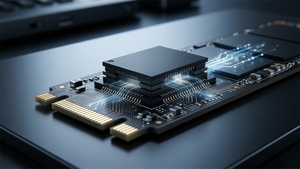
As of March 16, 2026, the global semiconductor landscape has shifted from a race for raw compute power to an urgent battle for memory bandwidth. At the center of this "AI Supercycle" stands Micron Technology, Inc. (NASDAQ: MU). Once viewed as a cyclical commodity manufacturer prone to the boom-and-bust cycles of the PC and smartphone markets, Micron has successfully reinvented itself as the "Memory Fortress" of the artificial intelligence era.
With its High Bandwidth Memory (HBM) supply fully committed through the end of calendar year 2026 and margins reaching heights previously reserved for software giants, Micron is no longer just a component supplier; it is a strategic gatekeeper for the world’s most advanced AI accelerators, including NVIDIA’s Blackwell and Rubin platforms. This deep-dive explores how the Boise-based giant transitioned from the basement of a dental office to a $450 billion linchpin of global infrastructure.
Historical Background
Micron’s story is one of improbable survival. Founded on October 5, 1978, in Boise, Idaho, by Ward Parkinson, Joe Parkinson, Dennis Wilson, and Doug Pitman, the company began as a semiconductor design consulting firm operating out of a dental office basement. By 1981, the team pivoted to manufacturing, producing the world’s smallest 64K DRAM chip.
The 1980s and 90s were a period of brutal consolidation in the memory industry. While dozens of American firms folded under the pressure of Japanese and later South Korean competition, Micron survived through lean operations and aggressive legal and trade strategies. Key acquisitions—most notably Texas Instruments’ DRAM business in 1998, Elpida Memory in 2013, and Inotera in 2016—consolidated the market into the "Big Three" (Samsung, SK Hynix, and Micron). Under the leadership of CEO Sanjay Mehrotra, who took the helm in 2017, Micron shifted its focus from being a "fast follower" to a primary innovator, beating rivals to the market with 1-alpha and 1-beta DRAM nodes and industry-leading 232-layer NAND.
Business Model
Micron operates primarily through four segments: Compute and Networking Business Unit (CNBU), Mobile Business Unit (MBU), Storage Business Unit (SBU), and Embedded Business Unit (EBU).
- DRAM (Dynamic Random Access Memory): Accounting for roughly 71% of total revenue in early 2026, DRAM is the company’s primary engine. Within this, HBM has become the crown jewel. HBM chips are essentially stacks of DRAM that provide the massive bandwidth required for GPUs to process LLMs (Large Language Models).
- NAND (Flash Memory): Used for long-term data storage in SSDs and mobile devices. While historically more volatile than DRAM, the rise of AI-driven data centers has increased demand for high-capacity enterprise SSDs.
- Customer Base: Micron’s revenue is increasingly concentrated among hyperscale cloud providers (AWS, Microsoft Azure, Google Cloud) and AI hardware leaders like NVIDIA and AMD.
Stock Performance Overview
Micron’s stock has witnessed a meteoric rise over the last several years, reflecting its transition to an AI-essential play.
- 1-Year Performance: As of March 2026, MU is up a staggering 325% year-over-year. The rally began in earnest in early 2025 when the company confirmed that its HBM3E production for NVIDIA’s H200 and Blackwell chips was fully sold out.
- 5-Year Performance: Investors have seen a ~373% return. This period included a painful cyclical downturn in 2022-2023, followed by the most aggressive recovery in the company's history.
- 10-Year Performance: Long-term shareholders have enjoyed a ~3,625% return, vastly outperforming the S&P 500 and even many of its peer semiconductor firms.
- Market Position: Trading near $426.13 (as of March 13, 2026), the stock is currently valued at a forward P/E of approximately 12.4x, suggesting that despite the price surge, the market is still pricing in the cyclical risks inherent to memory.
Financial Performance
Micron's fiscal year 2025 and the beginning of 2026 have produced record-shattering results.
- Revenue Growth: FY 2025 revenue hit $37.38 billion, a 49% increase from 2024. In the first quarter of fiscal 2026 (ended November 2025), Micron reported record quarterly revenue of $13.64 billion.
- Margins: The "HBM premium" has fundamentally altered Micron’s profitability. Non-GAAP gross margins reached 56.8% in FQ1 2026. For the current quarter ending March 2026, management has guided for an unprecedented 68% gross margin.
- Profitability: Net income for FY 2025 was $8.54 billion, compared to just $778 million in the previous year. Analysts now model peak earnings power of $50–$60 per share by 2027.
- Capital Expenditure: To keep pace with demand, Micron has ramped up its FY 2026 CapEx budget to $20 billion, focusing on HBM expansion and EUV (Extreme Ultraviolet) lithography integration.
Leadership and Management
The current leadership team is widely credited with executing the most successful technology transition in the company's history.
- Sanjay Mehrotra (CEO): The co-founder of SanDisk and a veteran of the industry, Mehrotra has prioritized technology leadership over market share at any cost.
- Mark Liu (Director): The 2025 appointment of Mark Liu, the former Chairman of TSMC, to Micron’s board of directors signaled a deeper alliance with the world’s leading foundry, crucial for the "Base Die" integration required for HBM4.
- Governance: The board is currently composed of eight directors following a planned transition in early 2026, focusing heavily on global operations and manufacturing scale.
Products, Services, and Innovations
Micron’s competitive edge currently rests on two pillars: HBM3E and the upcoming HBM4.
- HBM3E: Micron’s current flagship, which offers 30% lower power consumption than competitors. It is a critical component for NVIDIA’s Blackwell GPUs.
- HBM4 & HBM4e: Micron has already begun sampling HBM4, which features a 2048-bit interface. Significantly, the company has confirmed that its entire 2026 capacity for HBM4 is already under binding contract.
- 1-Gamma (1γ) Node: Micron is aggressively deploying EUV technology in its 1-gamma DRAM production, which allows for higher density and better power efficiency, essential for "edge AI" in smartphones and PCs.
Competitive Landscape
Micron operates in a triopoly with Samsung Electronics and SK Hynix.
- SK Hynix: Currently the market leader in HBM with approximately 55% share. They maintain a close partnership with NVIDIA but have faced yield challenges in the transition to 16-high stacks.
- Samsung: After falling behind in the HBM3E generation, Samsung is aggressively investing to catch up with HBM4, utilizing its "turnkey" advantage as both a memory maker and a foundry.
- Micron's Edge: Micron currently holds an estimated 21-25% HBM market share. While smaller than its rivals, Micron has achieved higher yields and better power efficiency in the current generation, allowing it to command premium pricing.
Industry and Market Trends
The memory market is being reshaped by three macro trends:
- The "HBM Squeeze": HBM requires roughly 3x the wafer capacity of standard DDR5 DRAM to produce the same number of bits. This is creating a structural undersupply of standard DRAM, pushing up prices for PCs and servers.
- Edge AI: The release of AI-integrated operating systems (Windows 12, iOS 19) has doubled the minimum RAM requirements for smartphones and laptops, sparking a massive replacement cycle in the consumer segment.
- Taiwan Centricity: Micron has shifted its center of gravity to Taiwan, which now hosts 60% of its global capacity and its "HBM Center of Excellence."
Risks and Challenges
Despite the current euphoria, Micron faces significant headwinds:
- Cyclicality: While AI demand feels structural, the memory industry remains inherently cyclical. An over-expansion of capacity could lead to a glut by 2027.
- China Exposure: The Cyberspace Administration of China (CAC) has maintained its restrictions on Micron products in "critical infrastructure." Micron is effectively winding down its Chinese server business, focusing instead on the mobile and automotive sectors.
- Concentration Risk: A significant portion of Micron's growth is tied to the success of a few AI chipmakers, specifically NVIDIA. Any slowdown in AI CapEx from hyperscalers would hit Micron first.
Opportunities and Catalysts
- US Expansion: Micron is fast-tracking its Boise "ID2" facility for a 2027 opening. This will be the first advanced memory fab in the US in decades, providing a "sovereign supply chain" premium.
- HBM4 Mass Production: The shift to HBM4 in late 2026 will involve custom "base dies" tailored to specific customers, potentially leading to more stable, long-term pricing models rather than commodity spot pricing.
- M&A Potential: Analysts speculate that Micron could look to acquire specialized packaging firms to further verticalize its HBM production.
Investor Sentiment and Analyst Coverage
Wall Street is overwhelmingly bullish on MU as of March 2026.
- Consensus Rating: "Strong Buy."
- Price Targets: The average price target stands at $444.42, with high-side targets reaching $550 (Stifel) and $525 (Susquehanna).
- Institutional Moves: There has been a notable increase in "long-only" institutional ownership as funds reclassify Micron from a "cyclical trade" to a "core AI infrastructure holding."
Regulatory, Policy, and Geopolitical Factors
Micron is a primary beneficiary of the U.S. CHIPS and Science Act, having secured approximately $6.4 billion in direct grants. This government support is designed to offset the higher costs of domestic manufacturing. However, this also subjects Micron to strict "guardrail" provisions, limiting its ability to expand advanced capacity in China. Furthermore, the company's heavy reliance on its Taiwan-based fabs (now over 60% of capacity) remains a key geopolitical risk factor for investors concerned with regional stability.
Conclusion
Micron Technology stands at the pinnacle of its nearly 50-year history. By successfully navigating the transition to High Bandwidth Memory, the company has secured its place as an indispensable partner in the AI revolution. With record-high margins, a "sold out" order book for 2026, and significant US government backing, Micron has largely de-risked its near-term financial outlook.
However, for investors, the central question remains: is this truly a "new era" of stable, high-margin growth, or simply the highest peak of a familiar cycle? While the AI demand appears insatiable today, Micron’s heavy capital investments and geopolitical exposure in Taiwan require a disciplined approach. For now, Micron remains the premier way to play the "picks and shovels" of the AI infrastructure trade.
This content is intended for informational purposes only and is not financial advice.