I recently described in a Barchart article why Microsoft Corp (MSFT) stock looks cheap here, despite the market's concerns about its free cash flow (FCF). My price target is $521, or 23% higher over the next year. One play for value investors is to sell short at-the-money and out-of-the-money put options with one-month expiration periods.
MSFT is down today at $424.53 per share, well off its recent Jan. 28 peak of $481.63, before its market close release of fiscal Q2 earnings on the same day. This is a near-12 % decline over several days that seems overdone.
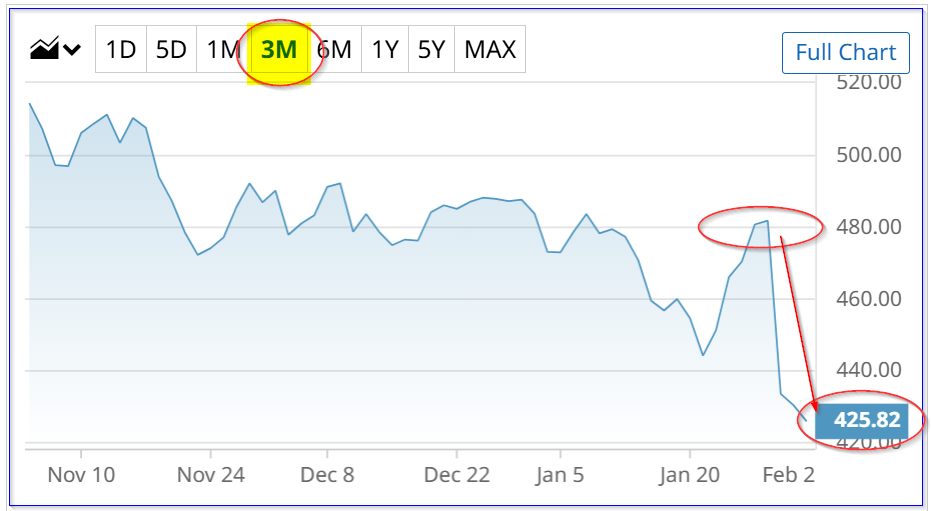
Upside Potential
My Jan. 30 Barchart article discussed this ("Microsoft's Free Cash Flow Crashes Due to High Capex - But Is MSFT Stock's Dip Overdone?"). I showed why Microsoft's FCF could reach $86 billion over the next 12 months (NTM), and this could give Microsoft a $3.87 trillion market cap.
That is 22.66% higher than today's market cap of $3.155 trillion, according to Yahoo! Finance. In other words, MSFT could be worth:
$424.53 stock price x 1.2266 = $520.73 per share
Upside: +23%
Other analysts are also optimistic. Yahoo! Finance's survey of 57 analysts' price targets (PTs) is $599.58. That's +41% higher than today's depressed stock price.
Similarly, Barchart's mean survey price target (PT) is $604.46. However, AnaChart.com, which tracks recent stock analysts' write-ups, shows that the average PT of 29 analysts is $511.78.
That still implies upside of 20.6% from today.
So, along with me, most analysts are bullish over the long-term. That does not mean MSFT stock couldn't keep falling in the near term.
This prospect has elevated put option premiums. That makes it profitable for value investors to sell short puts in one-month expiration periods.
Shorting MSFT Puts
This play allows investors to set a lower potential buy-in point for MSFT stock and also get paid while waiting.
For example, look at the March 6, 2026, option expiration period, 32 days to expiry (DTE). It shows that the $410.00 put option exercise (i.e., strike) price contract has a midpoint premium of $5.93.
That strike price is 3.4% lower than today's price and gives a short-seller of this put contract an immediate income yield of 1.446% (i.e., $5.93/$410.00).
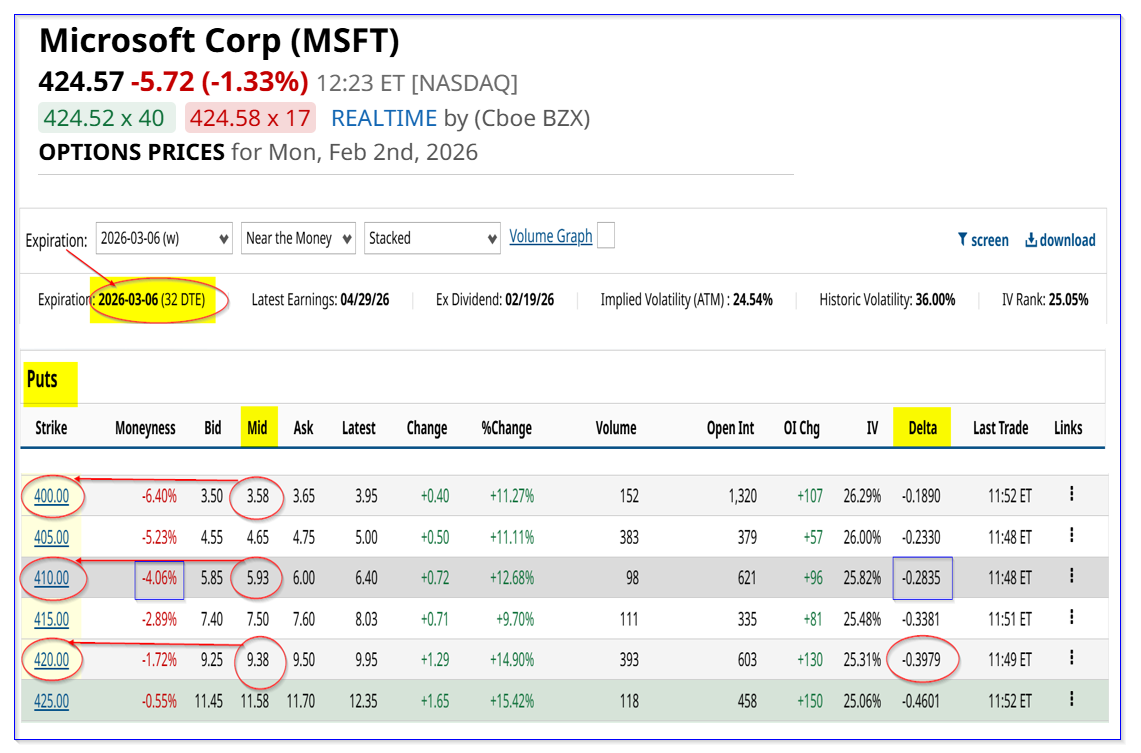
This means an investor who secures $41,000 with their brokerage firm can enter an order to “Sell to Open” 1 put at $410, and then the account will receive $593.00.
Downside Risks and How to Handle Them
If MSFT falls below $410 on or right before March 6, 2026, the account will be assigned to buy 100 MSFT shares using the $41K in collateral.
That could potentially result in an unrealized capital loss. However, the worst that happens here is that the investor now owns 100 shares with a breakeven cost of $410-$5.93, or $404.07.
That's 4.83% lower than today's price.
The investor could then sell short more out-of-the-money puts or calls to mitigate any potential unrealized loss.
However, risk-averse investors could also use that $5.93 in premium to buy put options at lower strike prices. That could also mitigate any potential unrealized loss.
Another play, for less risk-averse investors, especially those who believe MSFT has hit a bottom, is to sell at-the-money (ATM) or in-the-money puts (ITM) in one-month periods.
For example, look at the table above. It shows that the $420 put option, which is just $4.57 below today's price (i.e., 1.07% out-of-the-money), has a $9.38 premium. That gives the investor a one-month yield of 2.23% (i.e., $9.38/$420.00).
And the $425.00 put contract, which is basically at-the-money, since it's only slightly higher than today's price, has an $11.58 premium. That provides a one-month yield 2.723% yield, and could work out well if MSFT rises over $425 on or before March 6.
They could also buy ITM call options in longer-dated periods using some of this short-put income. For example, look at the Aug. 21, 2026, expiry period. It shows that the $410.00 call option expiring in 200 days (about six months) has a midpoint premium of $47.28.
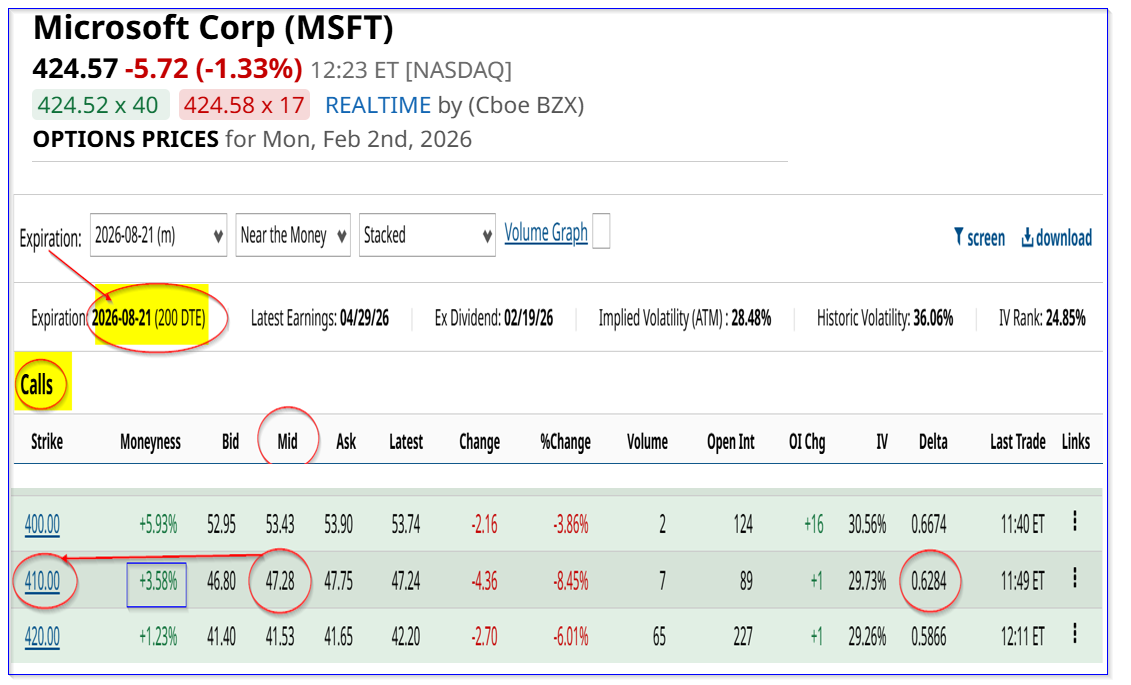
So, if the investor can continue to make $5.93 in premium for 7 months by shorting OTM or ATM puts at $410 or higher, the total premium collected would almost cover the call option:
$5.93 x 7 mo = $41.51 - $47.28 for call option = $5.77
That means as long as MSFT closes over $410+5.77, or $415.77 on Aug. 21, the investor could make a leveraged return.
For example, let's say MSFT rises to $4500.00 by Aug. 21. The call option's intrinsic value would be $40 ($545-410.00 = $40.00).
However, the net cost of the option could be just $5.77. So, the total return would be $40/$5.77-1, or 6.93-1 = 5.93x, or about 6x profit on the investment. (There is no guarantee that this would occur, or the investor could lower the all-in cost of the ITM calls to this price.)
The bottom line is that there are various ways for value investors to play MSFT at this depressed price.
On the date of publication, Mark R. Hake, CFA did not have (either directly or indirectly) positions in any of the securities mentioned in this article. All information and data in this article is solely for informational purposes. For more information please view the Barchart Disclosure Policy here.
More news from Barchart