Following the release of the latest artificial intelligence (AI) models, software stocks are being sold as if the business model itself is broken, in what’s being described – only half-jokingly – as a “SaaS–pocalypse.”
Relative to the broader Nasdaq, the software sector is now underperforming by the widest margin this century – a performance gulf that visually resembles past panic events more than a gradual fundamental decline. The scale and speed of the selloff has pushed investors toward a dramatic conclusion: AI is killing software.
But in this software-focused video segment from Friday’s Market on Close, Senior Market Strategist John Rowland, CMT, argues a different case:
This isn’t a death spiral for software stocks. It’s a capitulation — and those moments tend to separate the long-term survivors from the casualties.
A Selloff Defined by Extremes, Not Subtlety
On a relative-performance basis, software has collapsed.
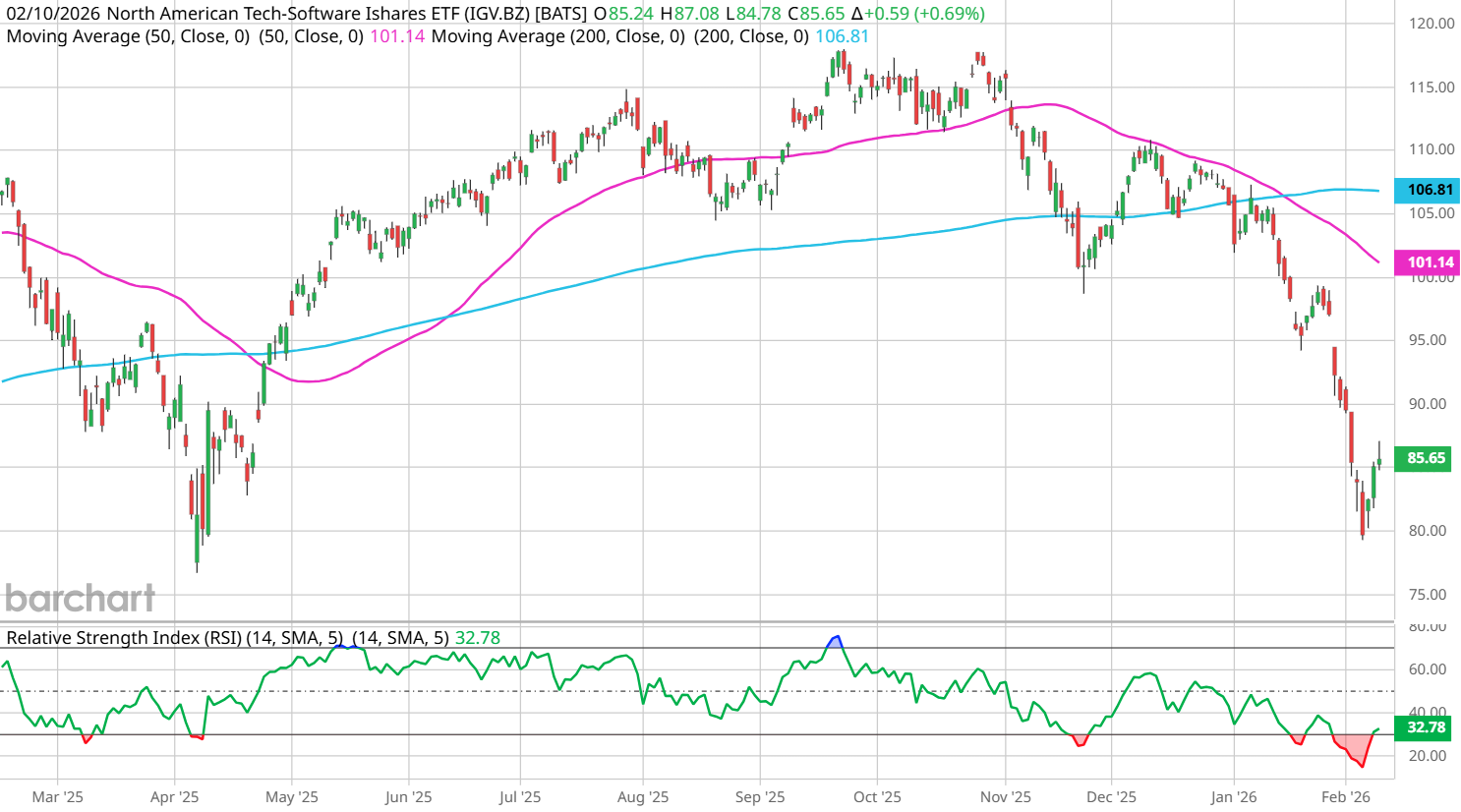
The iShares Expanded Tech-Software ETF (IGV) has been crushed while AI hardware and infrastructure names remain near highs. From a technical standpoint, the sector has pushed multiple standard deviations below its historical mean — a rare, statistically extreme event.
These types of moves are typically driven by:
- Forced selling
- Risk reduction
- Narrative compression
… and not careful discrimination between business models. That distinction matters.
AI Isn’t Killing Software
The fear-driven narrative around software right now is simple:
AI agents can write code, automate workflows, and replace tasks once handled by software-as-a-service (SaaS) platforms. If AI can do the work, why pay recurring software fees?
Markets love simple narratives during selloffs — even when they’re incomplete.
Instead, Rowland frames this moment as a filtering event:
- Undifferentiated, easily replaceable software is vulnerable.
- Mission-critical platforms embedded into real workflows are not.
He grounds this with an anecdote describing real-world usage. Across healthcare, HR, sales, and engineering, SaaS tools like Salesforce (CRM) remain deeply integrated. That broadly ingrained usage across industries isn’t theoretical; it’s a structural advantage.
And importantly, Salesforce is one of the few large software names showing relative resilience inside a collapsing sector.
Barron’s and the Case for Cybersecurity Survivors
Where the discussion becomes most constructive is cybersecurity.
As explained recently by Barron's, AI agents don’t remove risk — they expand it. Autonomous systems require identity controls, access permissions, and audit trails. Someone still has to guard the doors, whether figuratively or literally.
That’s why identity and security software stand apart.
Barron’s highlighted Okta (OKTA), which is also a favorite of John’s. He notes OKTA stock has quietly held a higher low while the broader software ETF made fresh lows — a classic sign of relative strength during panic.
Rowland also calls out some of the positive or stabilizing performances inside IGV from differentiated software leaders:
These aren’t random software names — they share entrenchment, switching costs, or security relevance.
Tradable Fear vs. Investable Confirmation
As with his thesis on Microsoft (MSFT) after earnings, John is careful not to blur timeframes.
From a trading perspective:
- Volatility is elevated
- Fear is priced in
- Options premiums are rich
This creates opportunity for defined-risk strategies, including selling puts inside clearly established demand zones.
From an investing perspective, though, the sector is still below key trend levels. The signal John’s watching for now is a reclaiming of the 50-day moving average, which would suggest fear is fading and institutions are returning.
Until then, this remains a market ruled by caution — not conviction.
The Bigger Picture
The “SaaS-pocalypse” isn’t about AI destroying software.
It’s about:
- A violent rotation
- Valuations unwinding
- Investors reassessing which software deserves a premium in an AI-driven world
Some companies will lose relevance. But others — especially those tied to security, identity, and core enterprise workflows — may emerge stronger once the panic clears.
Watch this video from John Rowland to see the charts and trade setup:
- Stream the full episode of Market on Close
- Turn on notifications so you don’t miss the next live broadcast
On the date of publication, Barchart Insights did not have (either directly or indirectly) positions in any of the securities mentioned in this article. All information and data in this article is solely for informational purposes. For more information please view the Barchart Disclosure Policy here.
More news from Barchart
- This Is the Top-Rated Dividend Stock to Buy in February 2026
- No, AI Isn’t Killing Software: OKTA & More Top Stocks to Pull from the Ashes of ‘SaaS-pocalypse’
- 'If People in the Rest of the World Knew What I Know': MicroStrategy's Michael Saylor's Viral Message About MSTR Stock and Bitcoin to $10 Million
- As Upwork Plunges Below Key Support Levels, Should You Buy the UPWK Stock Dip?